
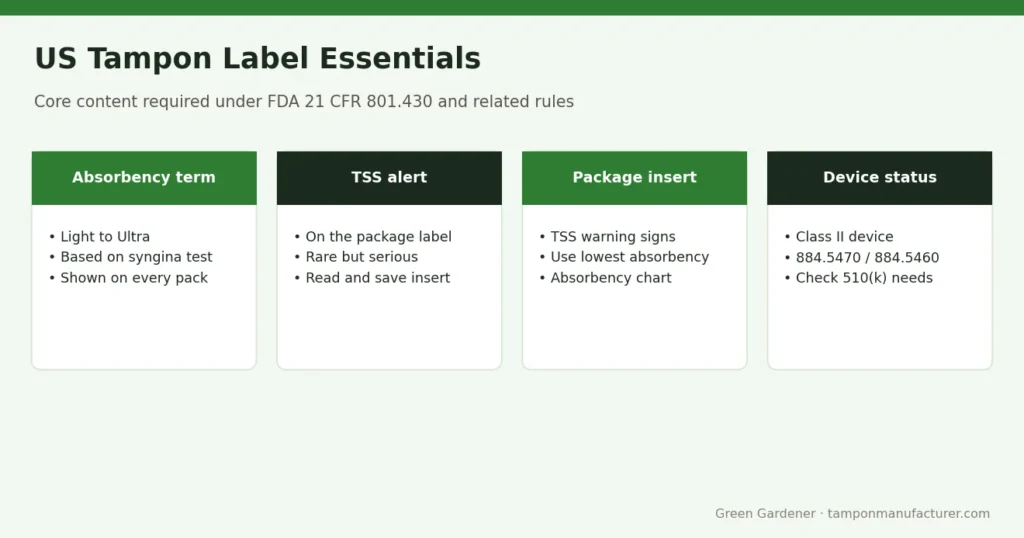
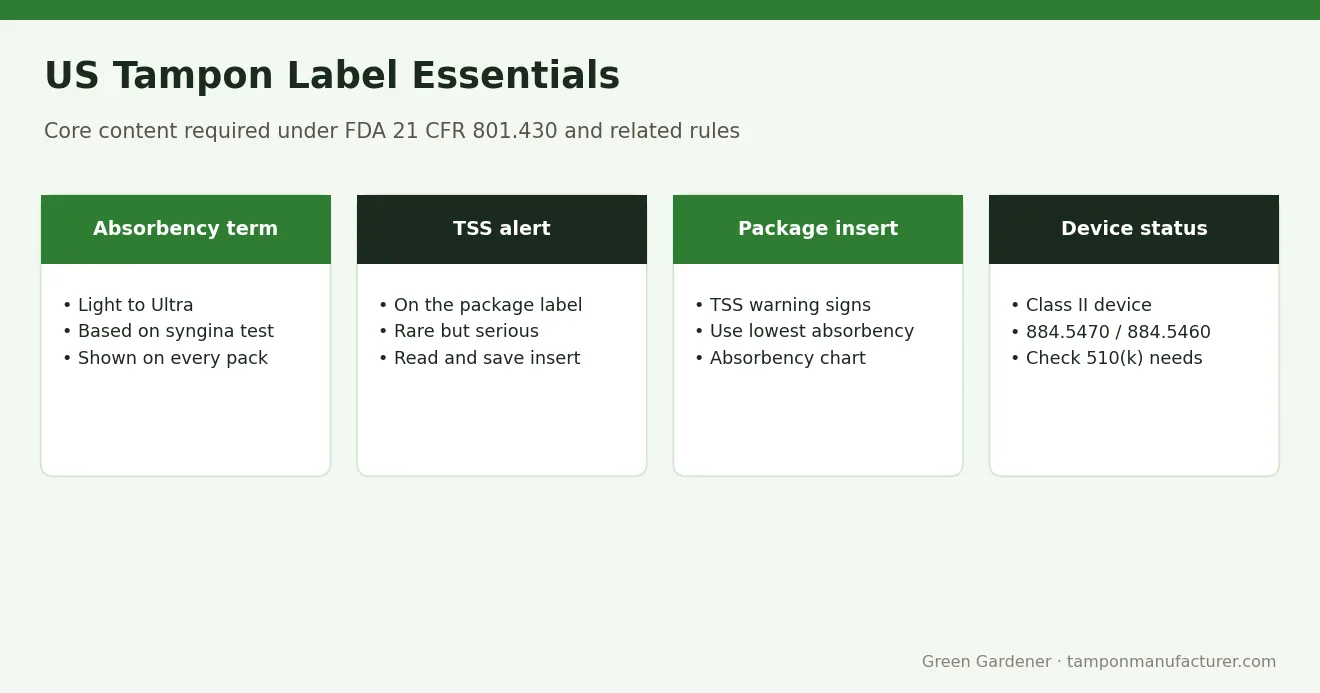
In the United States, tampon labeling is governed mainly by FDA regulation 21 CFR 801.430. It requires a standard absorbency term on the package (Light, Regular, Super, Super Plus or Ultra) based on syngina test results, a prominent Toxic Shock Syndrome (TSS) alert on the package, and an insert explaining TSS warning signs, risk and safe use. Tampons are also Class II medical devices. This guide summarizes what the rule covers and how private label brands can check their artwork before printing.
Which Rule Applies: 21 CFR 801.430 at a Glance
21 CFR 801.430 is the FDA regulation titled “User labeling for menstrual tampons”. It sits within the general device labeling rules in 21 CFR Part 801 and applies to tampons marketed in the US, whether made domestically or imported. In summary, it addresses three areas:
- TSS information – what the package label and the consumer leaflet must say about Toxic Shock Syndrome.
- Absorbency terms – a fixed set of terms tied to gram ranges, so shoppers can compare brands.
- Test method – the syngina method used to determine which absorbency term a product may carry.
This article is a practical summary, not legal advice. Always read the current text of the regulation in the electronic Code of Federal Regulations (eCFR) and check current FDA requirements before finalizing a label. For the wider import picture, see our guide to FDA requirements for importing tampons into the US.
Standard Absorbency Terms and Ranges
A US tampon package must show one of the standard absorbency terms. The term is chosen from the measured absorbency in grams of fluid, using the syngina method described in the regulation:
| Absorbency term | Range in grams (syngina) |
|---|---|
| Light | 6 and under |
| Regular | 6 to 9 |
| Super | 9 to 12 |
| Super Plus | 12 to 15 |
| Ultra | 15 to 18 |
Key points for brands:
- Marketing names such as “mini”, “slim”, “junior” or “heavy flow” may appear, but they do not replace the standard term.
- The labeling must also explain the absorbency ranges so shoppers can compare products, typically as a chart in the insert or on the package.
- Multi-absorbency packs need each tampon’s absorbency clearly identified, often by wrapper color, with the key explained on the box.
Our explainer on absorbency levels gives consumer-friendly wording you can adapt.
The TSS Alert on the Package
The regulation requires the package label to carry a prominent alert stating that tampons are associated with Toxic Shock Syndrome, that TSS is a rare but serious disease that may cause death, and that the user should read and save the enclosed information. The exact wording is set out in the regulation, so copy it from the current eCFR text rather than paraphrasing.
Practical artwork tips:
- Place the alert on a principal panel or another panel where it is easy to see at the point of sale.
- Use a legible type size with good contrast; do not hide it in a fold or under a seal.
- Keep the absorbency term near the product name so shoppers do not have to search for it.
What the Package Insert Must Cover
21 CFR 801.430 lists the TSS information that must be provided to users, usually in a leaflet inside the box. In summary, the labeling must cover:
- The warning signs of TSS, such as sudden high fever, vomiting, diarrhea, dizziness or fainting, and a rash that looks like sunburn.
- What to do if signs appear: remove the tampon and seek medical attention at once.
- The risk of TSS for people using tampons during menstruation, including the higher reported risk for teenagers and younger women and the estimated incidence, as specified in the regulation.
- Advice to use the minimum absorbency needed to control menstrual flow.
- That the risk of tampon-associated TSS can be avoided by not using tampons and reduced by alternating tampons with pads.
- Advice for anyone who has had TSS to consult a doctor before using tampons again.
- The absorbency terms and ranges, with an explanation of how to use them to compare products.
Most inserts also include illustrated directions for use, wearing-time guidance and disposal instructions. Keep the language plain and the layout easy to scan.
Device Classification and 510(k)
Labeling is only one part of US compliance. FDA classifies unscented menstrual tampons under 21 CFR 884.5470 and scented or scented deodorized menstrual tampons under 21 CFR 884.5460. Both are Class II devices, which generally require a 510(k) premarket notification unless an exemption applies to the specific product. FDA has published guidance for menstrual tampon and pad 510(k) submissions that covers topics such as absorbency, materials and biocompatibility.
Exemptions, establishment registration, device listing and Unique Device Identification obligations can change over time, so check current FDA requirements for your exact product and role (manufacturer, specification developer or importer). A label that meets 801.430 does not by itself make a product legal to sell.
Other US Label Elements Brands Often Miss
| Element | Source | Note |
|---|---|---|
| Name and place of business | 21 CFR Part 801 general rules | Manufacturer, packer or distributor, with qualifying phrase if not the maker |
| Adequate directions for use | 21 CFR Part 801 | Usually in the insert with diagrams |
| Quantity of contents | Packaging and trade practice | Tampon count on the principal panel |
| Ingredient or material list | Some state laws | Several states, including New York, have menstrual product ingredient disclosure laws |
| Country of origin | US Customs rules | Imported goods generally need origin marking |
| Lot code | Quality system practice | Supports traceability and complaint handling |
State requirements change, so confirm current rules in each state where you sell.
Private Label Artwork Checklist
Before approving artwork with your manufacturer, check each item against the current regulation and your target market rules:
| Check | Where | Done when |
|---|---|---|
| Absorbency term matches test data | Box and wrapper | Syngina report supports each term |
| TSS alert wording | Package label | Matches current regulation text |
| Insert TSS content complete | Leaflet | All required topics covered |
| Absorbency chart present | Insert or box | All five terms with ranges |
| Multi-pack color key | Box | Wrapper colors explained |
| Company name and origin | Box | Correct entity and country shown |
Our full packaging artwork checklist and quality control documentation guide cover the rest of the pre-print review.
Labeling Outside the US
Other markets have their own frameworks, and US wording should not simply be copied across. In the UK and EU, tampons are generally sold as consumer products under general product safety rules, and many brands follow industry codes of practice for absorbency and TSS information. The Period Products (Free Provision) (Scotland) Act 2021 concerns free access to period products rather than labeling. Canada, Australia and the GCC states regulate tampons too: confirm current requirements with Health Canada, the TGA or the SFDA before launch. We provide documentation on request to support your registration work.
Request a Quote
We manufacture private label tampons with plastic, compact, cardboard and non-applicator options and organic cotton choices, and we help brands prepare insert and box content for their target markets. Send your specifications through our contact page or WhatsApp +86 173 1689 5054. Samples come before bulk, and order terms are confirmed in your quotation.
Frequently Asked Questions
What does 21 CFR 801.430 require on tampon packaging?
It requires a standard absorbency term based on syngina test results, a prominent alert about Toxic Shock Syndrome on the package label, and user information explaining TSS warning signs, risk, the advice to use the lowest absorbency needed, and the absorbency ranges. Always check the current regulation text before printing.
Can I use “mini” or “heavy flow” instead of an absorbency term?
You can use marketing names as additional descriptions, but US packages must still show the standard absorbency term, such as Light, Regular, Super, Super Plus or Ultra. The term must match the product’s measured syngina absorbency, so test results should be confirmed before artwork is finalized.
Are tampons FDA regulated as medical devices?
Yes. FDA classifies unscented menstrual tampons under 21 CFR 884.5470 and scented ones under 21 CFR 884.5460. Both are Class II devices that generally need a 510(k) premarket notification unless exempt. Requirements can change, so check current FDA requirements for your specific product.
Does a multi-absorbency pack need special labeling?
Yes. Each tampon’s absorbency must be clearly identifiable to the user, which brands usually achieve with different wrapper colors or printed terms on each wrapper, plus a key on the box. The package and insert should still explain all absorbency terms and the advice to use the lowest absorbency needed.
Can the manufacturer prepare US-compliant tampon artwork?
We help brands lay out insert and box content, including absorbency terms, the absorbency chart and TSS sections, and we supply syngina test documentation on request. Final legal responsibility for labeling sits with the brand owner, so we recommend a regulatory review against current FDA requirements before printing.