
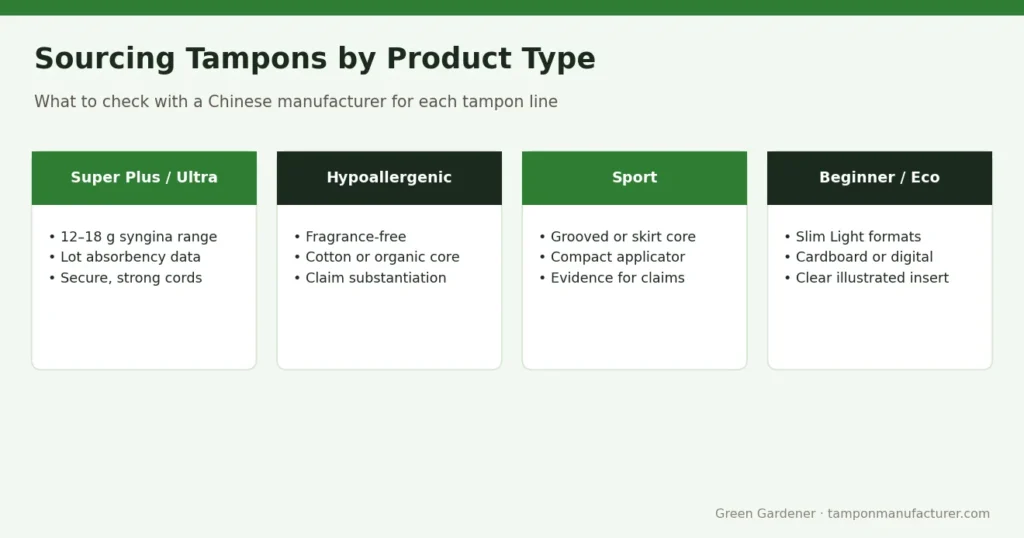
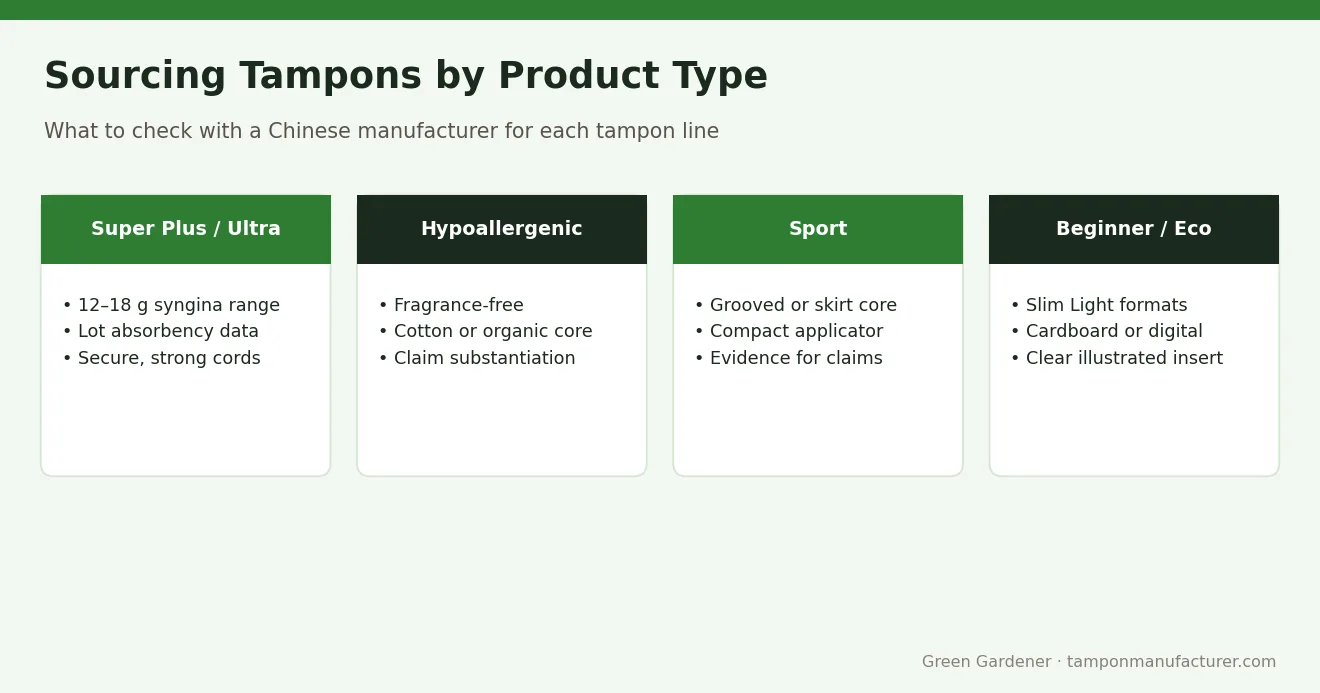
When sourcing tampons from China, start with the product type, because each one depends on different capabilities. Super Plus and Ultra lines need tight absorbency control, hypoallergenic positioning needs material documentation, sport tampons need leak-protection design, beginner tampons need slim formats and smooth applicators, and eco-friendly lines need cardboard, non-applicator or organic cotton options. This guide explains what to check for each type and how to verify that a Chinese factory, not a trading layer, can deliver it.
Why Source by Product Type
Many Chinese suppliers list every tampon type on their websites, but production capability is more specific. Absorbency range, applicator lines, material sourcing and packaging equipment differ from factory to factory. Matching your product plan to proven capability reduces sample rounds, avoids subcontracting surprises and makes compliance work easier.
Start by defining each SKU: absorbency term, width, applicator type, core material, wrapper and pack count. Then ask suppliers to show existing production or samples for that exact type, not a general catalog.
It also helps to decide early which markets you will sell in. A range for the US needs syngina data and labeling under 21 CFR 801.430, while products for Europe, the Gulf or Australia may need different documentation and insert language. Sharing target markets at the inquiry stage lets a manufacturer flag gaps before samples are made, rather than after artwork is printed.
Product Types at a Glance
| Product type | Key capability | What to ask for |
|---|---|---|
| Super Plus and Ultra | High-absorbency cores within range | Syngina data by lot |
| Hypoallergenic positioning | Controlled, documented materials | Material composition and test reports |
| Sport | Leak-protection design, compact formats | Design details, absorbency data |
| Beginner and teen | Slim Light tampons, smooth applicators | Width and absorbency specs |
| Eco-friendly | Cardboard, digital, organic cotton | Material certificates for supplied inputs |
Super Plus and Ultra Tampon Manufacturing
China super plus tampon manufacturing requires precise control of fiber weight and compression, because high-absorbency products must still fall within their labeled range. Under FDA 21 CFR 801.430, Super Plus covers 12 to 15 g and Ultra 15 to 18 g in the syngina test. Larger cores also need applicators sized to hold them and secure cords that perform when fully saturated.
Ask suppliers for syngina results across several lots, internal target ranges and how they handle results near a boundary. Labeling for these absorbencies must carry full TSS information and the advice to use the lowest absorbency needed. See our Super Plus and Ultra tampon OEM page for formats we produce.
Hypoallergenic and Sensitive-Skin Tampons
Buyers searching for China hypoallergenic tampons suppliers should know that “hypoallergenic” is a marketing claim, not a regulated category with a single definition. Any such claim must be substantiated for the markets where you sell. In practice, sensitive-skin positioning usually rests on:
- Fragrance-free (unscented) products.
- Simple material lists, such as 100% cotton or organic cotton cores and covers.
- Chlorine-free bleaching processes for fibers.
- Test reports relevant to skin contact and material safety, as required by your market.
Ask for material composition, raw material supplier documents and the test reports your regulatory adviser requires. Our organic cotton tampon range is often the basis for sensitive-skin lines.
Sport Tampons
For China sport tampons wholesalers and brands, “sport” usually describes design features rather than a separate regulatory class. Common features include grooved or ribbed cores to guide fluid, protective covers or skirts intended to reduce leakage, compact applicators that fit in a kit bag and secure wrappers. Absorbency still follows the standard terms, and performance claims such as “leak-proof” need evidence.
Ask suppliers to explain how each feature is produced, whether it is made in-house, and which absorbencies are available in the sport format. Request samples in final packaging to judge wrapper strength and opening ease, since sport users often change tampons on the go.
Range planning matters as well. Sport lines are often sold as Regular and Super, with a compact applicator so the tampon fits in a pocket, locker or gym bag. Swimming is a common use case, so inserts should remind users to change tampons regularly and use the lowest absorbency they need, exactly as for any other tampon.
Beginner and Teen Tampons
A China tampons for beginners factory should be able to produce slim tampons in Light and Regular absorbency, with smooth plastic, compact or cardboard applicators and rounded tips. Clear, illustrated package inserts are equally important, because first-time users rely on them for insertion guidance and TSS information.
Check width and length specifications, applicator finish and how the factory controls absorbency at the low end of the range. Our slim, mini and Light tampon OEM page lists options for junior and starter ranges.
Many brands also bundle beginner tampons into starter packs with a few Light and Regular tampons, liners and a pouch. If you plan a kit, confirm that the factory can pack mixed contents and print a multi-absorbency key on the box, as US labeling requires each absorbency in a mixed pack to be clearly identified.
Eco-Friendly Tampons Wholesale
China eco friendly tampons wholesale demand centers on three options:
- Cardboard applicators – paperboard tubes replace plastic; see our cardboard tampons.
- Non-applicator (digital) tampons – no applicator at all, the lowest-material format.
- Organic cotton cores – with certification held by the raw material supply chain where applicable.
Environmental claims are increasingly regulated in the EU, UK and US, so avoid vague terms such as “eco” or “biodegradable” without evidence. Ask suppliers for material documentation and plan wording with your compliance team.
Packaging is part of the eco story too. Paper wrappers, recyclable cartons and reduced ink coverage can strengthen a cardboard or organic cotton line, but each change should be tested for hygiene protection and shelf life. A wrapper that tears easily or lets in moisture undermines the product, however sustainable it looks.
How to Verify a Chinese Tampon Factory
| Check | How | Red flag |
|---|---|---|
| Business scope and licence | Review company documents | Trading scope only for a claimed factory |
| Production lines | Video call or on-site audit | Refuses to show equipment |
| Product-type samples | Order samples of each SKU | Samples differ from specification |
| Test documentation | Request reports for your products | Generic reports for other items |
| Quality records | Ask for lot-linked QC records | No traceability system |
Our step-by-step guide on how to verify a tampon manufacturer covers audits and pre-shipment checks in more detail. For US sales, also check current FDA requirements, including device classification under 21 CFR 884.5470 for unscented tampons. For Canada, Australia or the GCC, confirm requirements with Health Canada, the TGA or the SFDA.
Request a Quote
When you contact suppliers, a structured request for quotation with SKU specifications, target markets and documentation needs will produce comparable answers and make the differences between factories easier to see.
We are a factory-direct manufacturer with a 37,600 m² facility, ISO 13485 and ISO 9001 certification plus FDA 510(k) clearance, producing plastic, compact, cardboard and non-applicator tampons with organic cotton options and private label packaging. Share your product types and markets through our contact page or WhatsApp +86 173 1689 5054. Samples come before bulk, and order terms are confirmed in your quotation.
Frequently Asked Questions
Can one Chinese factory produce all tampon types?
Some manufacturers produce a broad range, but capability varies by applicator line, absorbency range and material sourcing. Ask each supplier to show samples and production evidence for every specific SKU you plan, and check whether any type would be subcontracted. A single factory simplifies quality control and documentation if it truly makes everything in-house.
Is “hypoallergenic” a regulated tampon claim?
There is no single regulatory definition of hypoallergenic for tampons, so the claim must be substantiated for each market where you sell. Brands usually support sensitive-skin positioning with fragrance-free products, simple cotton or organic cotton materials and relevant test data. Review wording with your regulatory adviser before printing.
What is the difference between Super Plus and Ultra tampons?
Both are high-absorbency terms defined in FDA 21 CFR 801.430. Super Plus covers 12 to 15 g and Ultra covers 15 to 18 g in the syngina test. Users are advised to choose the lowest absorbency that controls their flow, so brands usually offer these alongside lower absorbencies.
Are sport tampons a separate product category?
Not in regulatory terms. Sport tampons follow the same absorbency labeling and device rules as other tampons. The sport positioning comes from design features such as grooved cores, leak-protection covers and compact applicators. Any performance claims, such as leak protection, should be supported by testing and reviewed for each market.
How do I check a Chinese tampon supplier is a real factory?
Review business documents, ask for a live video tour of production lines, order samples of each SKU, request test reports specific to your products and ask for lot-linked quality records. An on-site audit or third-party inspection before the first shipment adds further assurance for new supplier relationships.