
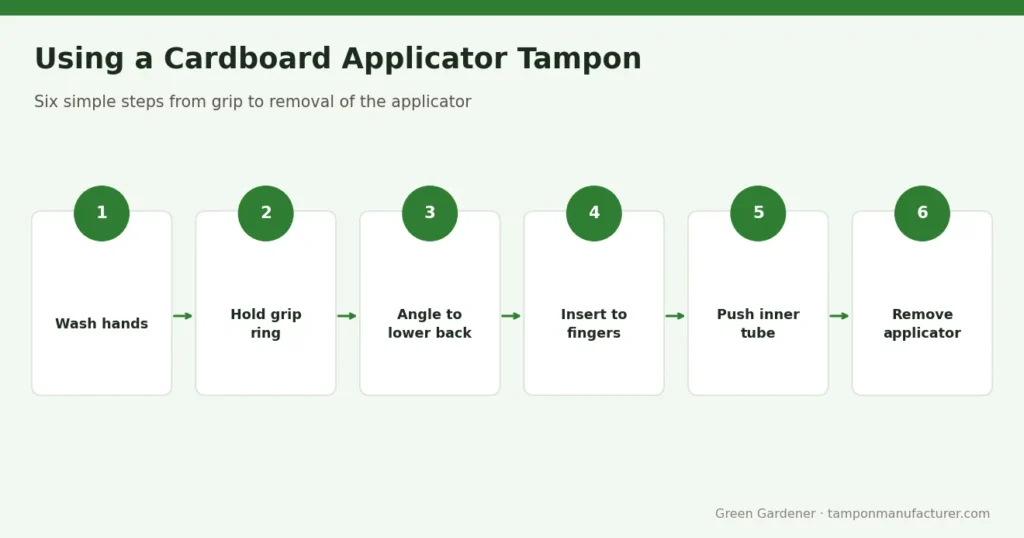
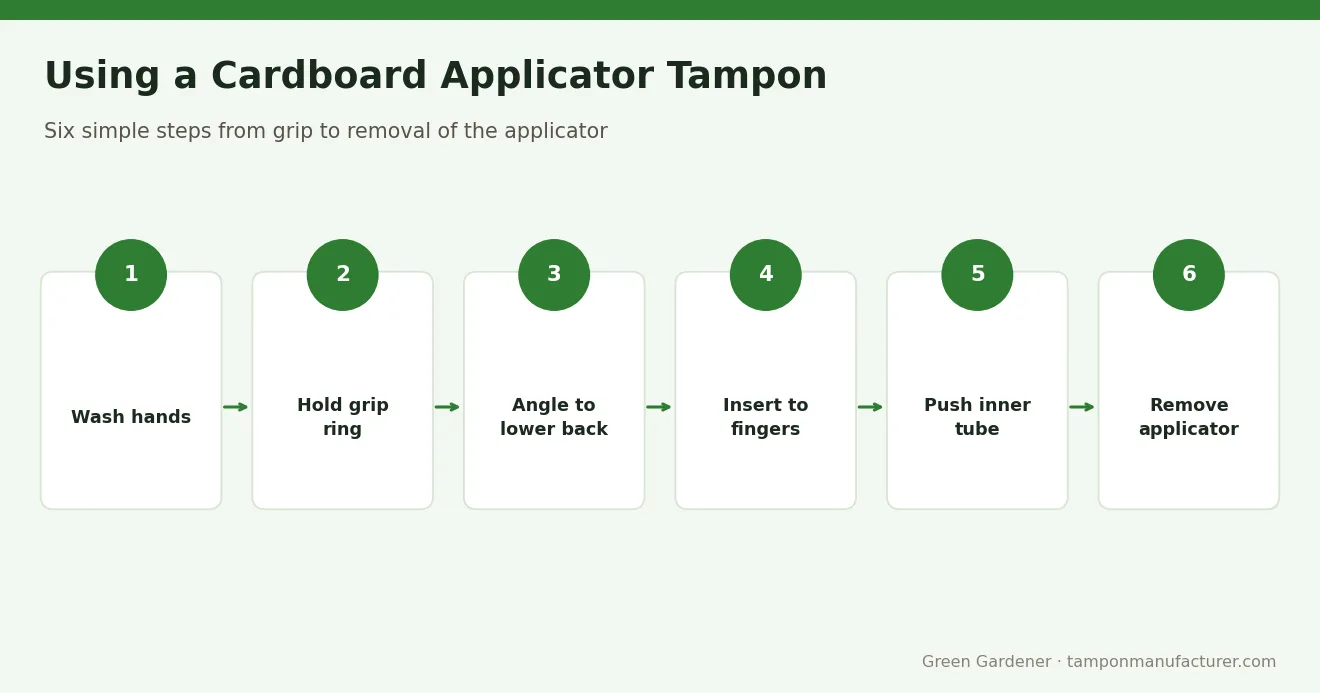
To use a cardboard applicator tampon, wash your hands, hold the outer tube at the grip ring, angle it toward your lower back and slide it in until your fingers touch your body. Then push the inner tube fully into the outer tube with your index finger, remove both tubes together and let the string hang outside. Cardboard feels firmer than plastic, so a relaxed position and the correct angle make the biggest difference. Here is the full process, plus troubleshooting and guidance for brands.
What Is a Cardboard Applicator Tampon?
A cardboard applicator tampon has the same absorbent core as other tampons, but the applicator is made from two rolled paperboard tubes instead of plastic:
- Outer tube (barrel) – holds the tampon and is the part inserted into the vagina.
- Inner tube (plunger) – the narrower tube you push to release the tampon.
- Grip area – where the two tubes meet; your fingers hold here during insertion.
- Withdrawal cord – the string used to remove the tampon later.
Cardboard applicators are popular with shoppers who want to reduce plastic. They are usually firmer and less slippery than plastic, so technique matters more. For a side-by-side look at applicator styles, read tampon applicator types explained.
Before You Start
- Read the package insert in your box; instructions can differ slightly by brand.
- Choose the lowest absorbency that manages your flow, as package inserts recommend.
- Wash your hands with soap and water.
- Check that the wrapper is intact and the tampon is not damaged or damp.
- Make sure the string is hanging freely from the end of the inner tube.
- Give the string a gentle tug to confirm it is securely attached before insertion.
- Find a comfortable position: sitting on the toilet with knees apart, squatting slightly, or standing with one foot on the edge of the bath or toilet.
If you are new to tampons, our beginner’s guide to tampon types explains the basics.
Step-by-Step: Inserting a Cardboard Applicator Tampon
- Unwrap the tampon and hold the outer tube at the grip ring with your thumb and middle finger.
- Place your index finger on the end of the inner tube, with the string hanging down.
- Relax your muscles and take a slow breath; tension makes insertion harder.
- Position the tip at the vaginal opening and angle the tampon toward your lower back, not straight up.
- Slide the outer tube in gently until your thumb and middle finger touch your body.
- Push the inner tube with your index finger until it is fully inside the outer tube and the two ends meet.
- Withdraw both tubes together, keeping the string outside your body.
- Check comfort: you should not feel the tampon. If you do, it is probably not deep enough.
Getting the Angle and Depth Right
Most insertion problems come from angle and depth. The vaginal canal slopes back toward the lower spine, so aiming the applicator in that direction lets it glide in. Pushing straight upward meets resistance and can feel uncomfortable, especially with firmer cardboard.
Depth is the other factor. Stopping too early leaves the tampon in the lower, more sensitive area, where it can be felt when you sit or walk. Inserting the outer tube until your fingers reach your body places the tampon correctly. If a tampon feels uncomfortable after insertion, remove it and try again with a new one rather than trying to push it further with your fingers.
Position also changes the angle slightly. When sitting on the toilet, leaning forward a little helps; when standing with one foot raised, the angle becomes more natural. If you are unsure, a hand mirror can help you locate the opening the first few times. Practising when your flow is moderate is easier than on a very light day, because a dry vaginal canal creates more friction against the paperboard tube.
Another useful habit is checking the grip before you begin. Hold the applicator where the outer tube narrows or where a ridge is printed or embossed. Holding it too far back reduces control, while holding it too close to the tip can stop you from inserting it far enough.
Cardboard vs Plastic Applicators
| Factor | Cardboard applicator | Plastic applicator |
|---|---|---|
| Feel on insertion | Firmer, less glide | Smooth, more glide |
| Tip shape | Usually rounded, open end | Often petal tip |
| Material | Paperboard | Polyethylene or similar plastic |
| Plastic reduction | Stronger story | Weaker story |
| Best for | Users comfortable with tampons | Many first-time users |
| Disposal | Follow pack and local guidance | Bin only |
Neither type changes absorbency; that is set by the core and shown by the absorbency term on the box.
Removal, Disposal and Wearing Time
To remove a tampon, relax, then pull gently on the string at the same angle you inserted it. A tampon that is fully saturated slides out easily; a dry one can feel uncomfortable, which may mean a lower absorbency would suit you better.
Wrap the used tampon and applicator in toilet paper or the wrapper and place them in a bin. Some cardboard applicator packs describe the applicator as flushable, but many water utilities ask people not to flush any period products, so check the pack and local guidance. Never flush plastic wrappers.
If the string has moved inside, sit or squat, relax and reach gently with clean fingers; the string is usually close to the opening. If you cannot remove a tampon yourself, contact a healthcare professional rather than leaving it in place.
Change tampons regularly. FDA consumer guidance generally refers to changing every four to eight hours; follow the maximum time stated on your insert. US labeling must explain Toxic Shock Syndrome (TSS). If you develop warning signs such as sudden high fever, vomiting, diarrhea, dizziness or a sunburn-like rash, remove the tampon and seek medical help immediately.
Troubleshooting Common Problems
| Problem | Likely cause | What to try |
|---|---|---|
| Tampon feels uncomfortable | Not inserted far enough | Remove and retry, insert until fingers touch body |
| Hard to insert | Angle too upright or muscles tense | Aim toward lower back, relax, change position |
| Inner tube will not push | Tubes not aligned | Hold grip ring firmly, push straight |
| Leaking early | Absorbency too low or placement | Check depth, consider next absorbency |
| Dry, painful removal | Absorbency too high | Use a lower absorbency |
If pain persists every time, consult a doctor.
For Brands: Cardboard Lines Need Clear Inserts
Because cardboard applicators feel different from plastic, shoppers switching for environmental reasons can be disappointed if the instructions are vague. Brands launching cardboard lines should plan:
- Illustrated step-by-step inserts showing grip, angle and depth.
- Accurate disposal wording aligned with the rules in each sales market.
- Full TSS and absorbency information required by FDA 21 CFR 801.430 for the US, and equivalent rules elsewhere.
- Applicator quality checks for smooth edges, consistent tube fit and reliable plunger travel.
We manufacture cardboard applicator tampons for private label brands, with conventional or organic cotton cores and custom packaging. Our packaging artwork checklist helps you prepare insert and box content.
Request a Quote
Planning a cardboard applicator range? Tell us your absorbency mix, core material, pack count and target markets through our contact page or WhatsApp +86 173 1689 5054. Samples are available before bulk production, and minimum order and pricing are confirmed in your quotation.
Frequently Asked Questions
Is a cardboard applicator harder to use than plastic?
Many users find cardboard slightly harder at first because it is firmer and has less glide. With a relaxed position, the correct angle toward the lower back and full insertion of the outer tube, most people find it works comfortably. First-time users sometimes start with plastic and switch later.
How far do I insert a cardboard applicator tampon?
Slide the outer tube in until your thumb and middle finger at the grip ring touch your body, then push the inner tube fully. If you can feel the tampon after removing the applicator, it is usually not deep enough. Remove it and try again with a new tampon.
Can I flush a cardboard tampon applicator?
Some packs describe cardboard applicators as flushable, but many water utilities ask people not to flush any period products because they can contribute to blockages. The safest approach is to wrap the applicator and tampon and place them in a bin, and always follow your pack and local guidance.
How long can I leave a cardboard applicator tampon in?
The applicator is removed straight after insertion, so wearing time depends on the tampon itself. FDA consumer guidance generally refers to changing every four to eight hours. Always follow the maximum time stated on your package insert and use the lowest absorbency that controls your flow.
Can you manufacture private label cardboard applicator tampons?
Yes. We produce cardboard applicator tampons for brands and retailers with a choice of absorbencies, conventional or organic cotton cores, and custom boxes and inserts. Samples are provided before bulk orders, documentation is available on request, and minimum order and pricing are confirmed in your quotation.