
High-absorbency tampons include Super, Super Plus and, in the United States, Ultra—but a higher absorbency rating does not allow a longer wear time. The label describes a tested absorbency range. Users should still choose the lowest absorbency needed and follow the product instructions.
Quick answer for U.S. labels: Super means more than 9 g and up to 12 g; Super Plus means more than 12 g and up to 15 g; Ultra means more than 15 g and up to 18 g. These are absorbency-test ranges, not the dry weight, physical dimensions or recommended wear duration of a tampon.
U.S. tampon absorbency levels
Under 21 CFR 801.430, U.S. menstrual tampon labels use standardized absorbency terms based on the measured absorbency of the production run, lot or batch.
| U.S. label term | Regulatory absorbency range | Boundary written precisely |
|---|---|---|
| Light | 6 g and under | ≤ 6 g |
| Regular | 6–9 g | > 6 g to ≤ 9 g |
| Super | 9–12 g | > 9 g to ≤ 12 g |
| Super Plus | 12–15 g | > 12 g to ≤ 15 g |
| Ultra | 15–18 g | > 15 g to ≤ 18 g |
| Above 18 g | No standardized term | > 18 g |
This table applies to U.S. labeling. A private-label brand must verify the terminology, test method and labeling rules for every destination market rather than copy the U.S. ranges onto a global pack.
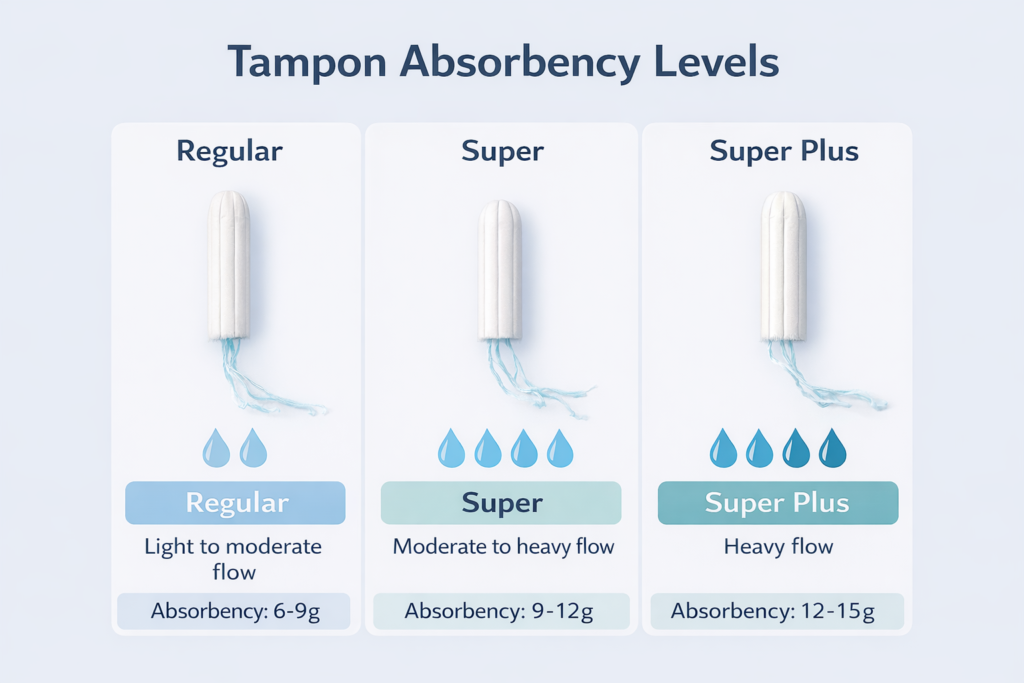
What is a Super tampon?
In the U.S. system, a Super tampon is a product whose tested mean absorbency is greater than 9 g and no more than 12 g. “Super” identifies the absorbency class; it does not define the fibre composition, applicator type, physical diameter or shape.
Two Super tampons can therefore differ in core material, compression, cover, expansion design, applicator and packaging while remaining within the same labeled absorbency range. Buyers should compare the complete specification and supporting test results, not the label term alone.
What is a Super Plus tampon?
In the U.S. system, Super Plus means greater than 12 g and no more than 15 g. The abbreviation “S+” commonly refers to Super Plus on product packaging, but the pack legend and applicable market requirements should confirm the meaning.
Super Plus is a high-absorbency category, but it is not automatically the highest standardized U.S. category because Ultra covers the next defined range. It also does not guarantee “maximum protection,” freedom from leakage or a longer interval between changes.
What is an Ultra tampon?
For U.S. labeling, Ultra means greater than 15 g and no more than 18 g. A product above 18 g does not receive another standardized term under the cited rule. Ultra availability varies by product line and market, so it should not be assumed to be an available OEM option until the exact product and documentation are reviewed.
Does higher absorbency mean a larger tampon?
Not necessarily. Absorbency and physical size are separate specification fields. Higher absorbency may involve changes to the absorbent mass, fibre arrangement, compression, product dimensions or a combination of design variables. The final construction is product-specific.
For physical-dimension questions, use the separate tampon sizes and absorbency guide. That page explains why common “size” language should not replace a drawing or dimensional specification.
Does a high-absorbency tampon last longer?
No absorbency label authorizes extended wear. The U.S. FDA advises changing each tampon every 4 to 8 hours, never wearing a single tampon for more than 8 hours, and using the lowest absorbency needed. A higher rating should not be used to justify exceeding the labeled wear time.
See the FDA’s current tampon safety and use guidance for consumer instructions and toxic shock syndrome warning signs. Product labeling and medical advice take priority over general online comparisons.
Safety note: This is a product-classification and sourcing guide, not individual medical advice. Stop use and seek medical attention for pain, fever, unusual discharge, allergic-reaction symptoms or possible signs of toxic shock syndrome.
How is a high-absorbency claim verified?
For U.S. labeling, the manufacturer measures absorbency using the method specified in 21 CFR 801.430 and assigns the corresponding term to the production run, lot or batch. The regulation also requires a sampling plan and specifies how the mean absorbency is calculated.
A B2B buyer should request evidence for the exact product being approved. The review should connect the labeled term to the applicable test method, product specification, lot-control approach, artwork and destination-market requirements. A result for one SKU should not be applied automatically to another core material, format or absorbency.
For testing detail, use the dedicated FDA tampon absorbency ranges and testing guide. Keeping testing standards on that page prevents this comparison article from competing with the regulatory intent.
How should a private-label buyer specify absorbency?
A private-label RFQ should identify more than “Regular” or “Super.” The buyer should provide the target market, requested label term, insertion format, applicator, core material, wrapper, pack count and documentation requirements. The manufacturer can then confirm which product routes are available for review.
- State the destination market: regulatory terminology and artwork must match the country of sale.
- Name the requested levels: list each proposed SKU separately.
- Define the format: standard plastic applicator, compact plastic applicator or non-applicator.
- Confirm the material scope: record the core, cover, removal cord, applicator and wrapper specifications.
- Request product-specific evidence: connect absorbency testing and documentation to the proposed SKU.
- Approve samples and artwork: ensure the approved product, color coding, wrapper and carton use consistent terminology.
MOQ, price and lead time vary with the number of absorbency SKUs, product format, wrapper, box count, artwork and order structure. Green Gardener does not publish one universal commercial figure; these terms are confirmed after the project specification is reviewed.
Common high-absorbency sourcing mistakes
- Treating absorbency grams as the dry weight of the tampon.
- Assuming Super Plus is the highest category in every market.
- Promising longer wear because the absorbency is higher.
- Using “heavy flow,” “maximum protection” or “leak-proof” without suitable evidence.
- Applying one absorbency test or market document to multiple unverified SKUs.
- Approving artwork before the product range and label terminology are confirmed.
Frequently asked questions
What is the highest tampon absorbency?
In the standardized U.S. labeling table, Ultra is the highest named range at greater than 15 g and up to 18 g. Products above 18 g receive no additional standardized term under 21 CFR 801.430.
What does S+ mean on a tampon?
S+ commonly means Super Plus. In the U.S. system, that corresponds to greater than 12 g and up to 15 g, but buyers and consumers should confirm the product’s own packaging legend.
How much does a Super tampon absorb?
Under U.S. labeling rules, Super means greater than 9 g and up to 12 g as measured by the specified absorbency test.
How much does a Super Plus tampon absorb?
Under U.S. labeling rules, Super Plus means greater than 12 g and up to 15 g using the specified test method.
Can absorbency grams be converted directly to milliliters?
The regulatory label is based on the specified laboratory absorbency test in grams. A simple gram-to-milliliter conversion can misrepresent the test setup and should not replace the official range or product data.
Should a high-absorbency tampon be used overnight?
Absorbency does not change the maximum wear-time instruction. Follow the product label and applicable health guidance; the FDA says never wear one tampon for more than 8 hours.
Can Green Gardener supply every absorbency level?
Availability must be confirmed for the exact format, core material, wrapper, target market and documentation scope. Send the requested SKU matrix for a project-specific review rather than assuming every labeled level is available.
Build an absorbency SKU matrix
Green Gardener is the B2B period-care team behind TamponManufacturer.com. Send your target market, requested absorbency levels, applicator format, core material, wrapper and pack count so the team can review product availability and the documentation required for each SKU.