Pharmacies and retail chains launch store-brand tampons to offer shoppers a trusted alternative to national brands, protect category margin and control their range. A successful programme starts with range architecture, meaning which absorbencies, applicator types and pack sizes to carry; then packaging that works on shelf; then compliance and quality files that satisfy the retailer’s own standards. This guide walks category and sourcing teams through each step.
Why Retailers Build Store-Brand Tampons
Tampons are a repeat-purchase essential, so shoppers notice price and availability. A store brand gives a retailer a lower-priced option alongside national brands, a premium tier where it wants to compete on materials, and more control over supply when brand manufacturers change ranges or packaging.
Pharmacies also benefit from the trust shoppers already place in them for health and hygiene products. A well-specified own-label range, with clear absorbency labeling and patient-friendly instructions, fits naturally next to pharmacy advice on menstrual health. Our private label tampons service is built for exactly this type of programme.
Store brands also give retailers flexibility. A chain can adjust pack counts, refresh packaging or add a new applicator type on its own timetable, instead of waiting for a national brand’s product cycle. Over time, a strong own-label range becomes part of the retailer’s identity and a reason for shoppers to return.
Range Architecture: Absorbencies, Formats and Pack Sizes
Start from shopper needs and shelf space rather than from a supplier catalogue. Most store-brand tampon ranges cover the core absorbencies in one or two applicator formats, then add multipacks and a premium line.
| Range element | Typical options | Planning note |
|---|---|---|
| Absorbencies | Light, Regular, Super, Super Plus | Ultra only where demand exists |
| Applicator type | Plastic, compact, cardboard, non-applicator | Match market habits |
| Pack sizes | Small, standard, value multipack | Mind shelf depth |
| Multipacks | Mixed absorbency boxes | Popular for new users |
| Material tier | Standard, organic cotton | Premium tier option |
| Fragrance | Unscented | Common store-brand choice |
Compare formats on our applicator tampons page and in our product comparison guide.
Good-Better-Best Tiering
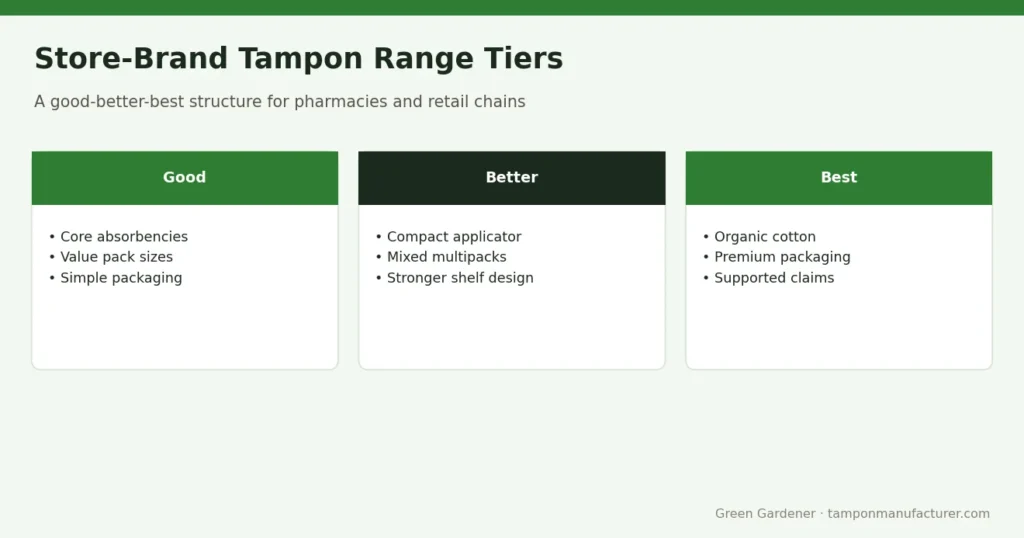
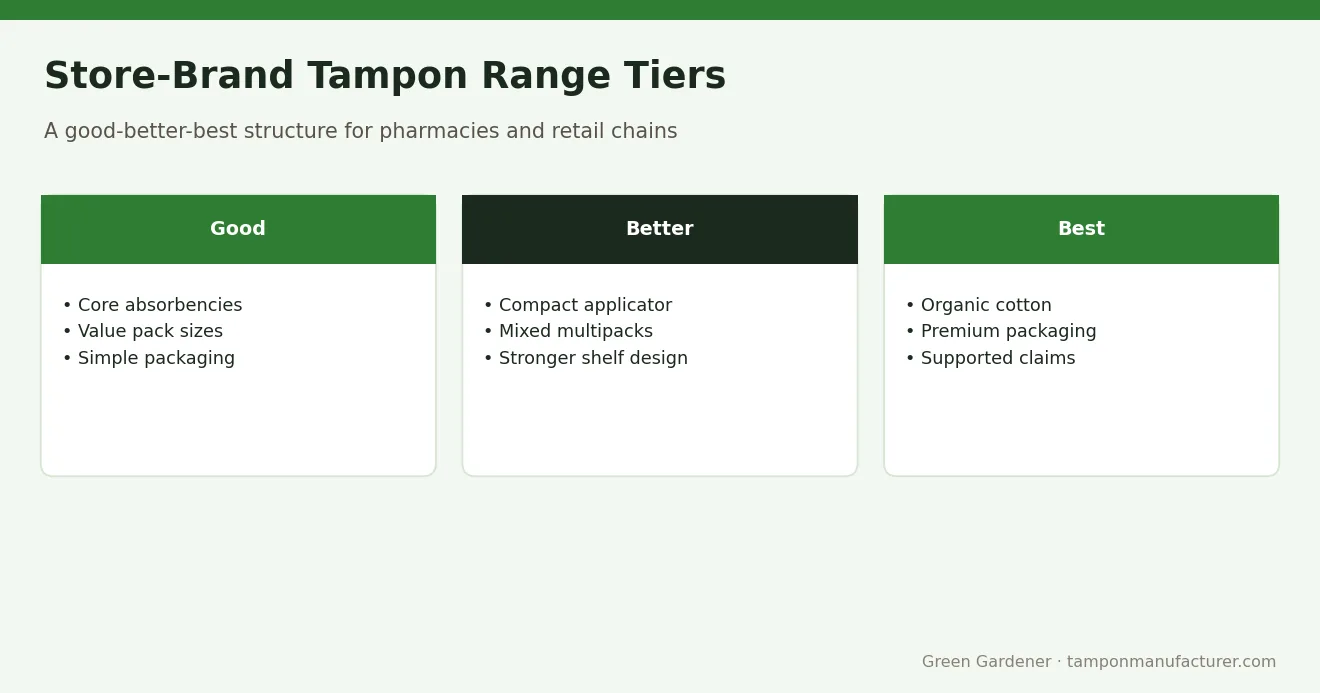
Tiering lets one supplier relationship serve several price points without confusing shoppers. A typical structure looks like this:
- Good: core absorbencies in a cost-efficient applicator, simple packaging, value pack sizes.
- Better: compact or smooth plastic applicators, mixed multipacks, stronger shelf design.
- Best: organic cotton tampons, cardboard or plant-based applicator options and premium packaging with supported claims.
Keep tier differences real and visible: shoppers trade up when the benefit is clear on pack, not when only the price changes.
Use one consistent absorbency colour system across all three tiers so shoppers can find their usual size quickly, whichever tier they choose. Many retailers also extend the tiers into companion products such as pads and panty liners, giving the whole period care shelf a unified store-brand look.
Shelf Packaging and Retail Compliance
Store-brand packaging must sell in a few seconds, meet retailer brand guidelines and satisfy regulations. Plan for:
| Packaging element | What retailers usually expect |
|---|---|
| Front of pack | Absorbency, count, applicator type, tier cue |
| Absorbency coding | Consistent colours across all tiers |
| Barcodes | GS1 barcodes for each SKU and case |
| Regulatory text | Absorbency terms and TSS information per market |
| Shelf-ready case | Easy open, stable on shelf, clear SKU marks |
| Lot and date coding | Readable panel on pack and carton |
Our packaging artwork checklist walks through these items before print approval.
Pharmacies with smaller stores should test packs on a real shelf before final approval. Box depth, facing width and how the pack stands or hangs all affect how many facings fit, and a pack that looks good on screen can be hard to read from the aisle.
Regulatory Responsibilities for Retailer Brands
When a retailer’s name appears on the pack, the retailer often carries legal responsibilities as the brand owner, importer or distributor. In the United States, tampons are Class II medical devices: unscented menstrual tampons fall under 21 CFR 884.5470 and scented tampons under 21 CFR 884.5460, and labeling must meet 21 CFR 801.430. Check current FDA requirements, including 510(k) status and establishment registration, for each SKU.
In the UK and EU, tampons are covered by general product safety rules. For Canada, Australia and GCC states, tampons are regulated; confirm requirements with Health Canada, the TGA or the SFDA before listing.
Agree in writing which party prepares and maintains each regulatory document, who reviews artwork for legal text, and who handles adverse event reports and complaints. Clear roles prevent gaps when a retailer sells the same store brand in several countries, each with its own rules for labeling and post-market reporting.
Quality Standards Retailers Ask For
Large retailers usually apply their own supplier standards on top of legal requirements. These may include factory audits, recognised quality or social compliance audit schemes, product specifications signed off by the retailer’s technical team, and regular retesting.
Ask your manufacturer early which audits it has completed and which documents it can share. We provide documentation on request, including specifications, test reports and quality records, so your technical team can review them against your own standard. Agree complaint handling, lot coding and recall contacts in the supply agreement before the first order.
Retailers also benefit from a clear change-control process. Any change to materials, applicator components, packaging suppliers or production site should be notified and approved before it happens, so the retailer’s technical file always matches what is on shelf.
Launch Timeline From Brief to Shelf
A store-brand tampon launch usually follows a predictable path. The duration of each stage is confirmed in your quotation and depends on artwork approvals and testing.
- Category brief: target shopper, tiers, SKUs and price positioning.
- Supplier selection and sampling against the specification.
- Specification sign-off and testing for each market.
- Artwork development, regulatory review and print proofs.
- Pilot production, inspection and shelf trial.
- Full launch, then regular range and sales reviews.
Building time for artwork corrections and retailer technical approval into the plan avoids rushed decisions close to the launch date.
For Category Managers: Choosing a Manufacturer
Look for a manufacturer that can cover your whole range from one site, with multiple applicator types, organic options and companion products such as pads and liners. Confirm that it understands retailer artwork processes, can code lots on every pack and carton, and can supply documentation in the format your technical team needs. Ask for samples from the exact production line that will make your products.
It is also worth checking how the manufacturer handles forecasts and replenishment. Retail programmes depend on steady availability, so agree how forecasts are shared, how promotions are planned and how out-of-stocks are prevented. Payment terms, order quantities and delivery schedules are confirmed in your quotation.
Request a Quote
We are a factory-direct manufacturer with a 37,600 m² facility, ISO 13485 and ISO 9001 certification plus FDA 510(k) clearance. We produce plastic, compact, cardboard and non-applicator tampons, organic cotton options, sanitary pads, panty liners, menstrual cups and period underwear, with private label packaging and samples before bulk.
Contact us to request a quote for your store-brand range or message us on WhatsApp +86 173 1689 5054. Pricing and terms are confirmed in your quotation.
Frequently Asked Questions
How many tampon SKUs should a store brand launch with?
Many retailers start with the core absorbencies in one applicator format, plus one multipack, then add a premium or organic tier once sales data is available. The right number depends on shelf space, store formats and how shoppers in your market buy. Plan the full range, but launch in stages if space is limited.
Who is legally responsible for a pharmacy own-brand tampon?
Responsibility usually sits with the company named on the pack and the importer of record, often the retailer or its sourcing partner. The manufacturer supports with specifications, test data and quality records. Confirm your exact obligations with a regulatory adviser for each market where the product will be sold.
Should a store-brand range include organic tampons?
An organic cotton tier can help a retailer compete with premium brands and meet shopper demand for natural materials. It requires certification documentation for the cotton supply and careful claim wording. Many retailers add organic as the top tier of a good-better-best range rather than as the only offer.
What packaging information must store-brand tampons show?
Requirements depend on the market. In the United States, tampon labeling must include the absorbency term and toxic shock syndrome information under 21 CFR 801.430. Retailers also expect count, applicator type, barcodes and lot coding. Check local rules in each market and review artwork with a regulatory specialist.
Can one manufacturer supply all tiers of a store-brand range?
Yes, if the factory produces several applicator types, absorbencies and materials on its own lines. Using one manufacturer simplifies specifications, artwork, testing and logistics, and keeps quality consistent across tiers. Ask for samples of every format you plan to list before you approve the range.