

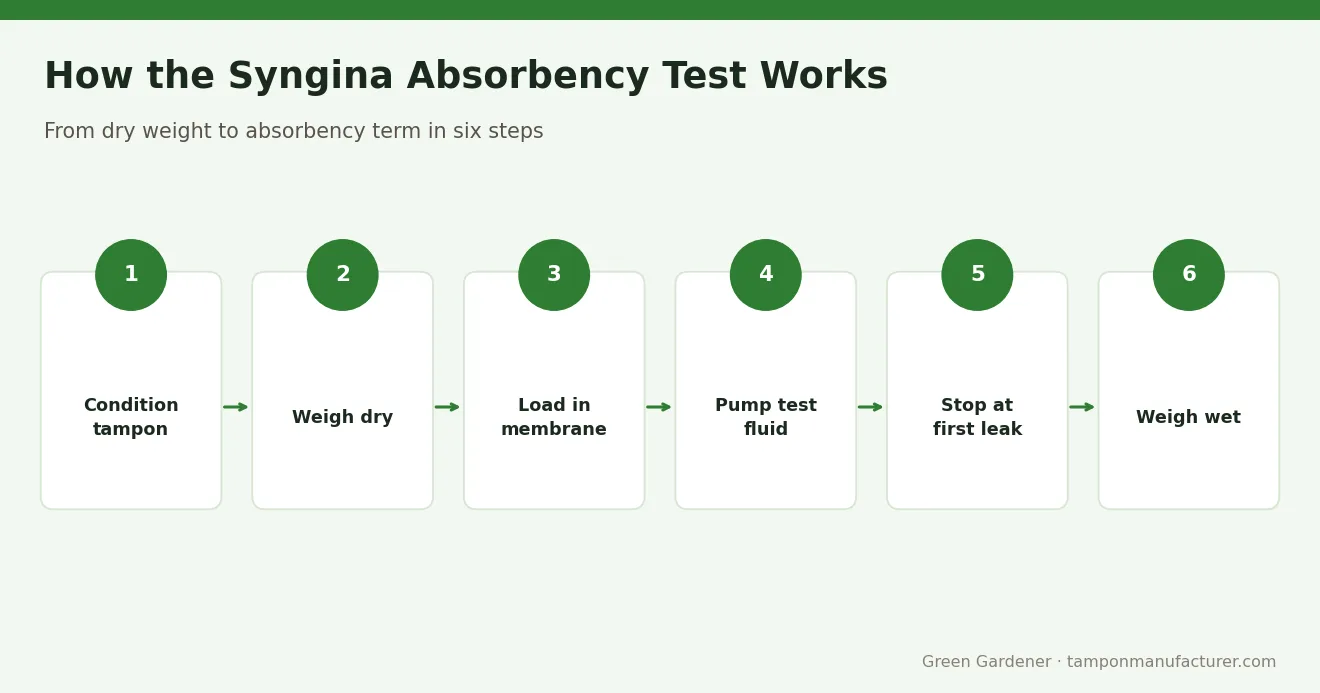
The syngina (synthetic vagina) method is the standard laboratory test for tampon absorbency. A tampon is placed inside a thin membrane in a sealed chamber, test fluid is pumped in at a controlled rate under pressure, and the test stops when fluid first leaks past. The weight of fluid absorbed, in grams, decides whether a tampon may be labeled Light, Regular, Super, Super Plus or Ultra under FDA rule 21 CFR 801.430. Here is how it works and what buyers should check in test reports.
What the Syngina Test Is
“Syngina” is short for synthetic vagina. The method was developed to give a repeatable, comparable measure of how much fluid a tampon absorbs under conditions that loosely simulate use. It became the reference method for US labeling when FDA standardized absorbency terms, and it is widely used by manufacturers and test laboratories in other markets as well.
The background is safety. After the Toxic Shock Syndrome cases linked to high-absorbency tampons in the early 1980s, regulators wanted users to be able to choose the lowest absorbency they needed. That only works if every brand measures absorbency the same way, so a single reference method was written into the labeling rule.
The test does not attempt to reproduce the body exactly. Its value is consistency: two tampons tested with the same equipment and procedure can be compared fairly, and a brand can show that a product’s labeled absorbency is supported by data. For background on how tampons are produced before they reach the lab, see how tampons are manufactured.
Why Absorbency Labeling Depends on It
Under 21 CFR 801.430, the absorbency term on a US tampon package must correspond to the range in which the product’s syngina results fall:
| Absorbency term | Syngina result (grams) | Labeling impact |
|---|---|---|
| Light | 6 and under | Lowest band, often slim products |
| Regular | 6 to 9 | Core everyday term |
| Super | 9 to 12 | Heavier days |
| Super Plus | 12 to 15 | Heavy flow lines |
| Ultra | 15 to 18 | Very heavy flow lines |
Because TSS risk information in the labeling links to absorbency, regulators expect the term to be accurate. A product designed as Regular that tests just above 9 g on average, for example, would not be able to carry the Regular term. This is why product development includes several rounds of syngina testing before artwork is approved. Our article on absorbency levels explains the terms from the user’s side.
How the Test Works, Step by Step
The exact apparatus, fluid, temperature, pressure and flow rate are specified in the regulation and should be taken from the current text. In general terms, the procedure runs as follows:
- Conditioning – tampons are held under defined conditions so moisture content does not distort results.
- Weighing – each dry tampon is weighed before testing.
- Loading – the tampon is placed inside a thin, non-lubricated membrane (a condom is used) fixed inside a glass chamber.
- Pressurizing – water is circulated around the membrane to apply controlled pressure and temperature.
- Dosing – a saline-based test fluid is pumped into the top of the tampon at a fixed rate.
- End point – the test stops when the first drop of fluid passes the tampon and is detected below it.
- Re-weighing – the wet tampon is weighed again; the weight gain is its absorbency in grams.
Sampling and Statistics
One tampon does not prove a label. The regulation sets out how many tampons must be tested, drawn from more than one production lot, and how the results are evaluated statistically so that the labeled range is supported with confidence. Brands should ask their manufacturer to explain how the sample was drawn and how the results compare with the range limits.
In practice, a good product sits comfortably inside its range rather than close to a boundary. If average results are near 9 g, natural lot-to-lot variation in fiber and compression could push some lots into the next band. Factories manage this by setting internal targets and control limits during production and retesting at agreed intervals.
Factors That Affect Syngina Results
| Factor | Effect on absorbency | How it is controlled |
|---|---|---|
| Fiber type and blend | Cotton and rayon absorb differently | Approved material specifications |
| Pad weight | More fiber generally absorbs more | Weight checks on line |
| Compression and shape | Affects expansion and leakage | Press settings, dimension checks |
| Cover and cord | Can influence fluid path | Fixed component specifications |
| Moisture content | Distorts dry weight | Conditioning before test |
| Test setup | Pressure or flow errors skew data | Calibrated apparatus, trained staff |
Limitations of the Method
The syngina test is a comparison tool, not a prediction of how long a tampon will last for a specific person. Flow varies between users and across a period, and real-world comfort depends on width, applicator design and user technique. The test also says nothing about material safety, cord strength or applicator quality, which need their own checks. For these reasons, buyers should treat absorbency data as one part of a wider quality file.
Results can also differ between laboratories if equipment, membrane condition or operator technique varies. When comparing data from different sources, check that the same method version was followed and, where possible, run a side-by-side test of a reference sample. Large unexplained gaps between a factory report and an independent result are a signal to review the setup on both sides before drawing conclusions about the product.
What Buyers Should Ask for in Test Reports
- Product identification – model, absorbency term, core material and applicator type matching your specification.
- Method reference – confirmation that the syngina method follows 21 CFR 801.430 (or the method required in your market).
- Sample details – number of tampons and lots, with lot codes and production dates.
- Individual and summary results – not only the average, but the spread and the statistical evaluation.
- Laboratory details – who tested, when, and whether it was an in-house or external laboratory.
- Ongoing plan – how often absorbency is re-checked in mass production.
Our guides on tampon quality control documentation show how test reports fit with other quality records.
For Brands: Building Absorbency Data Into Your Launch
Plan absorbency targets at the specification stage, approve samples with syngina data attached, and keep reports on file for each product and absorbency. A simple workflow many brands follow:
- Agree the absorbency term and internal target range for each SKU.
- Review syngina results on pre-production samples before approving artwork.
- Confirm the retest frequency during mass production.
- Request results for the lots in each shipment when your quality plan requires it.
- Re-test after any change in fiber supplier, blend or compression settings.
As a manufacturer with 30 years of founder-level industry experience, we develop tampons across the Light to Ultra range with plastic, compact, cardboard and non-applicator options. We provide documentation on request so your regulatory team can review results before launch.
Request a Quote
Tell us your target absorbencies, materials, applicator types and markets through our contact page or WhatsApp +86 173 1689 5054. Samples are available before bulk production, and order terms are confirmed in your quotation.
Frequently Asked Questions
What does syngina mean?
Syngina stands for synthetic vagina. It is a laboratory apparatus in which a tampon sits inside a thin membrane in a pressurized chamber while test fluid is pumped in. The amount absorbed before leakage, measured in grams, is used to assign the standard absorbency term on US tampon packaging.
Is the syngina test required for US tampon labels?
Yes. FDA regulation 21 CFR 801.430 links each absorbency term to a gram range measured by the syngina method described in the regulation. Brands should keep test data that supports each absorbency term they use and check current FDA requirements, including any 510(k) expectations, for their product.
Why do absorbency results vary between lots?
Small differences in fiber weight, blend, compression and moisture can change how much fluid a tampon absorbs. Well-run factories control these variables with material specifications, in-line weight and dimension checks and conditioning before testing, and they set internal targets inside the labeled range to allow for natural variation.
Does a higher syngina result mean a better tampon?
Not necessarily. Package inserts advise using the lowest absorbency that controls flow, so the right product is the one that matches the user’s needs. A higher result simply places the tampon in a higher absorbency band. Comfort, width and applicator design also shape the user experience.
Can you provide syngina test reports for private label orders?
Yes. We provide absorbency test documentation on request for the products and absorbencies in your order, together with related quality records. Reports can be reviewed at the sample stage so your team can confirm the absorbency terms before artwork is finalized and bulk production starts.
Request a Tampon or Pad Quote
Tell us the product, quantity and your market. We reply with options, pricing and sample steps. Prefer chat? WhatsApp +86 173 1689 5054.