

The right tampon pack size balances what shoppers expect, what your sales channel rewards and how efficiently the boxes ship. Smaller counts suit trial, convenience and travel. Mid-size boxes are the everyday shelf standard. Larger value packs fit club stores, online subscriptions and heavy users. As a factory-direct OEM manufacturer, we help private label brands choose counts and box formats that fit their channels, then confirm carton configurations in the quotation.
Why Pack Count Is a Strategic Decision
Pack count affects far more than the number printed on the box. It sets the shelf price point, shapes how often consumers repurchase, determines how many boxes fit in a shipping carton and influences how a retailer compares your product with competitors. A count that looks generous online may be too bulky for a convenience store shelf, while a small box that suits a pharmacy may feel poor value on a marketplace.
There is no regulation that fixes how many tampons go in a retail box, so the choice is commercial. What is regulated is the information on the package, such as the absorbency term and the required consumer information, which must be correct whatever the count. Our packaging artwork checklist covers the label content in detail. This article focuses on the commercial side: which counts to offer, where each one fits and how to keep the range efficient to produce and ship.
Common Tampon Box Counts
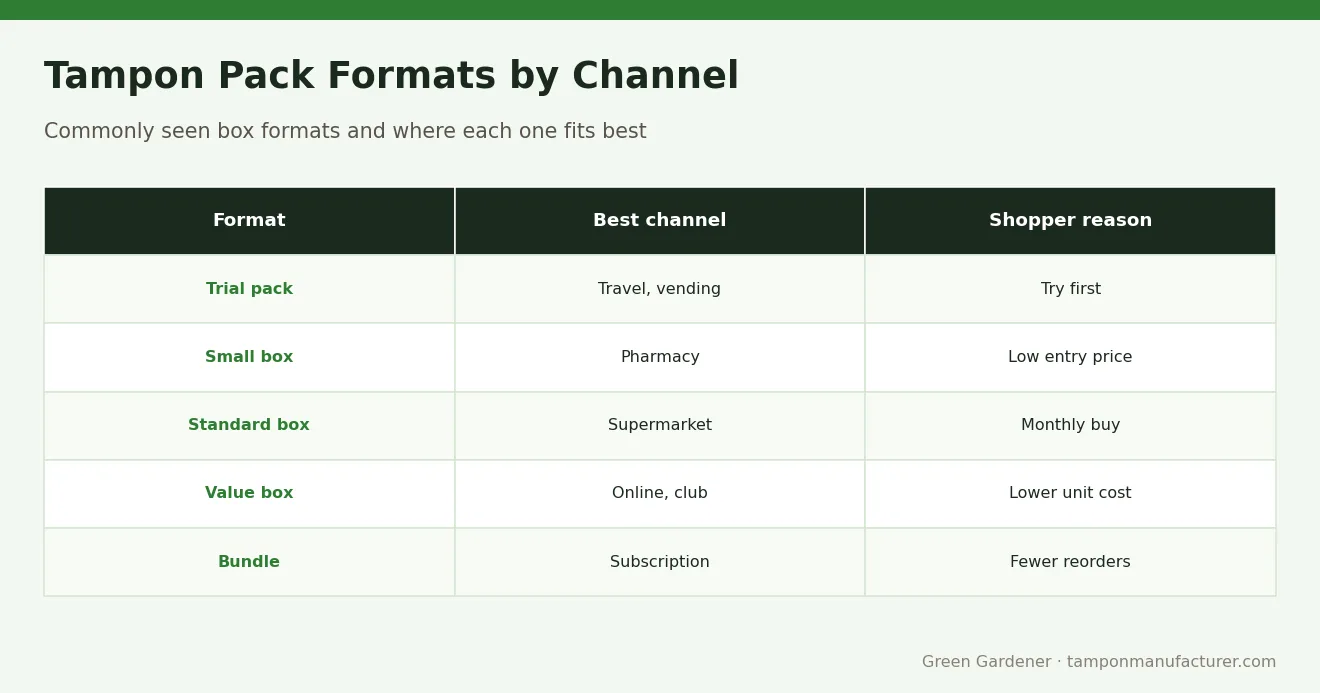
Across many markets, retail tampon boxes tend to fall into a few broad bands. These are commonly seen formats, not rules, and each brand should check what competitors in its own channels offer.
| Format band | Typical use | Consumer reason |
|---|---|---|
| Mini or trial pack | Sampling, travel, vending | Try before committing |
| Small box | Pharmacy, convenience | Low entry price |
| Standard box | Supermarket shelf | Regular monthly purchase |
| Large or value box | Online, club stores | Lower cost per tampon |
| Multi-pack bundle | Subscriptions, e-commerce | Fewer reorders |
Counts within each band vary by market and absorbency. Heavy-flow absorbencies are sometimes sold in smaller counts because users need them for fewer days, while light and regular options may come in larger boxes.
Matching Pack Size to Sales Channel
Each channel rewards a different format. Consider these patterns when planning:
- Supermarkets and drugstores: shelf space is limited, so standard boxes with clear absorbency signals perform best. Retailers may specify dimensions to fit their planogram.
- Pharmacies: shoppers often buy a smaller box alongside other items, and premium or organic positioning is common.
- Convenience and travel retail: small counts and compact boxes suit urgent purchases.
- E-commerce and marketplaces: larger boxes or bundles reduce shipping cost per tampon and improve value perception.
- Subscriptions: counts are often planned around a monthly or cycle-based delivery; see our tampon subscription box guide.
Institutional buyers, such as schools and workplaces, usually prioritise individually wrapped units in bulk cases rather than retail boxes.
Single-Absorbency Boxes vs Mixed Packs
Most ranges start with single-absorbency boxes, because they are simple to label and easy for shoppers to understand. Mixed or variety packs, which combine absorbencies in one box, appeal to users whose flow changes across a period, but they need extra care with labeling and colour coding.
A practical approach is to launch with single-absorbency boxes in the absorbencies your target customers use most, then add a variety pack once you have sales data. Each format you add creates more SKUs, more artwork and more inventory, so every new count should earn its place. For guidance on which absorbencies to prioritise, see our article on tampon sizes and absorbency.
Carton Efficiency and Shipping
Retail box size determines how many boxes fit in a shipping carton, and carton size determines how many fit on a pallet and in a container. Small changes to box dimensions can noticeably change freight cost per tampon, especially for brands shipping long distances.
| Factor | Effect | What to agree |
|---|---|---|
| Box dimensions | Carton fill and shelf fit | Approved dieline before printing |
| Boxes per carton | Handling and store replenishment | Retailer case-pack preference |
| Carton size | Pallet and container use | Pallet pattern and height limits |
| Wrapped tampon size | How tightly boxes fill | Final applicator and wrapper |
We confirm carton configurations, case quantities and packing details in your quotation once box formats are fixed.
Pricing Perception and Cost Per Tampon
Shoppers often compare boxes by price per tampon, either on shelf-edge labels or mentally. Larger counts usually deliver a lower cost per unit, which supports value positioning, while smaller boxes keep the entry price low and reduce the risk of trying a new brand.
The most effective ranges use both. A small or standard box recruits new users, and a larger box rewards loyal customers. Make sure the difference in value between formats is clear, because a large box that offers little saving per tampon can confuse shoppers and slow sales of both sizes. Unit cost depends on your specification, count and order volume, and it is confirmed in your quotation. For background on cost drivers, see our guide to MOQ and pricing in tampon manufacturing.
Box Construction and Shelf Presence
Once counts are chosen, the box itself needs to work for both the shopper and the store. The main construction choices are the opening style, the board grade and the orientation of the tampons inside. A flip-top or tear-open front lets users take one tampon at a time and close the box again, while a simple tuck-end box keeps cost down. Some brands add a perforated dispensing window so the box can sit on a bathroom shelf.
Shelf presence matters as much as structure. On a crowded shelf, shoppers scan for brand, absorbency and count in a few seconds, so those three pieces of information should be easy to find on the front face. Consistent box heights across a range create a clean brand block, which retailers appreciate when they set planograms. For a mixed range of applicator and non-applicator products, keep the same layout logic across all boxes so shoppers learn where to look.
You can review the formats we produce on our private label tampons page, and request physical box samples alongside product samples before artwork is finalised.
For Brands: Building a Lean Launch Range
New brands often launch with too many formats and spread their budget thin. A lean approach keeps inventory manageable while still covering the main needs:
- Choose two or three core absorbencies based on your target users.
- Pick one main retail count per absorbency that fits your primary channel.
- Add one trial or travel format if sampling is part of your plan.
- Review sales after the first cycles before adding value packs or bundles.
This approach reduces artwork, packaging and stock-holding cost, and it gives clearer data on what customers actually buy. Our team can share samples of different box formats before bulk production, so you can see how each count looks and feels in the hand.
Request a Quote
Tell us your target channels, absorbencies and preferred box counts, and we will prepare packaging options and a quotation with carton details. Contact our team through the contact page or on WhatsApp at +86 173 1689 5054 to plan your private label pack range.
Frequently Asked Questions
Is there a standard number of tampons per box?
No regulation sets a standard retail count. Brands choose counts commercially, and formats vary by market, channel and absorbency. What must be correct on every box is the required label information, such as the absorbency term and consumer information, regardless of how many tampons the box contains.
Which pack size should a new brand launch with?
Most new brands do well with one main count per core absorbency, chosen to fit their primary channel, plus an optional trial format. Adding value packs and bundles later, once sales data is available, keeps inventory and artwork costs under control during launch.
Do larger boxes always sell better online?
Larger boxes and bundles often perform well online because they lower shipping and cost per tampon, but trial buyers may still prefer a smaller first purchase. Offering a standard box and a larger value option gives new and loyal customers a clear choice.
How does box size affect shipping cost?
Box dimensions determine how many boxes fit in a carton, and carton size determines pallet and container fill. Poorly sized boxes waste space and raise freight cost per tampon. Agreeing on dielines and carton configurations before printing helps keep shipping efficient.
Can I use different counts for different absorbencies?
Yes. Some brands use smaller counts for heavy-flow absorbencies and larger counts for light or regular options, reflecting typical usage. Keep box sizes visually consistent so the range looks organised on shelf, and confirm each format’s carton configuration in your quotation.
Request a Tampon or Pad Quote
Tell us the product, quantity and your market. We reply with options, pricing and sample steps. Prefer chat? WhatsApp +86 173 1689 5054.