

Under Directive (EU) 2019/904, the Single-Use Plastics Directive, packaging of tampons and tampon applicators that contain plastic must carry a harmonised marking telling consumers that the product contains plastic and how to dispose of it properly. The design and placement rules are set out in Commission Implementing Regulation (EU) 2020/2151. As a factory-direct private label manufacturer, we help brands plan EU packaging and offer lower-plastic options such as cardboard and non-applicator tampons.
What the Single-Use Plastics Directive Covers
Directive (EU) 2019/904 on the reduction of the impact of certain plastic products on the environment, commonly called the SUP Directive, targets single-use plastic products often found as litter, especially in marine environments. It uses several measures depending on the product: consumption reduction, market restrictions, product design requirements, marking requirements, extended producer responsibility and awareness raising.
For marking, Article 7 and Part D of the Annex list specific products. These include sanitary towels (pads), tampons and tampon applicators, alongside wet wipes, tobacco products with filters and cups for beverages. Products in this list that are made wholly or partly of plastic must carry a marking on their packaging or on the product, as specified for each product type.
The Directive is implemented through national law in each EU member state, so brands should also check national transposition and any additional local requirements.
What the Marking Must Communicate
The Directive requires a conspicuous, clearly legible and indelible marking that informs consumers about two things:
- Appropriate waste management options for the product, or waste disposal means to be avoided, in line with the waste hierarchy.
- The presence of plastics in the product and the resulting negative impact of littering or other inappropriate disposal on the environment.
For tampons, inappropriate disposal includes flushing used tampons or applicators down the toilet. The harmonised marking therefore combines graphic elements with a short text element in the relevant official language or languages, so consumers across the EU see a consistent message.
Brands should use the exact artwork and specifications published with the Implementing Regulation rather than redrawing the marking themselves. Small changes to proportions, colours or text can make the marking non-compliant.
Implementing Regulation (EU) 2020/2151
Commission Implementing Regulation (EU) 2020/2151 lays down the harmonised marking specifications for the products listed in Part D of the Annex. It applies from 3 July 2021. For each product type, it sets out the marking design, where it must be placed, and size rules related to the packaging.
| Topic | What the Regulation addresses |
|---|---|
| Design | Graphic and text elements for each product category |
| Placement | Which packaging surface carries the marking |
| Size | Minimum dimensions linked to packaging size |
| Language | Text in the official language(s) of the member state where sold |
| Legibility | Colour, contrast and orientation requirements |
The annexes of the Regulation contain the official artwork and detailed rules. Your packaging designer and regulatory adviser should work directly from the published text, available on EUR-Lex, and check whether any later amendments or guidance apply.
Does Your Tampon Fall Within Scope?
The marking duty applies to listed products made wholly or partly from plastic, as plastic is defined in the Directive. Plastic applicators are clearly made of plastic. For tampons themselves and for paper-based applicators, the answer depends on the materials used.
| Component | Scope question to check |
|---|---|
| Plastic applicator | Made of plastic; marking requirements apply |
| Cardboard applicator | Any plastic coatings, laminates or parts? |
| Absorbent core and cover | Fibre types used and whether any meet the plastic definition |
| Withdrawal cord | Fibre composition |
| Non-applicator tampon | Material composition of the tampon itself |
The European Commission published guidelines on single-use plastic products in 2021 to help interpret the definition of plastic and product scope. Because classification can depend on detailed material specifications, brands should get advice from a qualified regulatory professional. We provide documentation on request, such as material specifications, to support that assessment.
Packaging Design: Practical Steps
Tampon boxes are small and already carry absorbency information, usage instructions, warnings and brand content. Adding the SUP marking requires planning so that it remains legible and correctly sized.
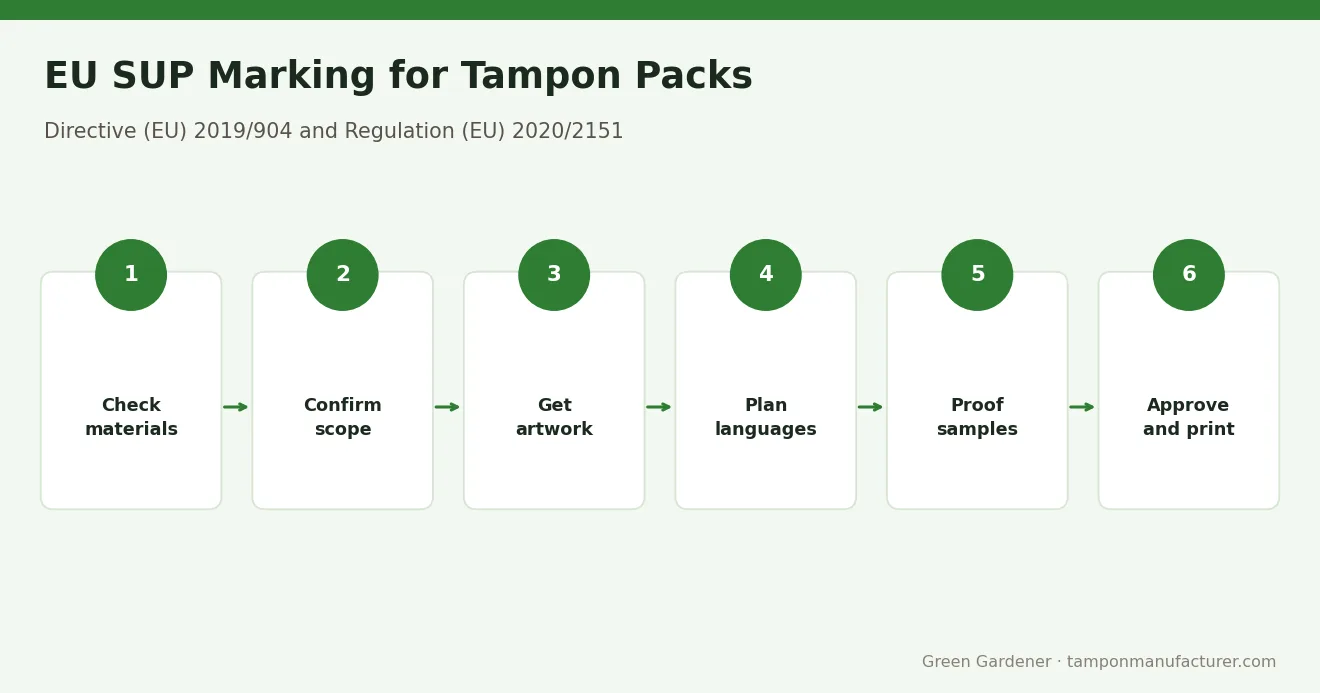
- Confirm whether each SKU falls within scope, using material specifications.
- Identify every EU market and language for each pack version.
- Download the official marking artwork from the Implementing Regulation.
- Reserve a panel area that meets the size and placement rules.
- Check contrast and legibility on printed samples, not only on screen.
- Record approvals in your artwork file for future audits.
Our packaging artwork checklist can be extended to include the SUP marking as a separate approval step for EU SKUs.
Lower-Plastic Alternatives for EU Ranges
Many brands selling in Europe review their range to reduce plastic, both to respond to consumer expectations and to simplify compliance. Options include:
- Cardboard applicator tampons: replace plastic with paper-based material; check coatings and other components for plastic content.
- Non-applicator (digital) tampons: widely used in several European markets and avoid applicator material entirely.
- Paper wrappers: can replace film wrappers on individually wrapped tampons, subject to hygiene and moisture performance.
Switching materials does not automatically remove the marking duty, because the tampon itself may still contain plastic depending on its construction. It can, however, reduce plastic use and support specific, substantiated environmental messaging, provided claims meet EU rules on environmental claims.
Related EU Requirements to Keep in View
The SUP marking is one of several EU requirements affecting tampon packaging. Packaging is also subject to EU packaging rules; the new Packaging and Packaging Waste Regulation, Regulation (EU) 2025/40, introduces harmonised requirements that phase in over time, including labeling for sorting. National rules on sorting labels, such as those in France and Italy, may also apply.
Environmental claims on pack are increasingly regulated, notably through Directive (EU) 2024/825 on empowering consumers for the green transition. Product safety and language requirements continue to apply as well. Because these rules interact, brands should review EU packaging as a whole rather than adding one marking at a time.
For Brands: Planning EU Packaging With Us
We are a factory-direct manufacturer with more than 15 years of experience, a 52,000 m² factory and over 500 clients served. For EU ranges we produce plastic applicator tampons, compact, cardboard and non-applicator tampons, with organic cotton options and private label packaging. We print the SUP marking to your approved artwork, share pre-production samples for checking and provide material documentation on request. Commercial terms are confirmed in your quotation.
We recommend that brands confirm scope and artwork with their own EU regulatory adviser or importer before approving packaging, as responsibility for compliance in the EU market rests with the economic operator placing the product on the market.
Request a Quote
Launching or updating a tampon range for the EU? Share your target markets, applicator preferences and packaging plans. We will advise on formats, prepare samples and print your approved markings. Request a quote or contact us on WhatsApp at +86 173 1689 5054.
Frequently Asked Questions
Do all tampons sold in the EU need the single-use plastics marking?
The marking applies to tampons and tampon applicators made wholly or partly of plastic, as defined in Directive (EU) 2019/904. Plastic applicator tampons are clearly in scope. For other designs, scope depends on the materials used, so brands should check material specifications with a qualified regulatory adviser.
Where can we find the official marking artwork?
The harmonised marking specifications and artwork are in the annexes of Commission Implementing Regulation (EU) 2020/2151, available on EUR-Lex. Designers should use the official artwork without altering proportions or text, and check for any later amendments or Commission guidance before finalising packaging for each EU market.
Does switching to cardboard applicators remove the marking requirement?
Not necessarily. A cardboard applicator may still contain plastic coatings or parts, and the tampon itself may contain materials that meet the Directive’s definition of plastic. Each SKU needs its own scope assessment based on material specifications. Switching can still reduce plastic use and support specific environmental messaging.
Which language should the marking text use?
The text element should appear in the official language or languages of the member state where the product is sold, following the Implementing Regulation. Multi-country packs may need several language versions, which affects panel space. Plan language coverage for each SKU before artwork design begins.
Who is responsible for SUP marking compliance?
Responsibility generally rests with the economic operator placing the product on the EU market, such as the brand owner or importer. As the manufacturer, we print the marking to your approved artwork and provide material documentation on request, but scope and artwork decisions should be confirmed by your EU regulatory adviser.
Request a Tampon or Pad Quote
Tell us the product, quantity and your market. We reply with options, pricing and sample steps. Prefer chat? WhatsApp +86 173 1689 5054.