
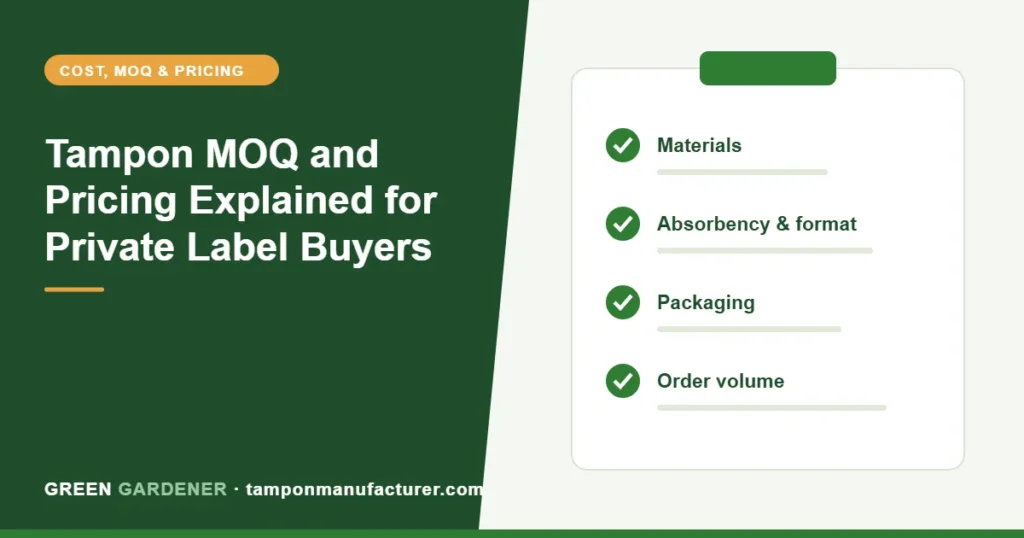
Quick answer: There is no single tampon MOQ or unit price — both are a result of your product format, absorbency range, packaging, automation level and order volume. Very low MOQs often signal manual production and weaker hygiene control, so professional factories prefer structured trial orders over unrealistic minimums. The most useful number is a feasibility-based quote for your exact spec, not a generic price list. Share your target market, format, absorbency and estimated volume and we will map MOQ, lead time and cost structure to your project.
Why the Lowest Price Is Rarely the Best Choice for Brands
Pricing is often the first question buyers ask when sourcing tampons—and the last one they fully understand. Many brands focus on unit price without considering how MOQ, production structure, hygiene systems, and scalability affect long-term cost and risk.
In tampon manufacturing, price is a result, not a starting point. This article explains how MOQ and pricing are determined, why prices vary widely between suppliers, and how professional buyers evaluate cost beyond the number on a quotation.
Why Tampon Pricing Is More Complex Than It Appears
At first glance, tampons may seem like a simple, standardized product. In reality, tampon manufacturing involves:
- Specialized production equipment
- Strict hygiene and contamination control
- Consistent absorbency performance
- Market-specific packaging and compliance considerations
Each of these factors contributes to cost. Two tampons that look similar can have very different production structures—and very different risk profiles.
What MOQ Really Means in Tampon Manufacturing
MOQ (Minimum Order Quantity) is one of the most misunderstood concepts in sourcing.
MOQ Is Not Arbitrary
In tampon manufacturing, MOQ exists to ensure:
- Stable machine setup and calibration
- Efficient material preparation
- Controlled hygiene conditions
- Consistent quality monitoring
Producing below a certain volume often means compromising one or more of these elements.
Why Extremely Low MOQ Can Be a Warning Sign
Some suppliers advertise very low MOQs to attract new buyers. While this may sound appealing, it often indicates underlying issues.
What Very Low MOQ May Signal
- Manual or semi-manual production
- Limited automation and process control
- Reduced hygiene investment
- Minimal in-process quality checks
These conditions increase the risk of batch inconsistency and hygiene problems.
Professional manufacturers prefer structured trial orders rather than unrealistic MOQs.
Trial Orders vs MOQ: Understanding the Difference
Trial orders are not the same as low MOQ.
Purpose of Trial Orders
Trial orders are designed to:
- Validate product quality
- Confirm absorption performance
- Test production stability
- Reduce risk before scaling
They are conducted within controlled parameters, not as exceptions to manufacturing discipline.
Key Factors That Determine Tampon Unit Price
Tampon pricing is shaped by multiple interconnected factors.
1. Raw Material Quality
Higher-quality absorbent materials:
- Improve performance consistency
- Reduce defect rates
- Increase cost stability
Lower-grade materials may reduce initial price but increase long-term risk.
2. Product Structure and Complexity
Product structure has a direct impact on cost.
- Applicator tampons involve more components and assembly steps
- Non-applicator tampons have simpler structures
- Higher absorbency levels require more material and tighter control
Structural complexity increases both production cost and QC requirements.
3. Automation Level and Equipment Investment
Factories with higher automation:
- Achieve better consistency
- Reduce human error
- Require higher upfront investment
This investment is reflected in pricing—but it also reduces long-term variability.
4. Hygiene and Cleanroom Management
Hygiene systems are a significant cost factor.
Professional factories invest in:
- Controlled production environments
- Personnel hygiene systems
- Environmental monitoring
These investments do not directly increase product appearance—but they dramatically reduce risk.
5. Quality Control Systems
Quality control is not free.
Effective QC includes:
- In-process monitoring
- Testing equipment
- Documentation and traceability
Suppliers who cut QC costs often offer lower prices—but at the expense of consistency.
6. Packaging and Branding Requirements
Packaging affects:
- Hygiene protection
- Export durability
- Labeling compliance
- Labor and material cost
Customized packaging increases complexity and cost, especially at lower volumes.
Why the Lowest Quote Is Often the Most Expensive
Extremely low quotations often hide costs that appear later.
Common Hidden Costs
- Increased product complaints
- Rework or repackaging
- Emergency inspections
- Market recalls
- Supplier switching
When these costs are considered, the “cheap” option often becomes the most expensive.
Where absorbency meets cost: higher absorbency uses more absorbent material per unit — the U.S. FDA grades Regular at 6–9 g, Super at 9–12 g and Super Plus at 12–15 g of fluid capacity (FDA 21 CFR 801.430), so a multi-absorbency range carries a different material-cost profile than a single SKU. This is exactly the kind of variable a feasibility-based quote accounts for.
How Professional Buyers Evaluate Pricing
Experienced buyers do not ask, “Who is cheapest?”
They ask, “Who offers the lowest risk-adjusted cost?”
Risk-Adjusted Cost Includes
- Quality stability
- Hygiene reliability
- Communication efficiency
- Scalability for growth
- Predictable lead times
A slightly higher unit price can deliver significantly lower long-term cost.
Pricing Transparency as a Sign of Professionalism
Professional manufacturers are willing to explain:
- What drives cost differences
- How volume affects pricing
- Where optimization is possible
Transparency indicates confidence in systems and respect for buyers.
Suppliers who avoid cost explanations often lack control over their own processes.
How MOQ and Pricing Affect Long-Term Cooperation
MOQ and pricing are not fixed forever.
As cooperation stabilizes:
- Production efficiency improves
- Material sourcing becomes optimized
- Unit cost often decreases
Brands that focus only on initial pricing often miss these long-term benefits.
Common Pricing Mistakes Brands Make
Brands entering tampon manufacturing often make avoidable errors:
- Comparing quotes without aligning specifications
- Ignoring hygiene and QC differences
- Assuming all tampons cost the same to produce
- Treating MOQ as a negotiation tactic rather than a production reality
These mistakes delay launches and increase sourcing risk.
How to Discuss Pricing Productively With Manufacturers
Productive pricing discussions focus on:
- Feasibility first
- Clear specifications
- Volume planning
- Long-term cooperation potential
This approach leads to better outcomes than aggressive price negotiation.
Price vs Value: A Critical Distinction
Price answers the question: “How much does this cost today?”
Value answers the question: “What risk does this reduce over time?”
In tampon manufacturing, value almost always outweighs short-term price savings.
When Lower Price Does Make Sense
Lower pricing can make sense when:
- Specifications are simplified
- Volumes are stable and predictable
- Packaging is standardized
- Long-term cooperation is established
Professional manufacturers help buyers identify these opportunities without compromising safety or quality.
Final Thoughts: Price Is a Result of Manufacturing Discipline
In tampon manufacturing, pricing reflects:
- How products are made
- How risks are controlled
- How consistency is maintained
The best pricing decisions are those that support quality, hygiene, and long-term growth, not just short-term savings.
Understanding MOQ and pricing logic allows brands to make informed sourcing decisions—and avoid costly surprises.
Get Pricing Based on Reality, Not Guesswork
If you are evaluating tampon manufacturers and want transparent MOQ and pricing aligned with quality and scalability, start with a clear discussion.
Contact us with:
- Your target market
- Product format and absorbency
- Estimated volume or trial plan
We will respond with:
- Feasibility-based pricing
- MOQ and lead time guidance
- Cost structure explanation
Contact us to receive a quotation grounded in real manufacturing considerations.
Project note: available formats, supporting documents, samples or pilot options, MOQ and lead time are confirmed against the exact SKU, packaging plan and destination market. This guide does not guarantee one configuration or quantity for every project.
For a project-specific review, see Private Label Tampons or contact our OEM team.
Related sourcing guides
- How to request a tampon manufacturing quote (RFQ guide)
- Applicator vs. non-applicator tampons
- Absorbency levels explained (Regular / Super / Super Plus)
- Common risks in tampon sourcing (and how to avoid them)
Ready for real MOQ & pricing?
Send your target market, product format, absorbency and estimated volume through our quote request form. We reply with feasibility-based pricing, MOQ and lead-time guidance, and a clear cost-structure explanation for your project.