
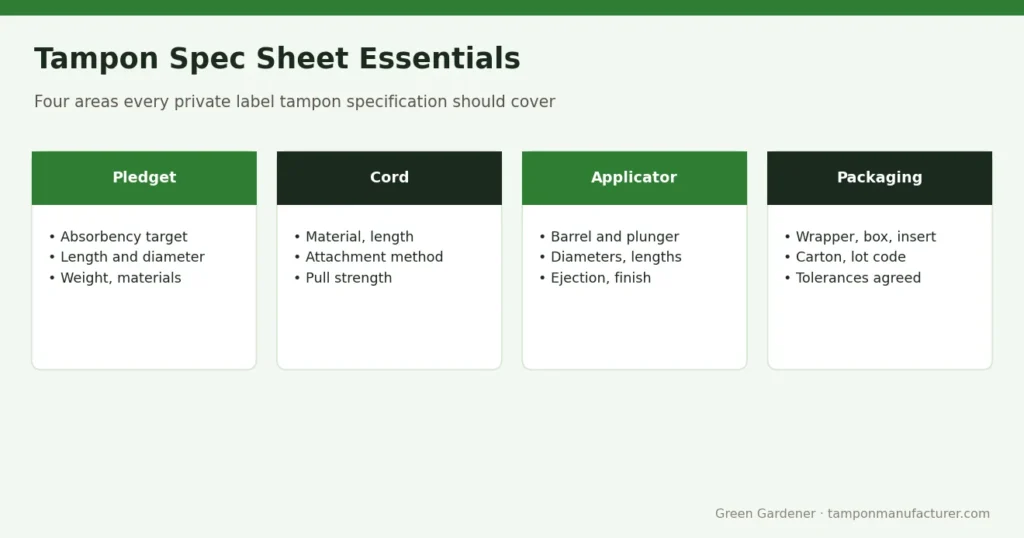
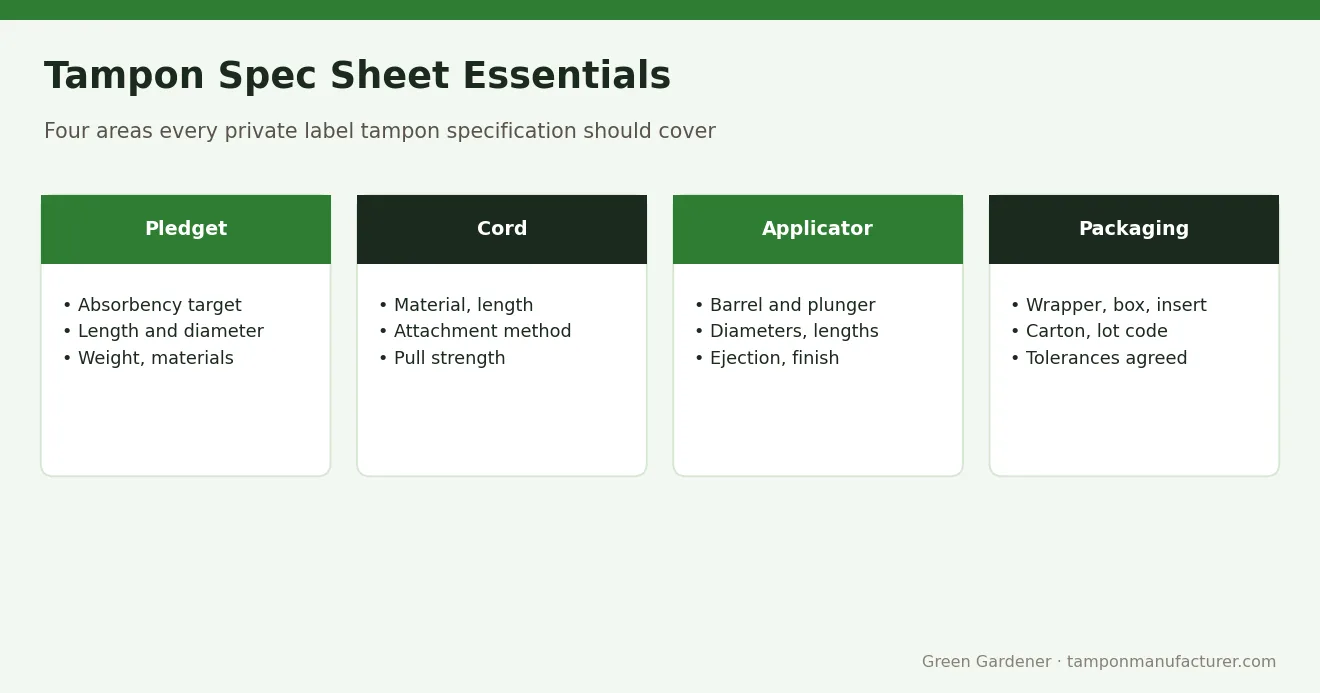
A tampon spec sheet records every measurable feature of your product so each lot matches the approved sample. It should cover the absorbent pledget (length, diameter, weight and absorbency range), the withdrawal cord, the applicator, the wrapper, materials and packaging, each with a target value and an agreed tolerance. Exact figures come from your approved samples and test results rather than a universal standard. This guide explains what to include and how to agree tolerances with your manufacturer.
Why a Spec Sheet Matters
When a brand approves a sample, it approves a set of physical properties. Without a written specification, “the same as the sample” is open to interpretation, and small drifts in width, cord length or absorbency can become complaints. A spec sheet turns the approved sample into measurable targets that the factory, the brand and any inspector can check.
The spec sheet also supports labeling. In the US, the absorbency term printed on the box must reflect syngina test results within the ranges set by FDA rule 21 CFR 801.430, so absorbency is the most important line in any tampon specification.
A good spec sheet is also a communication tool. It lets a new quality manager, an inspection company or a second production site understand exactly what the product should be without relying on memory or email threads. Brands that plan to add retailers or markets later find that a clear specification saves time in every supplier and buyer review.
Pledget Specifications
The pledget is the absorbent body of the tampon. Specify it per absorbency, because each size differs.
| Parameter | What to record | How it is checked |
|---|---|---|
| Absorbency term | Light, Regular, Super, Super Plus or Ultra | Syngina test against the labeled range |
| Absorbency target | Target grams within the labeled range | Syngina test, lot sampling |
| Length | Compressed length, target and tolerance | Calliper or gauge |
| Diameter | Compressed diameter, target and tolerance | Calliper or go/no-go gauge |
| Weight | Pledget weight, target and tolerance | Balance |
| Structure | Compressed, grooved or W-core design | Visual against reference sample |
| Materials | Core fibre and cover layer composition | Bill of materials, supplier documents |
The labeled ranges are fixed by regulation: Light up to 6 g, Regular 6–9 g, Super 9–12 g, Super Plus 12–15 g and Ultra 15–18 g. Your target should sit comfortably inside the range, not near its edge. Our syngina test guide explains how absorbency is measured.
Withdrawal Cord Specifications
The cord is a safety-critical component and deserves its own section. Record:
- Cord material and construction.
- Free cord length beyond the pledget, with tolerance.
- Attachment method, such as stitching through the pledget.
- Minimum pull strength and the test method used.
- Colour and any finish, where applicable.
Pull strength values and methods should be agreed between brand and manufacturer and verified during sampling. Our cord testing guide covers how this is checked.
Applicator Specifications
For applicator tampons, the applicator dimensions decide how the product feels to use and whether it ejects smoothly. Specify the outer barrel and inner plunger separately.
| Component | Key dimensions | Other details |
|---|---|---|
| Outer barrel | Length, outer diameter, tip design | Material, colour, finish, grip |
| Inner plunger | Length, diameter, extended length for compact types | Material, colour |
| Assembly | Total length as packed | Ejection force, fit between parts |
| Cardboard types | Tube lengths and diameters | Board grade, edge finish, coating |
Compact applicators also need the collapsed and extended lengths. For non-applicator tampons, specify tip shape and finger grip area instead. See our range of applicator tampons and cardboard tampons for available formats.
Setting Tolerances
A tolerance is the acceptable variation around a target. Every dimension needs one, and it must be realistic for the process and meaningful for the user. Tolerances that are too tight increase rejection without improving the product; tolerances that are too loose allow noticeable variation.
A practical approach is to measure a set of approved samples, review the factory’s normal process variation, and agree tolerances that capture good product while flagging real drift. Record whether each tolerance is a plus/minus value or a minimum or maximum limit, and which measurement tool is used. There is no single industry standard for tampon dimensional tolerances, so these figures are part of your agreement with the manufacturer.
It also helps to classify each parameter by importance. Absorbency, cord attachment and applicator edges are critical to safety and labeling and need the closest control and the most frequent checks. Overall length or box colour may be important for appearance but carry lower risk. Linking each parameter to a defect class makes the spec sheet directly usable for AQL inspection, because inspectors can see at once which deviations count as critical, major or minor, and how strictly each one should be judged during sampling.
Wrapper and Packaging Details
The spec sheet should also cover how the tampon is presented. Include:
- Wrapper material, dimensions, seal type, opening method and print.
- Retail box dimensions, board grade, count per box and insert leaflet.
- Mixed counts per absorbency for variety packs.
- Shipping carton dimensions, boxes per carton, gross weight and carton marks.
- Lot code format and position on box and carton.
Packaging details link to your artwork; see the packaging artwork checklist for the label content side.
Version Control and Change Approval
A spec sheet is a living document. Give it a version number and date, and require written approval for any change to materials, dimensions or suppliers of critical components. Store the approved reference samples with the same version number, so both sides can compare production against the physical standard as well as the written figures.
When the spec sheet changes, check whether labeling, test reports or regulatory files also need updating. Record the source of each critical material, such as the cotton or rayon fibre, cord yarn and applicator resin, so that supplier changes are visible and controlled. A change to the pledget material, for example, may affect absorbency results and supporting documentation in regulated markets.
For Brands: Building Your Spec Sheet With Us
As a factory-direct OEM manufacturer, we help private label brands translate approved samples into a clear specification. Samples are provided before bulk, and measurement data from approved samples forms the basis of your targets and tolerances. Supporting documentation is available on request, and final specifications are confirmed in your quotation and order documents.
A typical workflow looks like this:
- You share your target product, reference brand or draft specification.
- We propose suitable formats, materials and absorbencies and produce samples.
- You evaluate samples for fit, comfort and appearance and request adjustments.
- Approved samples are measured and tested to set targets and tolerances.
- The signed spec sheet and reference samples become the standard for bulk and inspection.
Request a Quote
Have a target product in mind? Send us your preferred absorbencies, applicator type and any existing specifications, and we will confirm options and samples in your quotation. Request a quote or contact us on WhatsApp at +86 173 1689 5054.
Frequently Asked Questions
What should a tampon specification sheet include?
A tampon spec sheet should cover the pledget (absorbency term and target, length, diameter, weight, structure and materials), the withdrawal cord, the applicator or non-applicator tip, the wrapper, retail packaging, shipping cartons and lot coding. Each measurable item needs a target value, a tolerance and the test or measurement method used.
Is there a standard size for tampons?
There is no single universal standard for tampon length or diameter. Absorbency terms are regulated, for example under FDA rule 21 CFR 801.430 in the US, but physical dimensions vary by brand and design. Dimensions in your spec sheet should come from measurements of the samples you approve with your manufacturer.
How are tolerances for tampon dimensions decided?
Tolerances are agreed between brand and manufacturer. A common approach is to measure approved samples, review normal process variation, and set limits that accept good product while flagging real drift. Each tolerance should state whether it is a plus/minus value or a minimum or maximum, and which measuring tool applies.
Why does the absorbency target matter so much?
The absorbency term printed on the box must match syngina test results within the regulated range for that term. If production drifts outside the range, the label becomes inaccurate. Setting a target well inside the range, and testing lots regularly, protects both labeling compliance and consistent user experience.
Should the spec sheet be updated after launch?
Yes. Treat it as a controlled document with version numbers and dates. Any change to materials, dimensions or critical component suppliers should be approved in writing and checked for effects on absorbency, testing and labeling. Keep approved reference samples matched to each version so production can be compared physically.
Request a Tampon or Pad Quote
Tell us the product, quantity and your market. We reply with options, pricing and sample steps. Prefer chat? WhatsApp +86 173 1689 5054.