
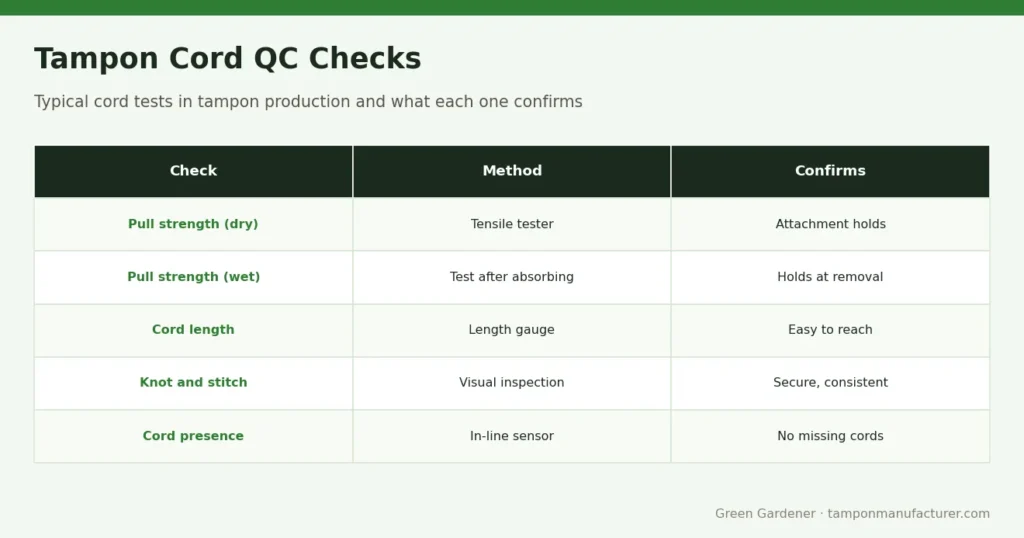
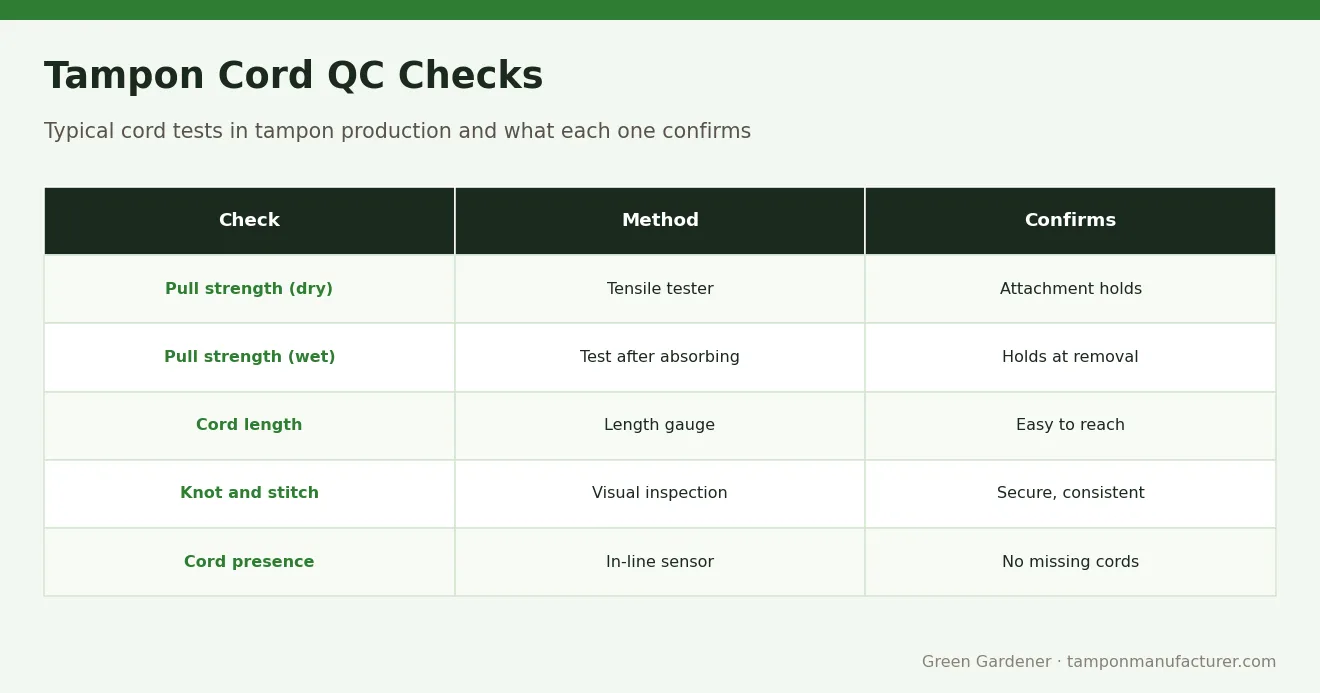
Tampon withdrawal cord testing checks two things: that the cord itself is strong enough, and that it is securely attached to the absorbent core so the tampon can always be removed in one piece. Factories use tensile pull tests on dry and wetted samples, visual and dimensional checks on stitching and knots, and statistical sampling during production. Pass limits are set in the product specification. This guide explains how cords are attached, how testing works, common defects and what buyers should ask for.
Why the Withdrawal Cord Matters
The withdrawal cord is a small component with a critical job. If it breaks, detaches or is too short to reach, a user may be unable to remove the tampon herself and may need medical help. Cord failures are also among the complaints most likely to damage trust in a brand. For these reasons, cord strength and attachment are treated as critical quality characteristics, not cosmetic ones.
FDA guidance for menstrual tampon 510(k) submissions refers to performance testing that includes the integrity of the tampon and its string. Requirements and recommended methods can change, so check current FDA requirements and the guidance applicable in each of your markets.
How Cords Are Made and Attached
Cords are typically twisted or braided yarns, often cotton or a cotton and polyester blend, sometimes treated to resist wicking. Organic cotton tampon lines usually specify an organic cotton cord as well. Cord color is normally white or undyed, and any dye or finish should be documented as part of the material file. The cord is joined to the absorbent pad before the pad is compressed into its final shape.
| Attachment method | How it works | Key control points |
|---|---|---|
| Sewn through pad | Cord is stitched along or through the fiber pad | Stitch length, needle condition, thread tension |
| Loop and knot | Cord loops around the pad and is knotted at the end | Knot type, knot position, tail length |
| Chain stitch | Continuous stitch that also forms the cord | Stitch count, thread continuity |
| Combined | Stitched and knotted for redundancy | Both stitch and knot checks |
Each method can perform well when the machine is set correctly and monitored. Learn more about the full process in how tampons are manufactured.
Pull Strength Testing
Pull strength testing measures the force needed to separate the cord from the tampon or to break the cord. A typical procedure looks like this:
- Remove the tampon from its applicator or wrapper without stressing the cord.
- Clamp the tampon body in a fixture so the cord exits freely.
- Attach the cord to the moving grip of a calibrated tensile tester or force gauge.
- Pull at a controlled speed until the cord breaks, detaches or reaches the specified hold force.
- Record the peak force and the failure mode: cord break, stitch pull-out, knot slip or pad tear.
The pass limit and test speed are defined in the product specification and agreed with the buyer. Recording the failure mode is as important as the number. A cord that breaks at high force is a different issue from a stitch that pulls out of the pad at lower force.
Wet Testing and Attachment Integrity
Cords must hold when the tampon is saturated, not only when dry. Many factories therefore run pull tests on tampons after they have absorbed test fluid, for example after a syngina absorbency test, to simulate removal conditions. Wet fibers can loosen and wet stitches can behave differently from dry ones.
Other integrity checks include:
- Cord length – measured from the base of the tampon to the cord end, within specified tolerance.
- Knot security – visual check that knots are tight and tails are trimmed consistently.
- Stitch placement – stitching runs the required length of the pad and is centered.
- Pad integrity on removal – fibers stay together and the cover does not shed excessively.
- Applicator interaction – the cord exits the plunger freely and is not pinched or cut.
Common Cord Defects and Their Causes
| Defect | Likely cause | Detection |
|---|---|---|
| Cord detaches under low force | Missed or short stitching | Pull test, stitch inspection |
| Knot slips | Wrong knot or loose tension | Pull test, visual check |
| Cord too short | Feed or cutting error | Length gauge |
| Frayed or cut cord | Worn blade or sharp applicator edge | Visual check, applicator review |
| Missing cord | Supply break on machine | In-line sensor, visual check |
| Cord trapped in plunger | Assembly misalignment | Assembly check |
A missing or detached cord is usually classed as a critical defect, with the tightest acceptance criteria in the inspection plan.
QC Sampling During Production
Cord testing is partly destructive, so it relies on sampling rather than testing every tampon. Factories commonly combine:
- Machine controls – in-line sensors that stop the machine or reject product when the cord is missing.
- Start-up checks – pull and length tests after setup, changeovers and maintenance.
- Periodic in-process checks – samples taken at fixed intervals during each shift.
- Final inspection – sampling of finished lots, often using plans based on ISO 2859-1 or ANSI/ASQ Z1.4 with acceptance levels agreed with the buyer.
Results should be recorded against lot codes so any issue can be traced to a specific machine, shift and material batch. Agree sampling levels and defect classifications in writing before mass production, rather than relying on general statements of quality.
Trend data is useful too. If pull results drift downward over a shift, even while still passing, it can signal needle wear, a tension change or a new yarn batch. Reviewing control charts rather than single pass or fail results lets the factory correct the cause before defects appear in finished product. Test equipment should also be calibrated on a schedule, with records available for review.
What Buyers Should Specify and Request
To make cord quality measurable, include these points in your specification and quality agreement:
- Cord material, color and any treatment, with supplier documentation.
- Attachment method and cord length with tolerance.
- Pull test method, speed, dry and wet conditions and pass criteria.
- Defect classification for cord issues and agreed sampling plan.
- Records to share: test results by lot, calibration status of test equipment and complaint trend data.
Our guides on quality control documentation and verifying a tampon manufacturer explain how to review these records during supplier selection and before shipment.
For Brands: Building Cord Quality Into Your Program
Cord quality is easiest to manage when it is designed in from the start. We manufacture applicator tampons and non-applicator tampons with conventional or organic cotton cores and cords, using controlled attachment and in-process pull and length checks. With 15+ years of experience and a 52,000 m² factory, we can share our inspection approach and provide test documentation on request. Samples are available for your own evaluation before bulk production, so your team or a third-party inspector can run independent pull tests.
Request a Quote
Send your tampon specification, including cord material and testing requirements, through our contact page or WhatsApp +86 173 1689 5054. Order quantities, pricing and schedules are confirmed in your quotation.
Frequently Asked Questions
What is a tampon withdrawal cord pull test?
It is a test in which the tampon body is clamped and the cord is pulled with a calibrated force gauge or tensile tester until it breaks, detaches or reaches a specified force. The peak force and the failure mode are recorded and compared with the pass limit in the product specification.
Why test cords on wet tampons?
Tampons are removed when saturated, and wet fibers and stitches can behave differently from dry ones. Testing after the tampon has absorbed fluid gives a more realistic view of attachment strength at the moment of removal. Many quality plans include both dry and wet pull tests.
Is there a fixed regulatory value for cord strength?
Pass criteria are generally set in the product specification and supported by test data, rather than being a single universal number. FDA guidance for tampon 510(k) submissions refers to tampon and string integrity testing. Check current FDA requirements and the rules in each target market for your product.
How are cord defects classified in inspections?
Missing or detached cords are usually treated as critical defects because they can prevent safe removal. Short, frayed or trapped cords are often classed as major defects. The exact classification and acceptance levels should be agreed between buyer and manufacturer and written into the inspection plan.
Can you share cord test records for my order?
Yes. We provide cord pull and length test records and related quality documentation on request, linked to lot codes. Samples are available before bulk production so you or a third-party inspector can carry out independent testing, and order terms are confirmed in your quotation.
Request a Tampon or Pad Quote
Tell us the product, quantity and your market. We reply with options, pricing and sample steps. Prefer chat? WhatsApp +86 173 1689 5054.