

Incoterms are standard trade rules published by the International Chamber of Commerce that define who pays for transport, who handles customs and where risk passes from seller to buyer. The current edition is Incoterms 2020. For tampon imports from China, the most common choices are FOB, CIF and DDP, with FCA and EXW used by experienced importers. The best term depends on your freight set-up, import capability and how much control you want. This guide explains each option.
Why Incoterms Matter in a Tampon Quotation
Two quotations for the same tampons can look very different simply because they use different Incoterms. One price may stop at the factory gate while another includes ocean freight and insurance to your port. Without understanding the term, you cannot compare offers or calculate landed cost properly.
Incoterms cover delivery, risk and cost allocation between seller and buyer. They do not decide payment terms, ownership of goods, or what happens if a contract is breached; those belong in your sales contract. Always name the term, the named place and the edition, for example “FOB Xiamen, Incoterms 2020”.
The Eleven Incoterms 2020 Rules
Incoterms 2020 contains eleven rules in two groups. Seven can be used for any mode of transport, and four are designed for sea and inland waterway transport only.
| Group | Rules | Typical use |
|---|---|---|
| Any mode | EXW, FCA, CPT, CIP, DAP, DPU, DDP | Containers, air, multimodal |
| Sea and inland waterway | FAS, FOB, CFR, CIF | Port-to-port shipments |
The 2020 edition replaced DAT with DPU (Delivered at Place Unloaded) and raised the default insurance level under CIP. Tampon buyers rarely need all eleven rules, but knowing the groups helps you choose sensibly.
Comparing Common Terms for Tampon Orders
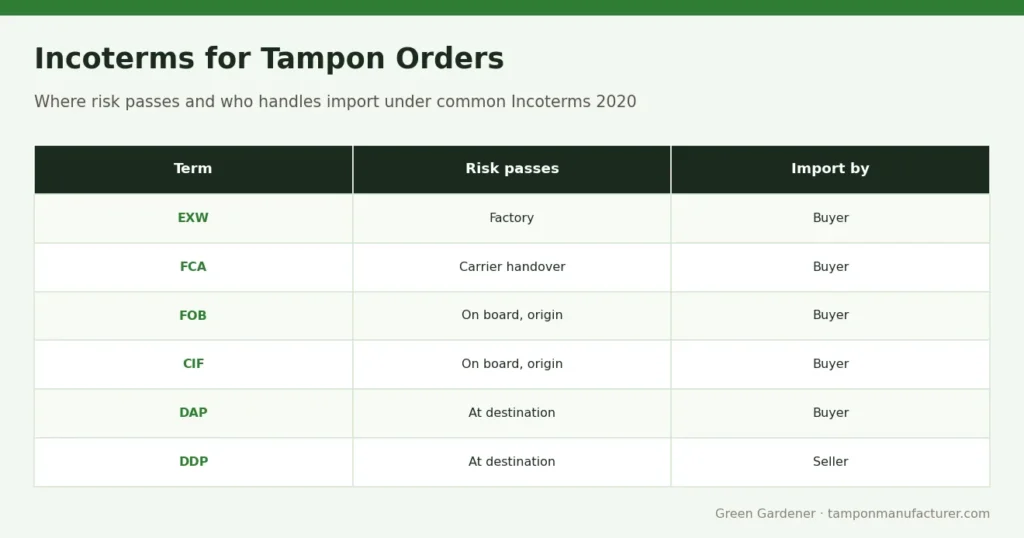
This table summarises where the main costs and risks sit under the terms most often used for tampon imports.
| Term | Seller arranges | Risk passes to buyer | Buyer handles |
|---|---|---|---|
| EXW | Goods ready at factory | At seller’s premises | Loading, export, freight, import |
| FCA | Export clearance, handover to carrier | On handover at named place | Main freight, import |
| FOB | Export clearance, loading on vessel | Goods on board at origin port | Ocean freight, insurance, import |
| CIF | Freight and minimum insurance to port | Goods on board at origin port | Destination charges, import |
| DAP | Transport to named destination | At destination, ready to unload | Unloading, import clearance, duty |
| DDP | Everything incl. import duty | At destination, ready to unload | Unloading |
Note that under CIF the seller pays freight to your port, but risk still transfers when goods are loaded at origin. Damage at sea is a matter for the insurance, not the seller.
FOB and FCA: Buyer-Controlled Freight
FOB (Free On Board) is the most familiar term in Asian sourcing. The seller clears the goods for export and loads them on the vessel your forwarder has booked. From that point, you control freight costs, transit time and the choice of carrier.
The ICC notes that FOB fits goods loaded directly on board and that FCA is often more suitable for containerised cargo handed over at a terminal or warehouse before loading. FCA lets risk pass at that handover point, which reflects how containers are actually handled.
- Choose FOB or FCA if you have a trusted forwarder and want visibility over freight.
- Confirm the named port or place precisely in the quotation.
- Arrange cargo insurance yourself, as it is not included.
EXW sits at the other extreme: the seller only makes goods available at its premises, and the buyer handles loading and export formalities. Because export clearance in China is normally handled by the exporter, EXW can create practical problems for foreign buyers, which is why FCA is often recommended as a cleaner alternative.
CIF and CFR: Seller-Booked Freight
Under CFR the seller pays freight to your destination port; under CIF the seller also buys insurance. CIF insurance only needs to meet minimum cover (Institute Cargo Clauses C) unless you agree otherwise, which may not cover all risks. If you rely on the seller’s insurance, ask for the policy details and consider requesting broader cover in the contract.
CIF can be convenient for first-time importers who do not yet have a forwarder. The trade-off is less control over destination charges, which some carriers set high. Ask your local agent what charges to expect at arrival before accepting a CIF offer.
DAP and DDP: Delivered Terms
Delivered terms move more responsibility to the seller. Under DAP, the seller delivers to your named place, and you clear customs and pay duty. Under DDP, the seller also acts as importer and pays duties and taxes, so the price is close to landed cost.
DDP sounds simple but needs care for tampons. In regulated markets the importer of record has legal duties, for example FDA-related obligations for devices in the US. The seller may not be able to act as importer in every country, and DDP prices include assumptions about duty that can change. Many brands prefer DAP, keeping import clearance under their own broker. Our FDA import requirements guide explains US importer responsibilities.
How to Choose the Right Incoterm
Use these questions to narrow your choice:
- Do you have a freight forwarder you trust? If yes, FOB or FCA usually gives the best control.
- Is this a first small order without a forwarder? CIF or DAP can simplify logistics.
- Can you act as importer of record with the right registrations? If not, solve that first, as DDP is not a shortcut around regulation.
- How will you pay? Letters of credit commonly work with FOB, CFR and CIF documents.
For payment options and how they interact with shipping documents, read our guide to tampon manufacturer payment terms, and see MOQ and pricing in tampon manufacturing for other factors behind a quote.
For Brands: Incoterms in Our Quotations
As a factory-direct manufacturer, we quote tampon orders under the Incoterm that fits your logistics. Tell us whether you work with your own forwarder or prefer us to arrange freight, and we will confirm the term, named place and inclusions in your quotation. Documents such as the commercial invoice and packing list are prepared for each shipment. Learn more about our private label tampon programme.
Whatever term you choose, write it into the purchase order and pro forma invoice exactly as quoted, with the named place and edition. If you change from FOB to CIF or DAP later, ask for a revised quotation, because freight, insurance and destination costs alter the price basis. Clear terms at the start prevent most disputes about who pays for what when the shipment arrives.
Request a Quote
Send us your destination, estimated volume and preferred Incoterm, and we will confirm pricing basis and shipping terms in your quotation. Samples are available before bulk. Request a quote or message us on WhatsApp at +86 173 1689 5054.
Frequently Asked Questions
Which Incoterm is best for importing tampons from China?
There is no single best term. FOB or FCA suits buyers with their own forwarder who want control over freight. CIF or DAP can suit first-time importers. DDP gives a near landed price but needs care where the importer of record has regulatory duties. Choose based on your logistics capability and market rules.
What is the difference between FOB and CIF?
Under FOB the buyer books and pays ocean freight and insurance, and risk passes when goods are loaded on board at origin. Under CIF the seller pays freight and minimum insurance to the destination port, but risk still passes at loading. CIF adds convenience; FOB gives the buyer more control over freight.
Is DDP a good option for tampons?
DDP can simplify buying because the seller handles import duty and taxes. However, tampons are regulated products, and the importer of record carries legal responsibilities in markets such as the US. The seller may not be able to act as importer everywhere. Many brands prefer DAP with their own customs broker instead.
Do Incoterms cover payment terms?
No. Incoterms define delivery, risk transfer and who pays which transport and customs costs. They do not set payment method, transfer of ownership or remedies for breach. Payment terms such as T/T deposits or letters of credit must be agreed separately in your sales contract alongside the chosen Incoterm.
Which Incoterms edition should we use?
Incoterms 2020 is the current edition published by the International Chamber of Commerce. Contracts should state the edition explicitly, for example “FOB Xiamen, Incoterms 2020”, so both parties apply the same rules. Older editions can still be used if named, but mixing editions or omitting the edition can cause disputes.
Request a Tampon or Pad Quote
Tell us the product, quantity and your market. We reply with options, pricing and sample steps. Prefer chat? WhatsApp +86 173 1689 5054.