

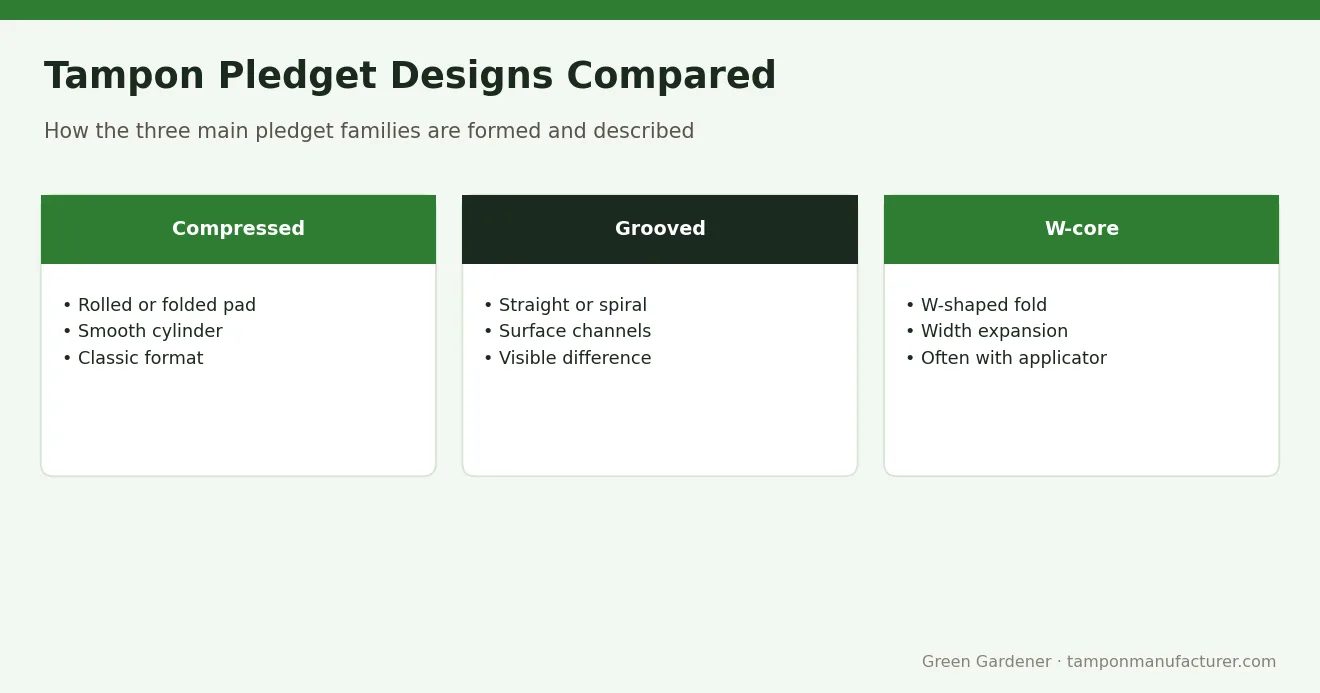
The pledget is the absorbent part of a tampon, and its design affects how it looks, how it feels to insert and how it is described to expand. Most pledgets start as a pad of cotton, rayon or a blend that is rolled or folded and then compressed into a cylinder. Grooved designs add channels pressed into the surface, while W-core designs fold the pad into a W shape before compression. Whatever the design, absorbency is labeled by the same standard terms. This guide compares the main options.
What a Pledget Is
A tampon has three main parts: the absorbent pledget, the withdrawal cord and, for applicator tampons, the applicator. The pledget usually consists of an absorbent core of cotton, viscose rayon or a blend, sometimes wrapped in a thin nonwoven cover layer that helps keep fibres in place and gives a smoother surface.
During manufacturing, a measured pad of fibre is formed, the cord is attached, and the pad is rolled or folded and then pressed in a mould into its final compressed shape. The way the pad is arranged before compression, and the shape of the mould, define the pledget design. For an overview of the full process, see how tampons are manufactured.
The Main Pledget Designs at a Glance
Manufacturers use many variations, but most pledgets fall into a few families. The descriptions below are general and reflect how these designs are commonly presented, rather than performance guarantees.
| Design | How it is formed | How it is commonly described |
|---|---|---|
| Compressed (standard) | Pad rolled or folded and pressed into a smooth cylinder | Simple, compact and widely used |
| Grooved | Compressed with longitudinal or spiral grooves in the surface | Grooves said to guide fluid and aid even expansion |
| W-core | Pad folded into a W shape before compression | Often described as expanding more in width |
| Wrapped or layered | Core with an outer cover or secondary layer | Smoother surface, may help hold fibres |
Each design is available at multiple absorbency levels, from Light to Ultra, by changing the amount of fibre and the dimensions.
Compressed Pledgets
The standard compressed pledget is the most familiar design. A rectangular pad is rolled or folded, then compressed radially or lengthwise into a firm, smooth cylinder with a rounded tip. As it absorbs fluid, the fibres relax and the tampon expands.
Compressed pledgets are used in both applicator and non-applicator (digital) tampons. They are efficient to produce and easy to pack, and they suit brands looking for a classic, dependable format. Variations include the shape of the tip, the firmness of compression and whether a cover layer is used.
Because the design is straightforward, compressed pledgets are also a practical starting point for new brands. They can be produced consistently across the full absorbency range, which makes it easier to build a coherent line with uniform packaging and to add grooved or W-core options later as the brand grows.
Grooved Pledgets
Grooved pledgets have channels pressed into the surface during compression. The grooves may run straight along the length of the tampon or spiral around it. Manufacturers commonly describe grooves as helping to guide fluid along the surface and to support more even expansion, and the visual difference is useful for brands that want a recognisable product.
- Longitudinal grooves – straight channels from tip to base.
- Spiral grooves – channels that twist around the pledget.
- Groove depth and number – vary between designs and are set by the mould.
Grooved pledgets are common in non-applicator tampons and also appear in applicator formats. Groove geometry is part of the product specification and should be agreed with your manufacturer.
W-Core Pledgets
In a W-core design, the absorbent pad is folded into a W or similar multi-fold shape before compression. Because of the folded structure, W-core pledgets are often described as opening out in width as they absorb, which some brands use to communicate a comfortable, adaptive fit.
W-core designs are usually combined with plastic or compact applicators. They can be offered at several absorbencies, and the fold pattern, cover layer and compression level can be adjusted. You can see this format on our W-core applicator tampons page.
As with all designs, any claims about leak protection or fit should be supported by appropriate testing, such as wear panels, before they appear on packaging.
Pairing Pledget Designs With Applicators
The pledget and the applicator work as a system. The applicator barrel must hold the compressed pledget securely, release it smoothly when the plunger is pressed, and position it correctly. That means pledget diameter, length and firmness are matched to the barrel and plunger dimensions during development.
| Format | Common pledget pairings | Points to check |
|---|---|---|
| Plastic applicator | Compressed, grooved, W-core | Smooth ejection, tip petals |
| Compact applicator | Compressed, W-core | Pledget length to suit telescoping plunger |
| Cardboard applicator | Compressed, grooved | Fit in tube, paper edge finish |
| Non-applicator | Grooved, compressed with rounded tip | Firm shape, finger grip area |
Non-applicator tampons rely on the pledget itself for insertion, so firm compression, a rounded tip and grooves that provide grip are especially common. Explore our non-applicator tampons for this format.
What Stays the Same Across Designs
Pledget design changes construction and appearance, but some fundamentals do not change:
| Topic | Applies to every design |
|---|---|
| Absorbency labeling | In the US, terms such as Regular or Super follow syngina ranges under 21 CFR 801.430 |
| TSS information | Package and insert carry Toxic Shock Syndrome information |
| Usage guidance | Use the lowest absorbency needed and follow the package insert |
| Materials | Cotton, rayon or blends, documented in the product specification |
| Testing | Absorbency, cord strength and safety testing as required by the market |
Consumers should choose by absorbency first, then by comfort and preference, and consult a doctor if they have health concerns. Our guide to tampon absorbency levels explains the label terms.
For Brands: Choosing a Pledget Design
The right pledget design depends on your positioning, applicator choice and range plan. Consider these points when briefing a manufacturer:
- Which applicator types you want, as some designs pair more naturally with certain applicators.
- Which absorbencies you need, and whether one design should run across the whole range.
- Whether you want a visible point of difference, such as grooves, for packaging and marketing.
- Material preferences, such as organic cotton or cotton and rayon blends.
- What claims you plan to make, and what testing will support them.
Sampling several designs side by side is the best way to decide. We offer compressed, grooved and W-core options across applicator formats, with samples before bulk; details are confirmed in your quotation.
Request a Quote
Want to compare pledget designs for your brand? Tell us your preferred applicator type, absorbencies and materials, and we will confirm suitable designs and sample options in your quotation. Request a quote or message us on WhatsApp at +86 173 1689 5054.
Frequently Asked Questions
What is a tampon pledget?
The pledget is the absorbent body of a tampon, usually made from cotton, rayon or a blend and sometimes covered by a thin nonwoven layer. It is formed from a pad of fibre that is rolled or folded, attached to the withdrawal cord and compressed into its final shape before being packed with or without an applicator.
Are grooved tampons more absorbent?
Not necessarily. Absorbency depends mainly on the amount and type of fibre, and it is measured and labeled using standard terms such as Regular or Super. Grooves are commonly described as helping guide fluid and support even expansion, but the absorbency term on the box is the reliable way to compare tampons.
What is a W-core tampon?
A W-core tampon has an absorbent pad folded into a W or multi-fold shape before compression. This design is often described as expanding more in width as it absorbs. It is usually combined with plastic or compact applicators and can be produced at several absorbency levels, labeled with the standard terms.
Which pledget design is best?
There is no single best design. Compressed, grooved and W-core pledgets each suit different preferences and brand positions. Users should choose by absorbency first, using the lowest absorbency needed, then by comfort. They should follow the package insert and speak to a doctor about any health concerns.
Can a brand choose its own pledget design?
Yes. Private label brands can usually choose between pledget designs, materials and absorbencies, and pair them with their preferred applicator. Sampling several designs side by side helps the decision. Any marketing claims about fit or leakage should be backed by suitable testing before they appear on packaging or listings.
Request a Tampon or Pad Quote
Tell us the product, quantity and your market. We reply with options, pricing and sample steps. Prefer chat? WhatsApp +86 173 1689 5054.