
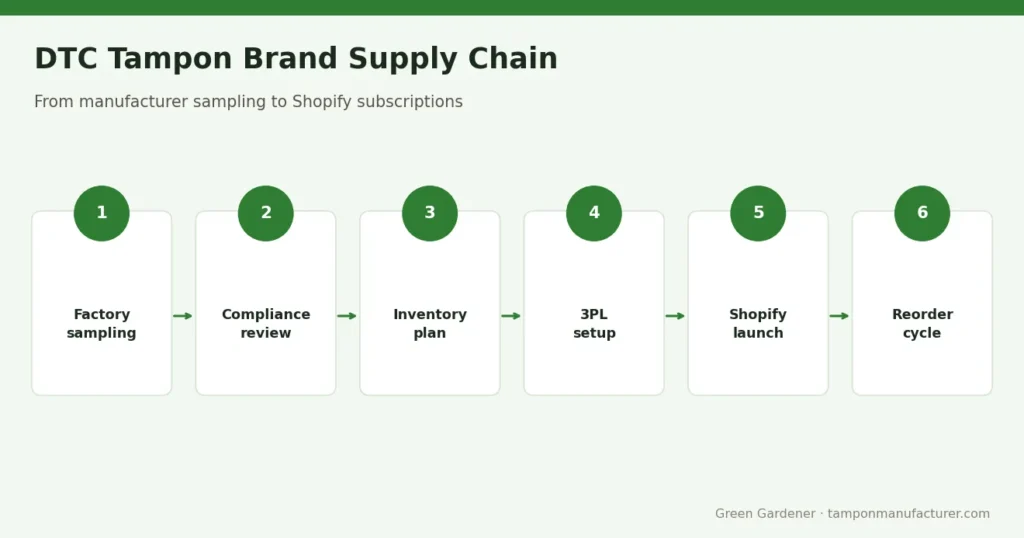

Launching a direct-to-consumer tampon brand on Shopify takes more than a good website. You need a reliable manufacturer, compliant product and packaging, an inventory plan that avoids stockouts, a fulfilment partner that stores and ships correctly, and a reorder process that supports subscriptions. As a factory-direct OEM manufacturer of private label tampons, we work with online brands from sampling to bulk production. This checklist walks through each stage so founders can plan their supply chain with confidence.
Why Supply Chain Planning Comes First
Many DTC founders start with branding, website design and social media, then discover that manufacturing, compliance and logistics take longer than expected. Tampons are a regulated product in many markets, and consumers expect consistent quality every month. A stockout in month three, a labeling problem flagged by a marketplace or a damaged shipment can undo months of marketing work.
Planning the supply chain early protects your launch. It sets realistic timelines, reveals the real landed cost per box and shows how much cash is tied up in inventory. It also shapes your website: delivery promises, subscription options and product pages all depend on what your supply chain can reliably deliver. The checklist below follows the order in which most brands make decisions, from choosing a manufacturer to running ongoing replenishment.
Step 1: Choose and Verify Your Manufacturer
Your manufacturer determines product quality, documentation and how smoothly reorders run. When evaluating suppliers, look at:
- Product range: applicator types, absorbencies and materials that match your plan, such as organic cotton options.
- Documentation: test reports, specifications and quality records available on request.
- Sampling process: samples before bulk production, with a clear approval step.
- Packaging support: private label boxes, inserts and wrappers in your branding.
- Communication: clear contacts for orders, artwork and quality questions.
We have more than fifteen years of experience and have supplied over 500 clients from a 52,000 m² factory. Our guide on how to request private label tampon samples explains what to ask for at the first stage.
Step 2: Compliance Basics for Your Market
Compliance responsibilities depend on where you sell and how your business is structured. For the United States, tampons are medical devices regulated by FDA. Unscented menstrual tampons are classified under 21 CFR 884.5470 and scented tampons under 21 CFR 884.5460, both Class II, and labeling must follow 21 CFR 801.430, including absorbency terms and toxic shock syndrome information. Check current FDA requirements for premarket notification, registration and listing with a qualified regulatory adviser.
| Area | What to confirm | Who helps |
|---|---|---|
| Federal rules | Device classification, labeling, import | Regulatory adviser |
| State rules | Ingredient disclosure and chemical rules | Compliance counsel |
| Claims | Organic, natural, eco wording | Compliance counsel |
| Documentation | Test reports, specifications | Manufacturer |
Some states, including New York and California, have menstrual product ingredient disclosure laws, and further state rules continue to develop. Our article on FDA requirements for importing tampons covers the import side.
Step 3: Plan Your Launch Inventory
Inventory planning is a balance between running out and tying up too much cash. Start with a forecast based on your marketing plan, then add safety stock to cover production and shipping time for the next order. Remember that DTC demand can spike suddenly after a campaign or influencer post.
- Estimate monthly unit sales per SKU for the first months.
- Add the full replenishment cycle: production, inspection, shipping and customs.
- Set a safety stock level and a reorder point for each SKU.
- Limit SKUs at launch to keep stock concentrated on best sellers.
- Review actual sales monthly and adjust the next order.
Production timing and order quantities depend on your specification and are confirmed in your quotation, so ask for them early and build them into your forecast.
Step 4: Choose a 3PL and Fulfilment Setup
Most growing DTC brands use a third-party logistics provider (3PL) to receive, store and ship orders. Shopify connects with many 3PLs, so orders flow automatically from your store to the warehouse. When choosing a partner, check:
| Question | Why it matters |
|---|---|
| Is storage clean, dry and temperature-stable? | Protects packaging and product |
| Can they track lot codes? | Supports traceability and recalls |
| Do they handle subscriptions and kitting? | Bundles and inserts packed correctly |
| What are receiving requirements? | Carton labels and pallet specs from the factory |
| How are returns handled? | Hygiene products are usually not resold |
Share the 3PL’s receiving requirements with your manufacturer before the first shipment, so cartons arrive labelled and palletised the way the warehouse expects.
Step 5: Set Up Subscriptions and Reorders
Subscriptions suit tampons well because usage is regular and predictable. They give you recurring revenue and better demand data, but they also require dependable stock. A subscription customer who receives a late or incomplete box is likely to cancel.
Design subscription bundles around your SKUs, such as a single-absorbency box or a mixed set, and make it easy to change absorbency or skip a delivery. Use subscription data to refine your forecast and reorder points. Our tampon subscription box guide explains how to build the offer and choose box contents, and how manufacturers can support kitting for mixed bundles.
Step 6: Product Pages and Customer Information
Your Shopify product pages should reflect the same facts as your packaging: absorbency terms, materials, applicator type and count. Keep claims consistent with the evidence you hold, and avoid wording such as “toxin-free” or “safest” that you cannot substantiate. Many brands add a page with tampon safety information, including toxic shock syndrome information that matches the package insert, and encourage users to follow package instructions and consult a doctor with health questions.
Clear content reduces customer service questions and returns. Product photos should show the actual box and wrapper, and any change to packaging should be updated on the site at the same time.
Think about the questions first-time buyers ask before they switch brands: what the tampon is made of, how the applicator feels, which absorbency to choose and how the box is delivered. A short absorbency guide, an FAQ block and discreet-shipping information answer most of them. If you sell into more than one country, keep a separate version of each product page that matches the label used in that market, because absorbency terms and required statements can differ.
For Brands: Your DTC Supply Chain Checklist
- Manufacturer selected, samples approved and specifications signed
- Label, insert and claims reviewed for each target market
- Launch inventory and reorder points set per SKU
- 3PL selected, receiving requirements shared with the factory
- Subscription bundles and kitting rules defined
- Product pages aligned with packaging and documentation
You can explore formats and applicator options on our private label tampons page.
Request a Quote
Tell us your target market, product range, packaging plans and expected launch timing, and we will prepare samples and a quotation for your DTC brand. Contact our team through the contact page or on WhatsApp at +86 173 1689 5054.
Frequently Asked Questions
Do I need FDA clearance to sell tampons on Shopify in the US?
Tampons are regulated by FDA as Class II medical devices, and the selling channel does not change that. Premarket notification, registration, listing and labeling requirements depend on your product and business role. Check current FDA requirements with a qualified regulatory adviser before launch, and work with a manufacturer that can provide documentation.
How much inventory should a new DTC tampon brand order?
There is no single answer. Base your first order on a realistic sales forecast, the full replenishment cycle and a safety stock buffer. Order quantities and production timing depend on your specification and are confirmed in your quotation, so build them into your forecast from the start.
Should I use a 3PL or ship orders myself?
Many brands ship from home or an office at the very start, then move to a 3PL as volume grows. A 3PL offers integrated Shopify fulfilment, scalable storage and faster shipping. Choose one with clean, dry storage, lot tracking and experience with subscriptions and kitting.
Can the manufacturer ship directly to my 3PL?
Yes. Share your 3PL’s receiving requirements, such as carton labels, pallet specifications and booking procedures, with us before the first shipment. We prepare cartons accordingly, and shipping terms and arrangements are agreed in your quotation and order documents. Clear instructions at this stage help avoid delays and extra handling fees at the warehouse.
What product page information should a tampon brand include?
Include absorbency terms, materials, applicator type, count and toxic shock syndrome information consistent with your package insert. Encourage users to read package instructions and consult a doctor with health questions. Keep marketing claims consistent with the evidence you hold, and update pages whenever packaging changes.
Request a Tampon or Pad Quote
Tell us the product, quantity and your market. We reply with options, pricing and sample steps. Prefer chat? WhatsApp +86 173 1689 5054.