

AQL inspection is a statistical method for checking a production lot by examining a random sample instead of every unit. For tampons, buyers or third-party inspectors usually follow ISO 2859-1 (equivalent in practice to ANSI/ASQ Z1.4), choose an inspection level, and set separate acceptance limits for critical, major and minor defects. If the defects found stay within the limits, the lot is accepted. This guide explains how sampling works and how to build a tampon-specific defect list.
What AQL Means
AQL stands for Acceptance Quality Limit (often still called Acceptable Quality Level). It is the worst process average of defects that a buyer is prepared to tolerate when lots are inspected using a sampling plan. AQL does not mean a lot is guaranteed to contain fewer defects than the limit; it is a sampling plan designed so that lots at or better than the limit are accepted most of the time.
Pre-shipment inspection with AQL sampling is a final check, not a substitute for in-process quality control. Factory controls during production, such as absorbency checks, cord testing and line inspection, determine actual quality. AQL inspection verifies that a finished lot is consistent with the agreed specification before it leaves the factory.
How ISO 2859-1 Sampling Works
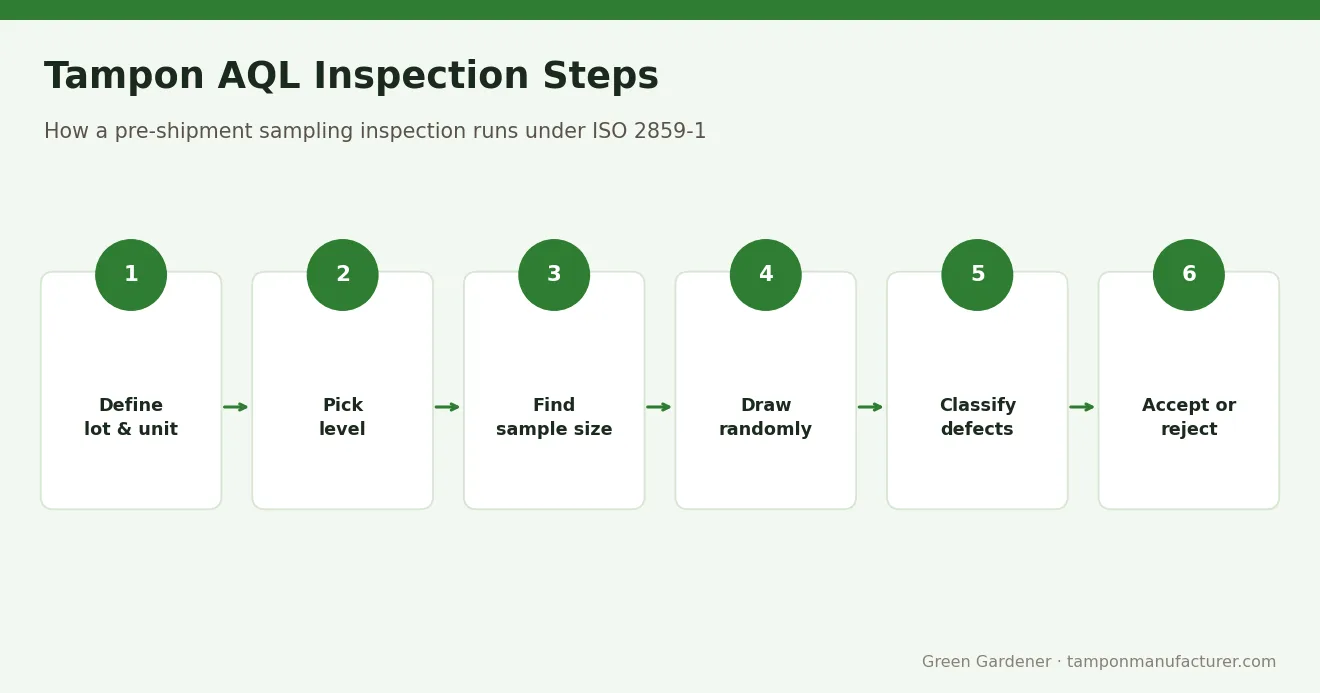
ISO 2859-1 links lot size and inspection level to a sample size code letter, then links that letter and the chosen AQL to accept and reject numbers. The process follows a clear sequence:
- Define the lot and the inspection unit, for example one retail box or one tampon.
- Choose the inspection level, usually General Level II.
- Find the sample size code letter from the lot size.
- Read the sample size and accept/reject numbers for each AQL.
- Draw the sample randomly from across the lot.
- Inspect, classify defects and compare totals with the limits.
As an example from the standard’s tables, a lot of 3,201 to 10,000 units at General Level II gives code letter L and a sample of 200 units. At AQL 2.5 the lot is accepted with up to 10 defects and rejected at 11; at AQL 4.0 the limits are 14 and 15. Always confirm values against the current standard or your inspector’s tables.
Inspection Levels Explained
Inspection levels change the sample size relative to the lot size. Higher levels inspect more units and give better discrimination between good and poor lots.
| Level | Sample size | Typical use |
|---|---|---|
| General I | Smaller | Stable suppliers, low-risk checks |
| General II | Standard | Default for most pre-shipment inspections |
| General III | Larger | New suppliers or quality concerns |
| Special S-1 to S-4 | Very small | Destructive or costly tests such as absorbency |
Special levels are useful for tampons because some checks destroy the sample, such as syngina absorbency testing or cord pull tests. Buyers often combine General Level II for visual and packaging checks with a special level for destructive tests.
Defect Classes for Tampons
Defects are grouped by seriousness, and each class gets its own AQL. The defect list should be written for your specific product and agreed before production.
| Class | Meaning | Tampon examples | Commonly used AQL |
|---|---|---|---|
| Critical | Could cause harm or breach regulations | Detached cord, foreign matter, broken applicator edge, wrong absorbency label | 0, zero tolerance |
| Major | Likely to cause failure or complaint | Torn wrapper, cord too short, applicator not ejecting, wrong count | 2.5 |
| Minor | Cosmetic, unlikely to affect use | Small print smudge, slight crease on box | 4.0 |
The AQL values above are common choices in consumer goods inspection, not fixed rules. Buyers set their own levels based on risk, market and retailer requirements.
What Inspectors Check on a Tampon Lot
A typical pre-shipment inspection for tampons covers more than counting defects. Checklist items usually include:
- Quantity – cartons and boxes ready against the order.
- Packaging – artwork, absorbency terms, lot codes, barcodes, inserts and carton marks.
- Product workmanship – pledget shape, cord attachment, applicator finish and wrapper seals.
- Measurements – length, diameter and cord length against the spec sheet tolerances.
- Function – applicator ejection and wrapper opening.
- Tests on site or by lab – absorbency or cord strength where agreed, often at special levels.
Our withdrawal cord testing guide and syngina absorbency test guide explain two of the most important checks.
Defining the Inspection Unit
One of the most common sources of disagreement is the inspection unit. If the unit is a retail box, a box with one faulty tampon counts as one defective unit. If the unit is a single tampon, the sample may need many boxes to be opened. Both are valid, but the choice must be agreed in writing.
Many buyers inspect packaging at box level and product workmanship at tampon level, sampling a set number of tampons from each selected box. State in the inspection protocol how many boxes are opened, how tampons are selected and how multiple defects on one unit are counted.
Random selection matters as much as sample size. Inspectors should pull cartons from different pallets, positions and production dates rather than the most accessible stack near the door. If the lot contains several absorbencies or SKUs, decide whether each SKU is treated as its own lot with its own sample, or whether a combined sample is acceptable. Separate lots per SKU give clearer results, especially when one absorbency has a problem the others do not.
When a Lot Fails
If defects exceed the reject number, the lot fails. That does not automatically mean scrapping goods. Typical next steps are:
- Review the defects with the factory and identify the root cause.
- Agree whether sorting or rework can remove the defect safely.
- Re-inspect the reworked lot, sometimes at a tighter level.
- Record corrective actions to prevent recurrence.
Critical defects linked to safety or labeling should always trigger a root cause investigation, even if only one is found.
For Brands: Planning Inspection With Us
As a factory-direct manufacturer with 15+ years of experience, we welcome buyer and third-party inspections before shipment. Share your inspection protocol, AQL levels and defect list during sampling so the same standards apply from the first bulk lot. Our in-process quality records and documentation are available on request, and our factory quality evidence guide explains what buyers usually review. For product options, see our applicator tampons.
To make inspections smooth, we recommend that brands provide:
- A written defect list with photos of acceptable and unacceptable examples.
- Approved reference samples sealed and signed by both parties.
- The spec sheet with target values, tolerances and measuring methods.
- The inspection protocol, including sampling plan, inspection unit and reporting format.
Request a Quote
Planning a tampon order with pre-shipment inspection? Send your specification and inspection requirements, and we will confirm quality arrangements and samples in your quotation. Request a quote or contact us on WhatsApp at +86 173 1689 5054.
Frequently Asked Questions
What AQL is normally used for tampons?
Many buyers use zero tolerance for critical defects, AQL 2.5 for major defects and AQL 4.0 for minor defects, which are common choices in consumer goods inspection. These are not fixed rules. Brands should set levels based on product risk, retailer requirements and their market, and agree them with the manufacturer before production.
What is the difference between ISO 2859-1 and ANSI Z1.4?
ISO 2859-1 and ANSI/ASQ Z1.4 are sampling standards for inspection by attributes with very similar tables, and in practice they give equivalent sample sizes and acceptance numbers for most plans. Inspectors in Asia commonly cite ISO 2859-1, while US documents often reference Z1.4. State which one applies in your protocol.
Does passing AQL mean there are no defects?
No. AQL sampling inspects a random sample, so a lot can pass while still containing a small number of defects. The plan is designed so lots at or better than the agreed limit are accepted most of the time. Strong in-process controls at the factory are what keep the overall defect rate low.
Who pays for a pre-shipment inspection?
Usually the buyer appoints and pays a third-party inspection company, although arrangements vary. Re-inspection costs after a failed lot are often negotiated with the supplier. Agree in advance who books the inspection, how much notice the factory needs and how failures and re-inspections are handled in your purchase terms.
Can absorbency be tested during inspection?
Absorbency testing uses the syngina method and destroys the tested tampons, so it normally uses a small special-level sample and laboratory equipment. Some buyers review the factory’s lot test records instead or send samples to an independent lab. Agree the approach, sample size and acceptance range in your quality agreement.
Request a Tampon or Pad Quote
Tell us the product, quantity and your market. We reply with options, pricing and sample steps. Prefer chat? WhatsApp +86 173 1689 5054.