
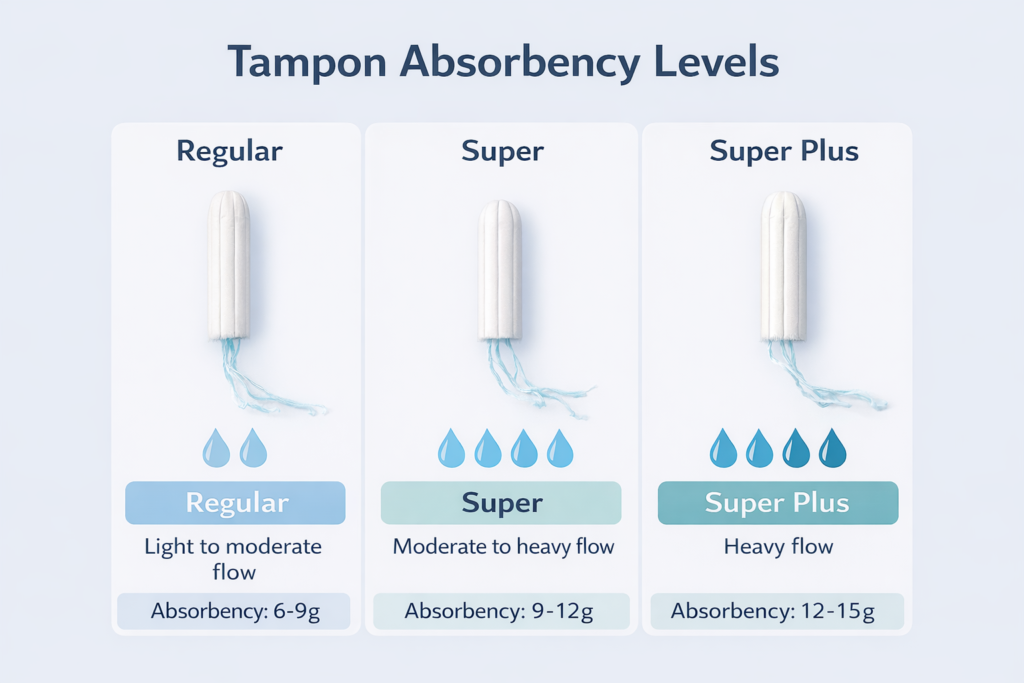
Supplier answer: A Super Plus or Ultra tampon OEM project should begin with the target market, required absorbency term, applicator format, core material, wrapper, pack count and quantity per SKU. A supplier cannot confirm manufacturability or issue a meaningful quotation from “high absorbency” alone. Green Gardener reviews finished private-label tampon briefs for brands, importers and distributors, with each absorbency and documentation requirement confirmed against the exact product route.
This is a procurement guide, not a recommendation that consumers use a higher-absorbency product. The U.S. Food and Drug Administration advises consumers to use the lowest absorbency needed. For OEM buyers, that makes accurate testing, labeling and assortment planning essential.
What do Super Plus and Ultra mean in the United States?
In the United States, absorbency terms are tied to measured ranges under 21 CFR 801.430. These terms should not be treated as informal size names or copied from a competitor’s packaging.
| U.S. absorbency term | Regulatory range | OEM implication |
|---|---|---|
| Super | More than 9 g up to and including 12 g | The finished SKU must be tested and labeled for this range |
| Super Plus | More than 12 g up to and including 15 g | Requires its own approved specification, testing and artwork |
| Ultra | More than 15 g up to and including 18 g | Availability and finished-product evidence must be confirmed for the proposed route |
| Above 18 g | No corresponding U.S. absorbency term | Do not invent an unrecognized size name for U.S. labeling |
Other countries may use different terminology, standards or regulatory pathways. An OEM brief should therefore name the destination market before defining the label, test method or package copy. For a detailed explanation of the ranges, see our Super, Super Plus and Ultra absorbency guide.
What should a high-absorbency tampon supplier confirm?
A qualified supplier should connect the requested absorbency to a complete finished-product specification. The buyer should ask for confirmation across five areas.
| Review area | Questions for the supplier | Required output |
|---|---|---|
| Absorbency | Which finished SKU and test method support the proposed term? | Controlled specification and applicable test evidence |
| Construction | What core, cover, cord and compression design is proposed? | Product-specific bill of materials and component specifications |
| Format | Is the SKU non-applicator, standard plastic applicator or compact plastic applicator? | Approved format and compatible dimensions |
| Packaging | What wrapper, pack count, assortment and warnings are required? | Artwork brief and packaging specification |
| Market documentation | Which evidence applies to this finished product and target country? | Document list with holder, scope and validity where relevant |
A generic catalog entry or certificate logo is not a substitute for this review. Absorbency, strength, integrity, materials, microbiological considerations and labeling should be connected to the proposed finished product and applicable market pathway.
Can Super Plus or Ultra be made as applicator and non-applicator tampons?
High-absorbency briefs can be evaluated for applicator or non-applicator designs, but the format affects dimensions, insertion system, wrapper and packaging. Green Gardener currently reviews non-applicator tampon projects and standard or compact plastic applicator projects. Cardboard applicators are not currently available from our production route.
Do not assume that an absorbency offered in one format is automatically available in every other format. The supplier should confirm the specific combination of absorbency, core construction and applicator route before sampling or quotation.
Which core materials should an OEM buyer specify?
The absorbent core may use cotton, rayon or a blend, depending on the product and market. A 100% organic cotton direction may also be reviewed for a private-label project, subject to material specification and certificate scope. Fibre name alone does not prove the finished absorbency, safety, comfort or regulatory status.
Ask the supplier to identify the core material, blend information where applicable, cover, withdrawal cord, attachment, applicator and wrapper separately. Our tampon material supplier guide provides a component-by-component checklist.
How should a brand plan its absorbency assortment?
An OEM assortment should be based on the brand’s market brief and approved product range, not on the idea that more absorbency is always better. A supplier may need separate specifications, samples, artwork lines and commercial calculations for each absorbency.
- Single-absorbency SKU: one absorbency per box, with a dedicated wrapper and retail-box specification.
- Multi-absorbency range: separate boxes for Regular, Super, Super Plus or other approved terms.
- Mixed-absorbency box: defined quantity of each approved SKU in one retail pack, subject to packaging and labeling review.
- Subscription or refill program: repeatable SKU coding and pack configuration that match the approved assortment.
Mixed boxes can increase artwork, inventory and packing complexity. The RFQ should state whether the buyer wants separate boxes or a mixed assortment, plus the exact count of each absorbency.
What affects the MOQ and quote for Super Plus or Ultra tampons?
There is no responsible universal MOQ or unit price for every high-absorbency project. Commercial terms depend on the complete SKU architecture and current production review.
| Quote factor | Why it changes the project |
|---|---|
| Number of absorbencies | Each absorbency may require a separate specification, sample and production quantity |
| Applicator format | Non-applicator, standard plastic and compact plastic routes use different components |
| Core material | Rayon/viscose, cotton, blends and organic cotton have different sourcing and documentation needs |
| Wrapper | Material, printing and seal construction affect specification and setup |
| Pack count and assortment | Separate or mixed boxes change packing and artwork complexity |
| Artwork customization | Wrapper, retail box and shipping carton requirements must be defined |
| Quantity per SKU | Production feasibility and current MOQ must be reviewed by individual configuration |
| Target market | Documentation and labeling requirements affect the project scope |
For a comparable quotation, ask each supplier to quote the same absorbency mix, materials, format, packaging and commercial terms. A low headline price that excludes wrappers, retail packaging, artwork setup, documentation or logistics is not comparable with a complete OEM offer.
What should the sample approval process include?
Supplier selection should not move from a generic sample directly to bulk production. The approved reference should match the intended material, absorbency, format and packaging route.
- Confirm the target absorbency and destination market before requesting samples.
- Record the sample code, material direction, format and relevant construction details.
- Compare the sample with the controlled specification rather than with an unrecorded verbal brief.
- Review applicable finished-product testing and documentation for the proposed SKU.
- Approve wrapper and retail artwork only after the supported claims and required labeling are confirmed.
- Retain an approved reference for production and inspection alignment.
Super Plus and Ultra tampon OEM RFQ template
Send the same brief to every shortlisted supplier. The following format is designed to produce a more useful first review:
Target market: [country or region]
Product format: [non-applicator / standard plastic applicator / compact plastic applicator]
Requested absorbencies: [Super / Super Plus / Ultra or market-specific terms]
Core material: [rayon/viscose / cotton / organic cotton / open to review]
Wrapper: [material and printing requirement]
Retail pack: [count per box; separate or mixed absorbencies]
Estimated quantity: [per absorbency and packaging design]
Branding: [wrapper, box and carton artwork scope]
Required documents: [list by target market]
Delivery destination and desired window: [location and timing]
If any field is undecided, label it “open to supplier review” rather than inserting an unsupported assumption. The supplier can then separate confirmed capabilities from options that require development or documentation review.
Frequently asked questions
Is Super Plus the same as Ultra?
No in U.S. labeling. Super Plus and Ultra correspond to different measured absorbency ranges under 21 CFR 801.430. Other markets may use different terminology, so confirm the target country.
Can a supplier call any high-absorbency tampon “Ultra”?
No. For the U.S. market, the term must match the regulated range and finished-product testing. Packaging terminology should be reviewed for the exact destination market.
Can Super Plus tampons use organic cotton?
An organic cotton direction may be reviewed, but the finished absorbency, format, certificate scope and applicable documentation must be confirmed for the proposed SKU. Material identity alone does not establish the absorbency term.
Does Green Gardener guarantee an Ultra option?
No universal Ultra option is promised. Green Gardener reviews the requested absorbency, format, material, quantity and market, then confirms which finished-product route and evidence are available for that project.
What information is needed before a supplier can quote?
Provide the target market, absorbency mix, format, core material, wrapper, pack count, quantity per SKU, artwork scope, documentation requirements and delivery destination. These inputs determine whether quotations are comparable.
Request a high-absorbency OEM review
Green Gardener is the B2B period-care team behind TamponManufacturer.com. Send the completed RFQ fields above, including the quantity for each absorbency. We will review the brief against the available production route and identify which Super, Super Plus or Ultra requirements can proceed, which documents apply and which points need product-specific confirmation.
For the wider customization process, visit our private-label tampon service. For available applicator directions, review the applicator tampon product page.