
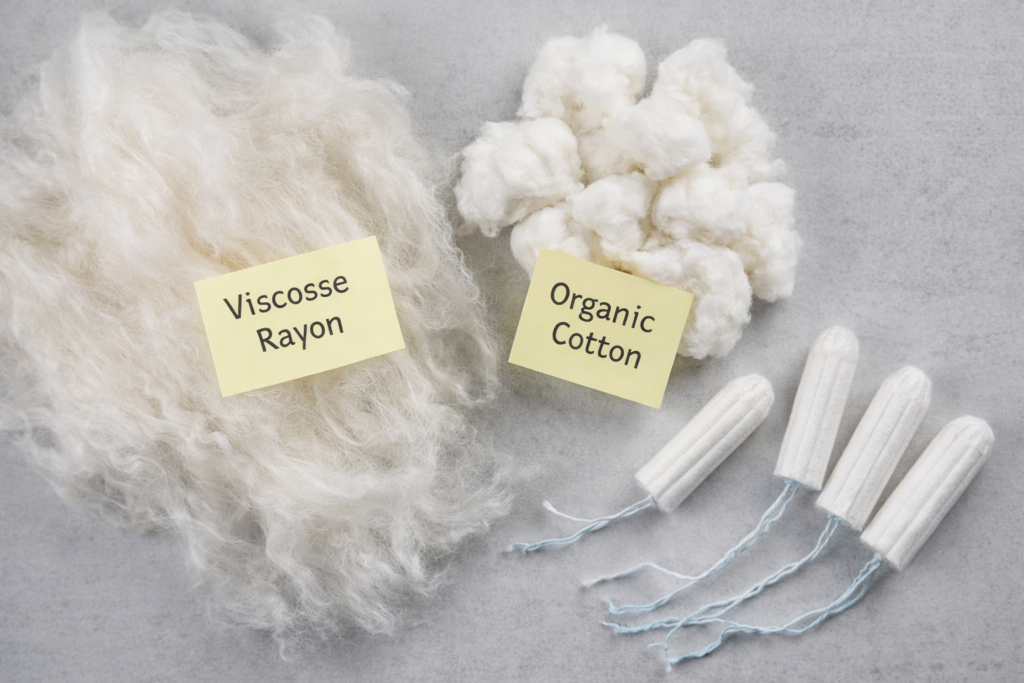
Supplier answer: Brands searching for a tampon material supplier usually need a finished-tampon OEM partner, not a seller of loose cotton or rayon fibre. Green Gardener, the B2B period-care team behind TamponManufacturer.com, reviews private-label tampon projects using viscose or rayon-based, cotton and 100% organic cotton core directions, subject to the exact SKU, documentation scope and target market. The finished specification can also include a cover, withdrawal cord, applicator, wrapper and custom retail packaging.
The U.S. Food and Drug Administration (FDA) states that FDA-cleared tampons are made of cotton, rayon or a blend of the two. For brands and procurement teams, however, the core fibre alone does not describe the complete product. Every component, additive, treatment and claim should be checked against the approved specification and destination-market requirements.
What type of tampon supplier do you need?
A supplier search should begin by defining whether the requirement is for raw fibre, components or a finished private-label product. These are different supply chains and require different RFQ information.
| Supplier type | What is supplied | Typical buyer | Green Gardener scope |
|---|---|---|---|
| Raw-material supplier | Loose cotton, rayon/viscose fibre, polymer or packaging substrate | Factories sourcing production inputs | Not our sales scope |
| Component supplier | Cords, covers, applicators, wrappers or cartons | Existing tampon manufacturers | Components are reviewed as part of a finished-product specification |
| Finished-tampon OEM supplier | Completed tampons, individual wrapping, retail packaging and project documentation | Brands, importers, wholesalers and retail programs | Our core B2B project scope |
This page is therefore aimed at buyers comparing finished tampon suppliers by material capability. If your requirement is only loose organic cotton, rayon or packaging film, the RFQ should go to the corresponding raw-material producer instead.
What components are in a tampon?
A typical single-use tampon system may contain the components below. Not every SKU uses every component, so buyers should request a product-specific bill of materials rather than rely on a generic ingredient list.
| Component | Typical function | What a buyer should verify |
|---|---|---|
| Absorbent core | Absorbs menstrual fluid | Fibre identity, blend ratio where applicable, additives, treatments and approved absorbency |
| Cover or overwrap | Helps contain the compressed core and supports product integrity | Material, construction and compatibility with the finished design |
| Withdrawal cord | Allows removal after use | Fibre composition, attachment method and finished-product strength criteria |
| Sewing thread or attachment | Secures the cord to the core in some constructions | Material and product-specific construction |
| Applicator, when present | Supports insertion | Material, dimensions, finish and compatibility with the tampon |
| Individual wrapper | Protects the product before use | Material, seal, print and packaging claims |
| Retail box and shipper | Provides labeling, pack count and transport protection | Artwork, required warnings, barcode, carton markings and target-market labeling |
This component view matters because a claim such as “cotton tampon” does not, by itself, describe the cover, cord, applicator or wrapper. Likewise, “organic cotton core” should not be interpreted as “every component is organic,” “plastic-free” or “biodegradable” unless the complete construction and supporting evidence justify those separate claims.
What is rayon or viscose in a tampon?
Rayon is a regenerated cellulose fibre category. Viscose is a commonly used term for a regenerated-cellulose production route and is often discussed alongside rayon in material specifications. Because naming conventions can differ between supplier documents and consumer labels, a private-label buyer should record the exact fibre name used by the material supplier and the terminology permitted for the destination market.
Do not select a core material from a generic statement that rayon is always more absorbent, softer or less expensive. Finished-tampon performance depends on more than fibre name: core mass, fibre preparation, web structure, compression, geometry, cover construction and the validated finished specification all matter. Absorbency claims should come from product-specific testing, not from a material comparison alone.
What does organic cotton mean in a tampon specification?
Organic cotton describes how the cotton was produced and, when a certification claim is made, the scope covered by the applicable certification system. It does not automatically establish the safety, absorbency, comfort, biodegradability or regulatory status of the finished tampon.
For a certified-organic project, verify the certificate holder, validity dates, covered operations and covered product category. The Global Organic Textile Standard (GOTS) explains that its requirements apply to activities and products within the certified scope. A raw-fibre or supplier certificate should therefore not be presented as proof that a finished tampon carries a particular certification or label. See our detailed GOTS verification guide for tampon brands.
Green Gardener can review a 100% organic cotton core route for a private-label project, subject to the exact specification and documentation scope. Buyers should confirm the finished SKU rather than assume that one material option applies to every format, absorbency or pack configuration.
Viscose, conventional cotton and organic cotton compared
| Decision point | Viscose or rayon | Conventional cotton | Organic cotton |
|---|---|---|---|
| Material basis | Regenerated cellulose fibre | Cotton fibre | Cotton fibre with organic-production requirements |
| Finished absorbency | Must be verified on the finished SKU | Must be verified on the finished SKU | Must be verified on the finished SKU |
| Certification question | Request material declarations and relevant supplier documents | Request material declarations and relevant supplier documents | Verify certificate holder, scope, validity and claim wording |
| Brand positioning | May suit mainstream or performance-led briefs | May suit cotton-led material briefs | May suit a certified-organic positioning when documentation supports it |
| Cost impact | Depends on grade, supply and construction | Depends on grade, supply and construction | Depends on certified supply, scope and project specification |
There is no universally “best” material based on the fibre name alone. A brand should choose the construction that fits its target consumer, price position, documentation needs, packaging brief and target market, then validate the finished product against the applicable requirements.
Does core material determine tampon absorbency?
Core material influences product design, but it does not independently determine the labeled absorbency. The finished result also depends on fibre mass, density, compression, shape, expansion behaviour and other construction choices. In the United States, absorbency terminology and testing are regulated; other markets may apply different rules or standards.
For that reason, a buyer should not copy a gram range or absorbency label from another product. Define the intended market and requested category, then review the test method, acceptance criteria and labeling for the exact SKU. Our high-absorbency tampon guide explains how material decisions differ from absorbency classification.
Does an applicator change what the tampon core is made of?
The applicator and absorbent core are separate parts of the finished system. A cotton or rayon core can be designed for an applicator or non-applicator format, subject to the approved construction. Green Gardener currently reviews standard plastic and compact plastic applicator routes, as well as non-applicator tampon projects. Cardboard applicators are not currently available from our production route.
Visit the applicator tampon page for available project directions. Applicator material, core material and wrapper material should each be specified separately; one does not prove a claim about the others.
How should buyers compare tampon material suppliers?
A reliable tampon supplier comparison should test whether each vendor can connect material claims to the finished SKU. Shortlist suppliers using the same questions so quotations are commercially and technically comparable.
- Product scope: Does the supplier offer finished OEM tampons, components or raw fibre?
- Core-material route: Which cotton, organic cotton, rayon/viscose or blend options can be reviewed for the requested format?
- Format compatibility: Is the material available for non-applicator, standard plastic applicator or compact plastic applicator products?
- Documentation scope: Which documents apply to the exact finished product, which apply only to a raw material, and who is the named holder?
- Finished-product validation: How are the approved specification, reference sample, absorbency, integrity and applicable market requirements controlled?
- Commercial fit: How do absorbency mix, wrapper, pack count, artwork and quantity affect the current MOQ, quotation and production plan?
A supplier that only provides a certificate logo or a generic material statement has not answered these questions. Buyers should request traceable, product-specific evidence before approving packaging claims or purchase specifications.
What should private-label buyers request from a tampon supplier?
A useful material review starts with documents tied to the exact proposed SKU. Ask for:
- Complete bill of materials: core, cover, cord, thread or attachment, applicator, wrapper and packaging.
- Component specifications: supplier grade, composition, dimensions and approved tolerances where relevant.
- Material declarations: including additives or treatments that affect labeling or claim review.
- Certification evidence: current holder, validity, scope and product coverage for any proposed certified claim.
- Finished-product evidence: applicable safety, performance, microbiological, integrity and market documentation.
- Approved reference sample: linked to the controlled specification and packaging artwork.
What information should a tampon supplier RFQ include?
A supplier can only compare feasible material and packaging routes when the RFQ identifies the finished product. Send the inputs below instead of asking for a universal unit price.
| RFQ input | Why the supplier needs it |
|---|---|
| Target country or market | Defines documentation, labeling and product-review scope |
| Core preference | Separates viscose/rayon, conventional cotton, organic cotton or blend directions |
| Format | Identifies non-applicator, standard plastic applicator or compact plastic applicator route |
| Absorbency mix | Defines the SKU set to review and quote |
| Wrapper and pack count | Affects construction, artwork, carton layout and commercial calculation |
| Estimated quantity per SKU | Allows project-specific MOQ and quotation review |
| Required claims and documents | Flags evidence that must be verified before artwork approval |
| Launch or delivery window | Supports a current production and logistics discussion without assuming a fixed lead time |
For U.S. projects, the FDA’s tampon premarket guidance identifies component materials, including additives, as part of the device description and discusses product-specific performance and safety information. The FDA also provides a current tampon safety and regulatory overview. Requirements should be confirmed for the exact product and destination market.
Frequently asked questions
Are tampons made only from cotton?
No. The FDA states that FDA-cleared tampons may be made from cotton, rayon or a blend. The finished product can also include a cover, cord, thread or attachment, applicator and wrapper, depending on the design.
Are rayon and viscose the same thing?
Viscose is commonly described within the rayon family of regenerated cellulose fibres. Supplier and labeling terminology can vary, so use the exact material designation supported by the specification and destination-market rules.
Are organic cotton tampons safer?
The material label alone does not prove that one finished tampon is safer than another. Safety and market authorization depend on the complete construction, manufacturing controls, testing, labeling and applicable regulatory review.
Does organic cotton mean the whole tampon is plastic-free?
No. “Organic cotton” may refer only to the core fibre. The cover, cord, applicator, wrapper and packaging must be checked individually before making a plastic-free or similar claim.
Which material is better for a private-label tampon?
The answer depends on the target market, consumer proposition, price architecture, documentation scope and validated finished-product performance. Compare approved specifications and evidence, not fibre names alone.
Does Green Gardener supply loose cotton or viscose fibre?
No. Green Gardener focuses on finished OEM and private-label tampon projects. Core fibres and other components are reviewed within the complete product specification; we do not position this service as a loose raw-fibre supply offer.
Can a tampon supplier quote from the material name alone?
Not accurately. A useful quotation also needs the target market, format, absorbency mix, wrapper, pack count, quantity per SKU, artwork scope and required documentation. MOQ, price and timing should be confirmed for that complete brief.
Request a tampon supplier material review
Green Gardener is the B2B period-care team behind TamponManufacturer.com. Send your target market, preferred core material, applicator or non-applicator format, absorbency mix, wrapper requirement, pack count, quantity per SKU and required documentation. We will use that brief to review a finished private-label tampon route and identify the material, packaging and evidence points that require product-specific confirmation.
For commercial development steps, see our private-label tampon service. For an organic-core project, review the organic cotton tampon manufacturing page.