
Supplying tampons for vending machines and dispensers comes down to three things: a pack format that fits the machine’s chute or coil, wrapping that survives drops and handling, and labeling that still carries the required information when one unit is sold or given away at a time. As a factory-direct manufacturer, we help facilities teams, machine operators and brands match individually wrapped tampons, boxed singles and small packs to the dispenser before bulk production starts.
Why Dispenser Supply Is Different from Retail Supply
A retail box sits on a shelf and is opened by the person who bought it. A dispenser product is loaded by a service technician, stored in a metal or plastic chamber, dropped through a mechanism and often used within minutes in a washroom. That changes what matters. Dimensions must be consistent from unit to unit, wrappers must not snag or tear, and every piece has to be recognizable as a tampon with its absorbency visible at a glance.
Dispenser programs also run on replenishment rather than seasonal orders. Schools, offices, gyms, airports and public buildings want predictable cartons that a cleaning team can count quickly. Our wholesale tampons program is built around those needs: stable specifications, clearly marked outer cartons and samples you can test in the actual machine before committing to volume.
Pack Formats That Work in Vending Machines and Dispensers
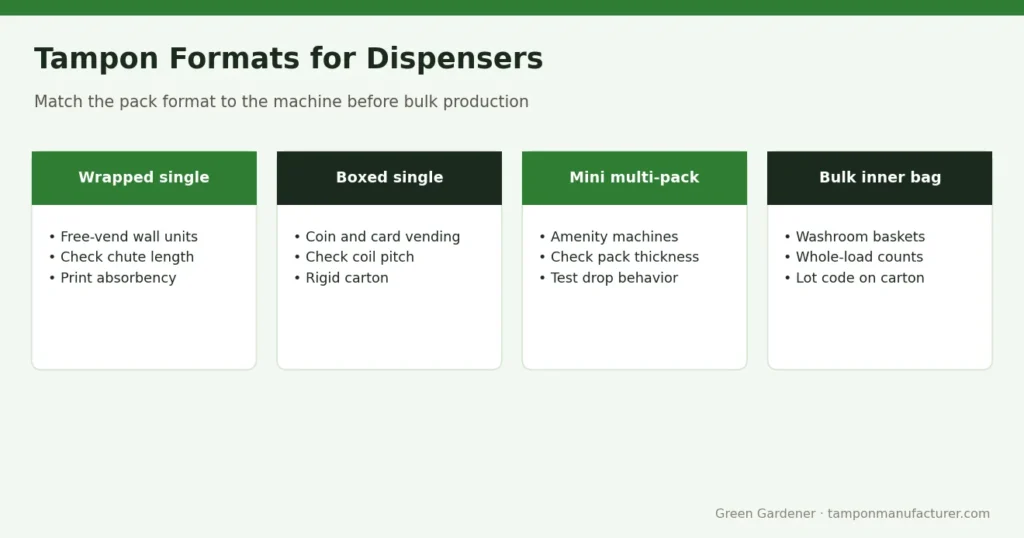
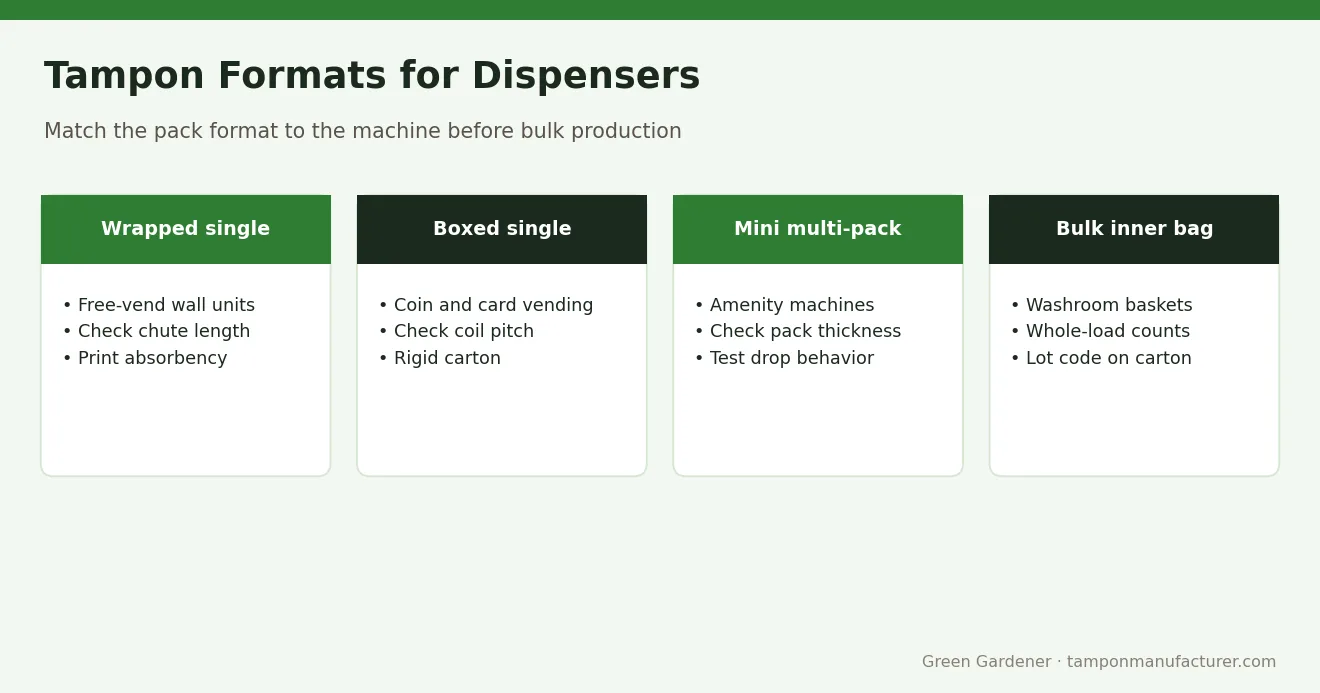
Most dispensers fall into a few families, and each favors a different pack format. The table below summarizes the common options we produce.
| Format | Typical dispenser | What to check |
|---|---|---|
| Individually wrapped single tampon | Free-vend wall units, push-button dispensers | Wrapper length, width and stiffness against the chute |
| Boxed single (one tampon in a small carton) | Coin or card-operated vending with coils or slots | Box dimensions, coil pitch, box rigidity |
| Small multi-pack in flow wrap or mini box | Combination vending, hotel and gym amenity machines | Pack thickness, weight and how it drops |
| Bulk inner bag of individually wrapped tampons | Open baskets and refill boxes in washrooms | Bag count, reclosability, dust protection |
Individually wrapped tampons in a sealed wrapper are the backbone of most free-vend programs. Boxed singles cost more to pack but present better in coin-operated machines, where a crushed or bent unit leads to complaints and jams.
Compatibility Checks to Run with Machine Operators
Machine operators know their equipment better than any factory. Before we finalize a specification, we ask buyers to share the dispenser model and, ideally, the operator’s product sheet. Then we check:
- Chute or coil dimensions – the maximum length, width and thickness the mechanism accepts, with a tolerance margin.
- Drop behavior – whether a unit falls flat, tumbles or bridges against the next one.
- Weight and stiffness – very light flow-wrapped units can cling together in gravity-fed tubes.
- Wrapper friction – glossy films slide differently from paper wraps.
- Loading orientation – which face shows the brand and absorbency when the unit is dispensed.
- Capacity per load – how many units fit per column, which shapes the inner bag count.
We record the agreed dimensions on the product specification so every production lot is built to the same envelope.
Choosing Applicator Types and Absorbencies for Public Dispensers
Applicator choice affects both the user experience and how the unit behaves inside a machine.
| Option | Strength in dispensers | Consideration |
|---|---|---|
| Compact plastic applicator | Short wrapped length suits small chutes | Plastic-reduction policies at some sites |
| Cardboard applicator | Fits sustainability policies | Check how the wrap grips in coils |
| Standard plastic applicator | Familiar to most users | Longer unit; confirm chute length |
| Non-applicator (digital) | Smallest unit size | Some users prefer an applicator |
For absorbency, many public programs stock Regular as the default, sometimes alongside Super in a second column, while school programs often add Light. Under US labeling rules (21 CFR 801.430), absorbency terms correspond to ranges measured with the syngina method, from Light (6 g and under) to Ultra (15–18 g), and package information tells users to choose the lowest absorbency needed for their flow. You can review the full range on our tampons page.
Labeling and Package Inserts When Units Are Dispensed One at a Time
Single-unit dispensing raises a practical regulatory question: how does the end user receive the information normally printed on a retail box and its package insert? In the United States, FDA’s tampon labeling regulation, 21 CFR 801.430, sets out absorbency terms and toxic shock syndrome (TSS) warning information that must accompany tampons. Requirements differ by market, so check current FDA requirements, or the rules in your destination country, before you design a dispenser pack.
Common approaches include printing the absorbency term and key warning text on the individual wrapper or single box, placing an insert in each boxed single, and displaying supporting information at the dispenser. Which approach is acceptable depends on the market and the format, so confirm it with your regulatory advisor. We prepare artwork to your approved text, and our packaging artwork checklist helps you collect everything before proofing.
Outer Cartons, Inner Bags and Replenishment Planning
Service teams refill machines quickly, often straight from a trolley. Packing should make that easy:
- Inner bags sized to a whole number of machine loads.
- Outer cartons printed with product name, absorbency, count and lot code on at least two faces.
- Carton strength suited to stacking in storerooms and to long-distance shipping.
- Consistent counts so stock can be checked by carton number or weight.
Lot codes on every carton and, where space allows, on individual units support traceability if a complaint arises. Distributors supplying many sites often standardize one or two carton configurations across all customers to simplify warehousing. Carton counts, pallet patterns and production timing are confirmed in your quotation.
Testing Samples in the Machine Before Bulk Production
Paper specifications cannot replace a real fit test. We supply samples before bulk so you or your operator can load a column, dispense repeatedly and inspect the results.
| Test | What to look for | Action if it fails |
|---|---|---|
| Repeated vend cycles | Jams or double vends | Adjust dimensions or wrap |
| Drop and handling | Torn or open wrappers | Change film or seal settings |
| Visual check after vending | Readable absorbency term | Move or enlarge the print |
| Storage inside the unit | Crushed or deformed packs | Increase box rigidity |
Record the dispenser model and the sample reference used for approval. If machines are replaced later, a repeat fit test avoids surprises at rollout.
For Operators and Brands: How to Brief Your Manufacturer
A clear brief shortens development. When you contact us, include:
- Dispenser make and model, plus any operator product specifications
- Target markets and the labeling languages required
- Preferred applicator type and absorbency mix
- Neutral facility packaging or branded private label artwork
- Number of sites and replenishment pattern, for carton planning
Schools have extra considerations around discreet packaging and age-appropriate absorbency; our bulk tampons for schools guide covers these. With more than 15 years of experience and over 500 clients, we supply neutral facility packs and fully branded dispenser lines from the same 52,000 m² factory.
Request a Quote
Ready to match tampons to your machines? Send your dispenser details, target absorbencies and preferred pack format through our contact page or on WhatsApp at +86 173 1689 5054. We will recommend a format, arrange samples for a fit test and confirm pricing, quantities and timing in your quotation.
Frequently Asked Questions
What tampon format works best in a free-vend wall dispenser?
Most free-vend wall units are designed for individually wrapped single tampons. The wrapper length, width and stiffness need to match the dispenser chute so units drop one at a time. We recommend testing samples in your actual dispenser model before bulk production, because small differences in film or fold can change how units feed.
Can you produce boxed single tampons for coin-operated vending machines?
Yes. We can pack a single tampon in a small printed carton for coin or card-operated machines that use coils or slots. Box dimensions and rigidity are set to suit the machine and checked with samples before bulk production. Pricing and quantities for boxed singles are confirmed in your quotation.
Which absorbency should a public dispenser stock?
Many facilities stock Regular as the default because it suits a wide range of users, adding Super or Light where a second column is available. Product information should remind users to choose the lowest absorbency needed for their flow and to follow the package instructions. The right mix also depends on who uses your site.
How is required labeling handled when tampons are dispensed individually?
Approaches include printing the absorbency term and key warning text on each wrapper or single box, including an insert in boxed singles, and displaying information at the dispenser. Requirements differ by market, so check current FDA requirements for the US, or local rules elsewhere, and confirm the approach with your regulatory advisor before artwork is final.
Do you supply both branded and unbranded dispenser tampons?
We supply neutral facility packs for operators who stock many sites, and fully branded private label versions for brands and distributors. Both can use plastic, compact, cardboard or non-applicator designs and organic cotton options. We arrange samples before bulk orders and provide documentation on request for your procurement file.