
NGOs and charities tackling period poverty need reliable products, packaging that survives distribution, and clear instructions in the languages people actually read. The best programs combine the right product mix for the community, simple kits that are easy to hand out, and education leaflets reviewed by local partners. As a factory-direct manufacturer of tampons, pads, liners, menstrual cups and period underwear, we help charities and their distributors plan bulk supply, with samples available before ordering.
What Period Poverty Programs Need From Suppliers
Period poverty describes a lack of access to menstrual products, safe facilities or information, often because of cost. Programs that respond to it run in schools, community centres, food banks, shelters and humanitarian settings. Each setting shapes what a supplier needs to deliver.
Charities usually look for three things from a manufacturer: consistent product quality, packaging that fits their distribution model, and documentation they can share with donors and partners. Budgets are often tight and funded by grants, so predictable pricing and transparent specifications matter as much as unit cost.
We work with NGOs, charitable distributors and corporate donors as a factory-direct supplier. Commercial details such as quantities, pricing and production timing are confirmed in your quotation, so program managers can plan against firm figures when applying for funding.
Choosing the Right Product Mix for the Community
No single product suits every community. Preferences depend on culture, age, access to water and private washing facilities, and familiarity with different products. Programs that consult local partners or recipients before ordering tend to see better uptake.
| Product | Strengths | Considerations |
|---|---|---|
| Disposable pads | Familiar in many communities, easy to use | Volume and disposal |
| Tampons | Compact, discreet, widely used in some regions | Familiarity, instructions, TSS information |
| Panty liners | Light days and backup | Not a replacement for pads |
| Menstrual cups | Reusable over a long period | Requires clean water and education |
| Period underwear | Reusable, comfortable | Requires washing and drying facilities |
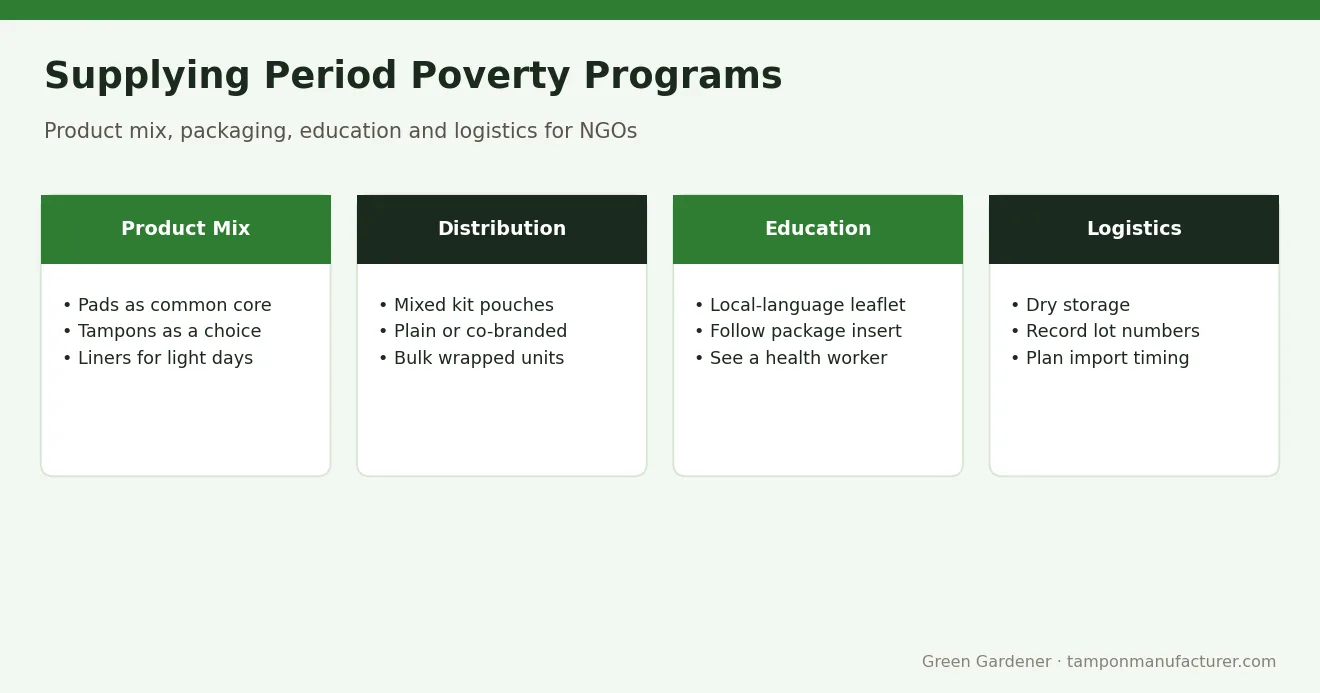
Many programs offer a choice of tampons and sanitary pads so recipients can use what they are comfortable with. Where tampons are included, Light and Regular absorbencies are often the core, with Super added for heavier flow.
Tampon Formats That Suit Distribution
When tampons are part of the mix, the format affects how easily volunteers can distribute them and how recipients store them.
- Individually wrapped tampons protect each unit when packs are opened and shared.
- Cardboard applicators reduce plastic and suit programs with sustainability goals; see our cardboard tampons.
- Compact or plastic applicators are familiar to many users in markets where they dominate retail shelves.
- Non-applicator (digital) tampons are small and use less material, but some new users find them less familiar.
Absorbency should be clearly marked on each wrapper and pack, and every pack should include the TSS information leaflet required in your market. Recipients should always be encouraged to read the leaflet, choose the lowest absorbency they need and change tampons as directed.
Packaging for Kits and Mass Distribution
Distribution packaging is often more important to a charity than retail shelf appeal. Kits are handed out at events, posted to homes or packed into school bags, so durability and discretion matter.
| Packaging option | Best for | Notes |
|---|---|---|
| Small mixed kit pouch | Events and school handouts | Tampons, pads and leaflet together |
| Plain unbranded packs | Shelters and discreet distribution | Required labeling still applies |
| Co-branded packs | Donor or campaign visibility | Artwork approved by all partners |
| Bulk cartons of wrapped units | Restocking free supply points | Clear carton labels by absorbency |
For younger recipients, a starter kit approach works well. Our article on first period kits explains how to combine products, a pouch and a guide in one pack.
Education Leaflets and Language
Products work best with clear information. A short leaflet in the local language, using simple wording and diagrams, helps people use tampons and pads correctly and with confidence.
Leaflets for tampons should be consistent with the package insert: how to insert and remove a tampon, how often to change it according to the instructions, choosing the lowest absorbency needed, and the warning signs of toxic shock syndrome. They should also encourage people to consult a doctor or health worker about any concerns with their periods.
We can print leaflets in multiple languages with content supplied and approved by your organisation. We recommend that local health partners review wording and images for accuracy and cultural appropriateness. Avoid adding health claims; the purpose of the leaflet is safe, informed use, not medical advice.
How NGO Procurement Usually Works
Charities range from small community groups to large international organisations with formal procurement rules. Larger organisations may require competitive quotes, supplier due diligence and documented specifications. Smaller groups may buy through a local distributor who imports from a manufacturer.
- Define the product mix and quantities from community consultation.
- Request quotations and samples from shortlisted suppliers.
- Review samples with staff and, where possible, recipients.
- Check documentation such as specifications and test reports relevant to the destination market.
- Agree packaging, leaflet content and delivery terms.
- Plan import, customs and storage before goods arrive.
We provide documentation on request to support due diligence. Donors increasingly ask where products are made and how quality is controlled, so keep these documents on file for reporting.
Storage, Logistics and Reporting
Charity warehouses and community spaces are not always climate controlled. Store cartons off the floor, away from damp walls and direct sunlight, and use older lots first. Keep lot numbers recorded against distributions, which helps if any product question arises later.
Shipping by sea is usually the most economical option for large program volumes, while smaller urgent top-ups may justify faster freight. Factor customs clearance and inland delivery into program timelines.
Donors and grant funders often require reporting on quantities distributed and locations served. Planning carton counts that match your distribution units, for example one carton per school or centre, makes reporting easier.
For Charities and Their Partners: Working With Our Factory
With more than 15 years of experience, a 52,000 m² factory and over 500 clients served, we support charitable programs, distributors and corporate donors with bulk and custom-packed supply. Options include applicator choice, organic cotton tampons, mixed kits with pads and liners, plain or co-branded packaging and multilingual leaflets. Samples are available before bulk orders, and our wholesale tampons page lists standard formats.
For ongoing programs, we recommend agreeing a stable specification for each product so that every shipment looks and performs the same. Recipients notice when products change, and consistency builds trust in the program. If your organisation runs projects in several countries, we can help plan a core range with country-specific leaflets and pack labeling, rather than separate products for every location.
We also understand that charity timelines are often linked to funding cycles, school terms or emergency appeals. Sharing your planned distribution dates early allows us to schedule sampling, artwork approval and production in the right order, with timing confirmed in your quotation.
Request a Quote
Planning a period poverty program? Tell us the community, product mix, kit format, languages and destination. We will suggest suitable products and send samples. Request a quote or contact us on WhatsApp at +86 173 1689 5054.
Frequently Asked Questions
Which products should a period poverty program include?
It depends on the community. Many programs include disposable pads as the core, with tampons offered as a choice, plus panty liners for lighter days. Reusable cups or period underwear can suit settings with clean water and private washing facilities. Consulting local partners and recipients before ordering usually improves uptake.
Do donated tampons still need full labeling and leaflets?
Yes. Donated or free products generally need the same labeling as retail products in the destination market, including absorbency information and the TSS leaflet for tampons. Plain or co-branded packaging is possible, but required information must still be included. Confirm requirements with your regulatory adviser for each country.
Can you print education leaflets in local languages?
Yes. We can print leaflets in multiple languages using content your organisation supplies and approves. We recommend that local health partners review the wording for accuracy and cultural fit. Leaflets should follow the package insert guidance and encourage people to consult a doctor or health worker with any concerns.
Can corporate donors co-brand charity kits?
Yes. Kits and packs can carry the logos of the charity, the donor or both, subject to agreement between partners. All parties should approve the artwork before production. Required product information remains on pack, and branding should not suggest any health claims or endorsements that have not been agreed.
How do charities budget for bulk tampon supply?
Start from the number of recipients, expected products per person per cycle and the length of the program. Add freight, customs, storage and distribution costs. Our pricing, order quantities and production timing are confirmed in your quotation, giving program managers firm figures for grant applications and donor reporting.
Request a Tampon or Pad Quote
Tell us the product, quantity and your market. We reply with options, pricing and sample steps. Prefer chat? WhatsApp +86 173 1689 5054.