
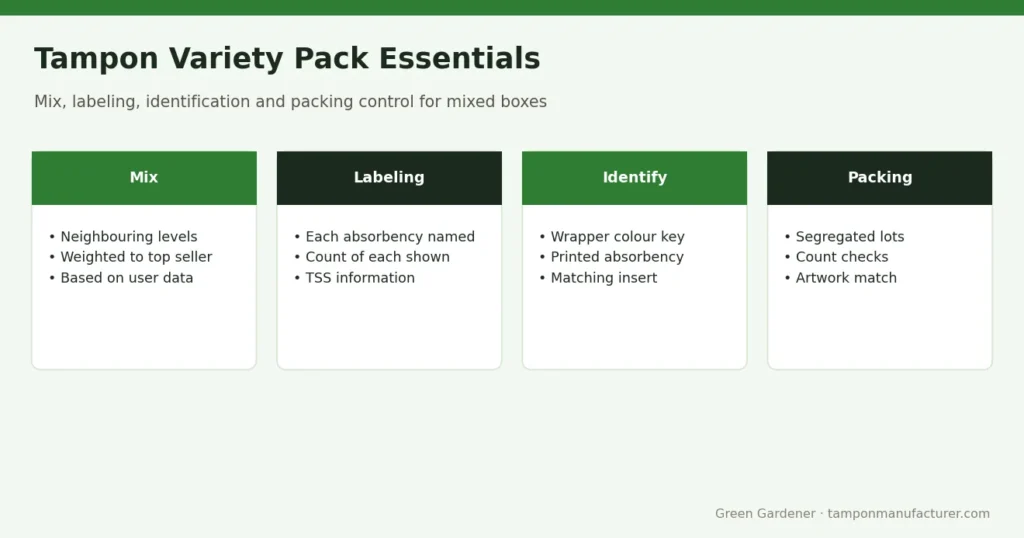

A tampon variety pack combines two or more absorbencies in one box so users can match the tampon to lighter and heavier days. Success depends on three things: a mix that reflects real usage, labeling that identifies every absorbency clearly and accurately, and colour coding that lets users tell tampons apart at a glance. As a factory-direct OEM manufacturer, we help private label brands design variety packs, from absorbency mix and wrapper colours to box layout and carton planning.
Why Brands Offer Variety Packs
Menstrual flow often changes from day to day, so many users need more than one absorbency during a single period. Buying two or three separate boxes is expensive and leaves half-used boxes in the cupboard. A variety pack solves that problem in one purchase and encourages users to choose the lowest absorbency that works for each day, which is consistent with the standard guidance printed in tampon package information.
For brands, variety packs offer several commercial benefits. They give first-time buyers an easy way to try a range, they create a distinctive product on shelf and online, and they can reduce the number of single-absorbency SKUs a retailer needs to list. They also work well in subscription models, where one box can cover a full cycle. The trade-off is complexity: mixed boxes need more careful labeling, packing control and inspection than single-absorbency boxes.
Choosing the Absorbency Mix
The most common variety packs combine neighbouring absorbencies, because most users move between adjacent levels rather than jumping from the lightest to the heaviest. Typical structures include:
| Mix | Target user | Positioning |
|---|---|---|
| Light + Regular | Lighter flow, newer users | Gentle everyday |
| Regular + Super | Average flow with heavier days | Mainstream all-cycle |
| Light + Regular + Super | Broad audience | Complete cycle pack |
| Super + Super Plus | Heavier flow | Heavy-day support |
The ratio inside the box matters too. Many brands weight the box towards the most-used absorbency, such as more regular than super. Base this on customer research or sales data where possible. For background on absorbency levels, see our guide to tampon absorbency levels.
Labeling Each Absorbency Under FDA 21 CFR 801.430
For tampons sold in the United States, FDA labeling rules in 21 CFR 801.430 set the absorbency terms that may be used and the ranges they correspond to, measured with the syngina method: Light up to 6 g, Regular 6–9 g, Super 9–12 g, Super Plus 12–15 g and Ultra 15–18 g. The regulation also requires information about toxic shock syndrome (TSS), including its warning signs and the advice to use the lowest absorbency needed.
The regulation also addresses packages that contain more than one absorbency, so a variety pack must identify each absorbency correctly on its label. Many brands also state how many tampons of each absorbency the box contains, which helps shoppers and retailers. Because the exact wording and placement matter, review the current text of the regulation with your regulatory adviser and check current FDA requirements before finalising artwork. Our article on tampon labeling requirements explains the label and insert content in more detail.
Colour Coding and Wrapper Identification
Once tampons are out of the box, users rely on the wrapper or applicator to tell absorbencies apart. Clear identification reduces the risk of someone using a higher absorbency than intended. Common methods are:
- Wrapper colour: one colour per absorbency, repeated in a colour key on the box and insert.
- Printed absorbency term: the word Light, Regular or Super printed on each wrapper.
- Droplet icons: a visual scale that supports the absorbency term but does not replace it.
- Applicator colour: an extra cue on plastic applicators.
Combining colour with printed text is the most robust approach, because colour alone can be hard to read for users with colour vision deficiency or in poor bathroom lighting. Approve wrapper colours on physical samples, since print can shift between materials.
Packing Control in Production
A variety pack is only correct if every box contains the right number of each absorbency. Packing control is therefore the most important production difference compared with single-absorbency boxes. We agree the packing method, the in-box arrangement and the inspection checks before bulk production.
| Control point | Purpose | Typical check |
|---|---|---|
| Absorbency segregation | Prevent mix-ups before packing | Separate lots and labels |
| Count per absorbency | Match the label statement | Box opening during inspection |
| Wrapper identification | Correct colour and text | Visual check against standard |
| Box and insert match | Right artwork for the mix | Artwork version check |
Lot coding should allow each absorbency component to be traced. Ask about our documentation in the tampon quality control documentation guide.
Planogram and Shelf Placement
Retailers organise tampon shelves by brand, absorbency and sometimes applicator type. A variety pack does not fit neatly into one absorbency slot, so brands should explain where it belongs. Many retailers place variety packs at the end of a brand block, next to the brand’s regular and super boxes, so shoppers see it as a natural option within the range.
Make the front of the box do the work. State clearly that the box contains mixed absorbencies, name each one and show the count of each. Keep the box height and width consistent with your single-absorbency boxes so the brand block looks tidy. When presenting to a buyer, explain how the variety pack recruits trial and supports the core range rather than cannibalising it, and share any sales data you have from online channels.
Markets Outside the United States
Absorbency and labeling rules differ by market. Many markets outside the United States use absorbency classes and droplet systems rather than FDA terms, and some require local-language labeling. Tampons are regulated in markets such as Canada, Australia and the Gulf states, so confirm requirements with Health Canada, the TGA or the SFDA as relevant. In the EU and UK, check general product safety rules, packaging marking obligations and any national requirements with a qualified adviser. Plan your variety pack artwork so the absorbency information can be adapted per market without redesigning the entire box.
A modular layout helps here. Keep the brand panel, product photography and colour key fixed, and reserve defined areas for the absorbency statements, regulatory text and local-language information. When a new market is added, only those areas change, which reduces artwork cost, speeds up approval and lowers the risk of errors creeping into a design that has already been checked. The same principle applies to the package insert, which often carries the most market-specific content.
For Brands: Launching a Variety Pack
A simple launch sequence keeps a variety pack manageable:
- Confirm the core single-absorbency range first.
- Choose a mix and ratio based on your target users.
- Approve wrapper colours and printed terms on samples.
- Finalise label and insert content with your regulatory adviser.
- Agree packing and inspection checks before bulk production.
You can review the absorbencies and applicator types we produce on our private label tampons page. Samples of mixed boxes are available before bulk production.
Request a Quote
Share your preferred absorbency mix, counts, applicator type and target markets, and we will prepare variety pack samples and a quotation. Contact us through the contact page or on WhatsApp at +86 173 1689 5054.
Frequently Asked Questions
What absorbencies usually go into a variety pack?
Most variety packs combine neighbouring absorbencies, such as Light and Regular, Regular and Super, or all three. Heavy-flow packs may combine Super and Super Plus. Base the mix and ratio on your target users and sales data, and keep the combination simple enough to label clearly.
Do I need to label every absorbency in a mixed box?
For the US market, FDA labeling rules in 21 CFR 801.430 address packages containing more than one absorbency, so each absorbency must be identified correctly. Many brands also state the count of each absorbency. Review the current regulation text and check current FDA requirements with your regulatory adviser before printing artwork.
How do users tell the tampons apart?
The most reliable method combines wrapper colour with the absorbency term printed on each wrapper, supported by a colour key on the box and insert. Colour alone can be hard to read in poor light or for users with colour vision deficiency, so printed text is important.
How do you make sure each box has the right mix?
We agree the packing method, in-box arrangement and inspection checks before production. Absorbency components are kept separate before packing, and inspection includes opening sample boxes to verify counts and wrapper identification against the approved standard and label statement. Lot coding lets each absorbency component be traced if a question arises later.
Are variety packs more expensive to produce?
They can be, because packing is more complex and inspection takes longer than for single-absorbency boxes. Exact cost depends on the mix, counts, applicator type and order volume, and it is confirmed in your quotation once the specification and artwork are agreed.
Request a Tampon or Pad Quote
Tell us the product, quantity and your market. We reply with options, pricing and sample steps. Prefer chat? WhatsApp +86 173 1689 5054.