Retail-ready tampon packaging is packaging designed so store staff can move a case from the stockroom to the shelf in one step, and shoppers can see and pick the product easily. It usually combines consumer boxes, a shelf-ready tray or PDQ display, and a shipping case with clear barcodes. For private label brands, planning these layers together with the manufacturer avoids crushed boxes, rejected deliveries and costly reprints. This guide explains the main formats and what to agree before production.
What Retail-Ready Packaging Means
Retail-ready packaging (RRP), also called shelf-ready packaging (SRP), is secondary packaging that doubles as a display. Instead of opening a case and placing each tampon box on the shelf by hand, staff tear off a perforated panel or lift a lid and set the whole tray on the shelf. Retailers like it because it cuts labor and keeps shelves tidy; brands like it because products are presented consistently.
Industry guidance often summarizes good shelf-ready design in five principles:
- Easy to identify in the stockroom, with clear product and barcode information.
- Easy to open without knives or damage to the product.
- Easy to shelve in one movement, at the right size for the shelf.
- Easy to shop, so shoppers can see and take a box without disturbing others.
- Easy to dispose of, ideally as a single recyclable material.
Packaging Layers for a Tampon Program
A retail tampon program usually has three packaging layers, each with a different job.
| Layer | Purpose | Key decisions |
|---|---|---|
| Consumer unit (box or bag) | Protects tampons and carries regulated information | Count, size, absorbency coding, insert placement |
| Shelf-ready tray or PDQ | Presents units on shelf or counter | Units per tray, front height, tear-off design |
| Shipping case | Protects trays in transit and storage | Board grade, case count, case labeling |
| Pallet configuration | Efficient freight and warehouse handling | Layer pattern, height, stretch wrap |
Decisions at one layer affect the next. A small change to box width can alter tray layout, case count and pallet pattern, so it is best to fix the consumer unit early.
Shelf-Ready Trays vs PDQ Displays
PDQ displays (the name comes from “pretty darn quick”) are compact, ready-to-place displays used for promotions, counters, endcaps and new launches. Shelf-ready trays are designed for everyday shelf replenishment. The table compares common formats.
| Format | Where it is used | Strengths | Watch-outs |
|---|---|---|---|
| Shelf-ready tray with tear-off front | Standard aisle shelves | Fast replenishment, tidy facings | Must match shelf depth and height |
| PDQ counter display | Pharmacy counters, checkout areas | Impulse visibility for travel or compact packs | Limited capacity |
| Floor or pallet display | Promotions, high-traffic areas | Large volume and strong branding | Needs retailer approval and space |
| Clip strip or hang-sell | Secondary placements | Extra sales points for small packs | Only suits light, small packs |
Many brands start with shelf-ready trays for core SKUs and add PDQ displays for compact applicator packs, launches or seasonal promotions.
Case Packs, Barcodes and Retailer Specifications
Large retailers usually publish supplier packaging manuals. These typically cover case dimensions and weight limits, barcode types and positions, case labeling, pallet height and labeling, and the materials they accept. Common identification practice uses GS1 barcodes: an EAN-13 or UPC-A on each consumer unit and an ITF-14 or GS1-128 label on shipping cases, all linked to GTINs registered to the brand owner.
Before production, share the retailer’s manual with your manufacturer. We build case counts, tray layouts and barcode placements to that document, and we confirm the final configuration in your quotation together with carton and pallet details. Our private label tampon RFQ template includes fields for these requirements, so nothing is missed at quotation stage.
Keeping Regulated Information on the Consumer Unit
Displays and trays are often discarded within days, so regulated information must stay on the consumer unit. For tampons sold in the United States, FDA’s labeling regulation, 21 CFR 801.430, sets out absorbency terms and toxic shock syndrome (TSS) warning information for the package and insert; check current FDA requirements for your product. For Canada, Australia and the GCC, tampons are regulated, so confirm requirements with Health Canada, the TGA or the SFDA.
Display graphics can repeat the brand message and absorbency color coding, but they should never contradict the box. Our packaging artwork checklist helps you gather regulated text, absorbency terms, barcodes and lot code areas before artwork is proofed.
Structural Design and Transit Protection
A tray that looks good in a rendering can still fail in a truck. Points to agree with your manufacturer include:
- Board grade and flute for trays and cases, balanced between print quality and strength.
- Tear-off perforations that open cleanly but do not split during handling.
- Stacking strength for the pallet height your logistics partner uses.
- Humidity exposure during sea freight, which can weaken corrugated board.
- Transit testing, such as drop and compression checks, if your retailer requests evidence.
Samples of the full packaging set, including filled trays and cases, are the best way to confirm the design. We supply samples before bulk so your team or retailer can review them.
Sustainability Expectations for Trays and Displays
Retailers and shoppers increasingly expect secondary packaging to be as responsible as the product inside. For tampon programs, this often means mono-material corrugated trays without plastic windows, water-based inks where suitable, and designs that flatten easily for recycling. PDQ displays can often be made entirely from board instead of mixed plastic parts, which also simplifies disposal in store.
Right-sizing matters as much as material choice. A tray or case with empty space wastes board and freight capacity, and loose boxes are more likely to be damaged. Matching consumer box dimensions to tray and case sizes improves pallet fill and reduces transport per unit. If your brand also offers cardboard applicator or organic cotton tampons, consistent low-plastic packaging across every layer keeps the sustainability message credible. Any environmental claim printed on packaging should be specific and supported by information you can provide to the retailer.
For Brands: Planning Retail-Ready Packaging with Your OEM
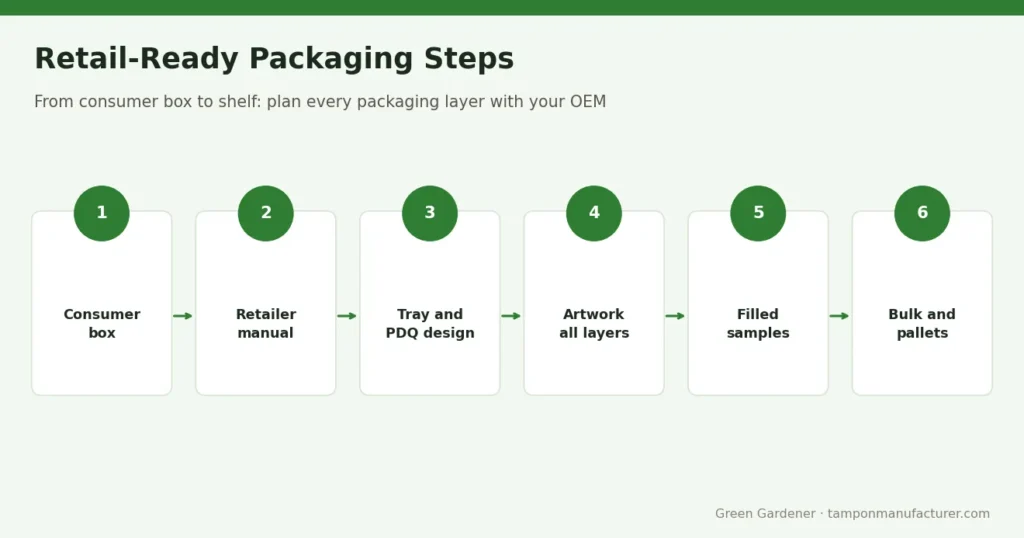
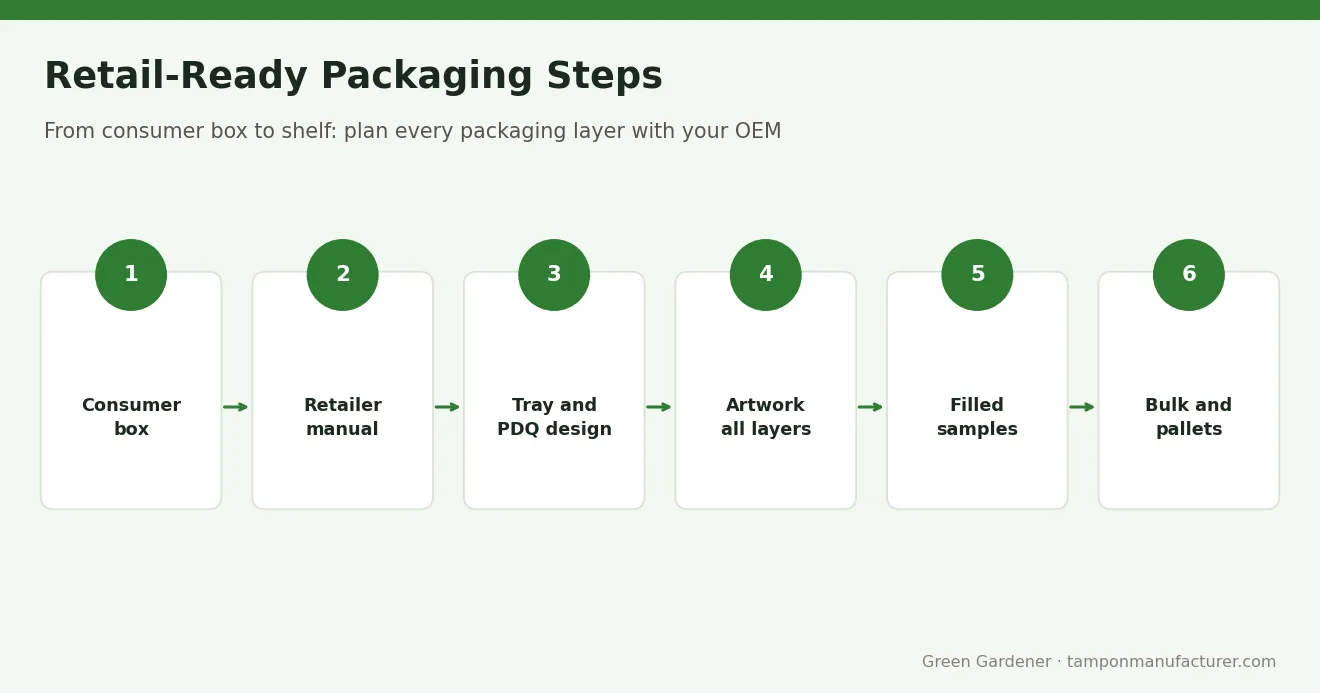
The most efficient programs plan packaging as part of product development rather than after it. A typical sequence is: confirm the tampon specification and consumer box, collect retailer requirements, design tray and case structures, prepare artwork for every layer, then approve samples before bulk. Our private label tampons service covers all of these steps, and our tampons range offers plastic, compact, cardboard and non-applicator options, including organic cotton, to build displays around.
With more than 15 years of experience, over 500 clients and a 52,000 m² factory, we coordinate product, printing and packing in one place. We provide documentation on request for retailer onboarding. Quantities, pricing and timing are confirmed in your quotation.
Request a Quote
Preparing for a retail listing or a promotional display? Send your retailer’s packaging requirements, SKU list and target formats through our contact page or on WhatsApp at +86 173 1689 5054. We will propose tray, PDQ and case options, arrange samples and confirm the details in your quotation.
Frequently Asked Questions
What is shelf-ready tampon packaging?
Shelf-ready packaging is a tray or case that staff can place directly on the shelf, usually after removing a tear-off panel, without unpacking boxes one by one. It speeds replenishment and keeps facings neat. The tampon boxes inside still carry the required labeling, because the tray is often discarded once the product sells through.
What is a PDQ display for tampons?
A PDQ display is a compact, ready-to-place display used on counters, endcaps or promotional areas. For tampons, PDQs often hold compact applicator packs, travel sizes or new launches. They arrive filled and are set up quickly by store staff. Retailer approval and space allocation are usually needed before a PDQ is shipped.
Which barcodes do retail tampon packs need?
Most retailers use GS1 standards: an EAN-13 or UPC-A barcode on each consumer unit and an ITF-14 or GS1-128 label on shipping cases, linked to GTINs registered to the brand owner. Requirements and positions vary by retailer, so check the supplier packaging manual and share it with your manufacturer.
Can regulated tampon information be printed only on the display tray?
That is not recommended. Trays and displays are usually discarded, so regulated information such as the absorbency term and TSS warning information should stay on the consumer unit and insert. In the US, 21 CFR 801.430 sets out these labeling elements; check current FDA requirements and confirm local rules for other markets.
Can you produce trays, PDQ displays and cases for private label tampons?
Yes. We coordinate consumer boxes, shelf-ready trays, PDQ displays and shipping cases to your retailer’s specifications, with artwork for each layer. Samples of the full packaging set are provided before bulk production. Quantities, pricing and timing are confirmed in your quotation, and we provide documentation on request.