
A tampon applicator is a two-part insertion component—typically a barrel and a plunger—used to position a tampon before the applicator is removed. The main commercial formats are full-size plastic, compact plastic and cardboard or paperboard. Non-applicator tampons are a separate format inserted without an applicator.
Quick sourcing answer: Green Gardener, the B2B period-care team behind TamponManufacturer.com, currently reviews projects for standard plastic, compact plastic and non-applicator tampons. Cardboard applicators are included in this guide for market comparison but are not currently available from our production route.
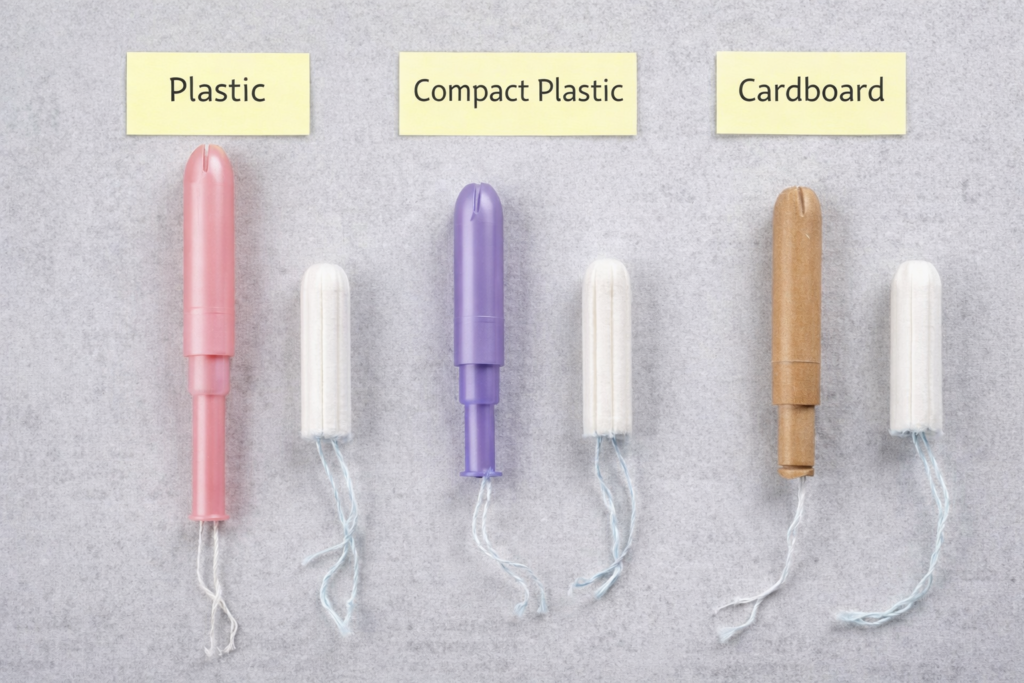
Tampon applicator types at a glance
| Format | How it is supplied | What a buyer should verify | Current project route |
|---|---|---|---|
| Full-size plastic | Barrel is supplied at its working length | Component drawing, resin specification, finish, dimensions and pack format | Available for project review |
| Compact plastic | Shortened for packing and extended before use | Extension mechanism, locked length, component integrity and instructions | Available for project review |
| Cardboard or paperboard | Paper-based barrel and plunger construction varies by supplier | Board grade, coating, seam, dimensional tolerance and substantiation for any environmental claim | Comparison only; currently unavailable |
| Non-applicator | Tampon supplied without a barrel or plunger | Product dimensions, wrapper, absorbency designation and user instructions | Available for project review |
What is a tampon applicator?
A tampon applicator is a temporary insertion component. The tampon sits inside the barrel, and the plunger advances it into position. After insertion, the applicator is removed and disposed of according to the product instructions and local waste rules. The applicator is not the absorbent part of the product.
For private-label buyers, “applicator type” is not a complete specification. The RFQ should identify the format, component dimensions, material specification, finish, tampon dimensions, absorbency designation, wrapper, retail pack and target-market labeling requirements.
What is a full-size plastic tampon applicator?
A full-size plastic applicator is supplied at or near its working length and normally requires no extension step before use. This format can simplify user instructions, but the exact barrel profile, tip geometry, grip, plunger travel and component material vary by design.
Do not approve a project from a marketing name alone. Ask the supplier for the component drawing and material declaration, then evaluate production samples in the intended wrapper and retail pack. Claims such as “smooth,” “comfortable” or “easy to use” should be supported by the relevant design evidence or user evaluation rather than treated as automatic properties of all plastic applicators.
What is a compact plastic tampon applicator?
A compact plastic applicator is shortened for storage and packing, then extended or activated before insertion. Its main commercial distinction is pack configuration: a shorter unit may support a different retail-box geometry or portability proposition, but actual pack savings depend on the approved component and count.
Buyers should review how the applicator extends, how it reaches and maintains its working length, whether the instructions clearly show the activation step, and whether the assembled component remains within the agreed dimensional and functional criteria.
What is a cardboard tampon applicator?
A cardboard or paperboard tampon applicator uses a paper-based construction for the barrel and plunger, often with design-specific surface treatment or coating. “Cardboard” does not define the complete material system, disposal route or environmental performance of the finished component.
Cardboard applicators should not automatically be described as biodegradable, compostable, plastic-free or environmentally friendly. The wording must match the exact board, coating, adhesive, finished construction, test evidence, disposal conditions and rules in the target market. The U.S. Federal Trade Commission Green Guides explain that environmental claims should be truthful, substantiated and appropriately qualified.
Availability note: Green Gardener does not currently offer cardboard applicator production. Buyers can request a review of standard or compact plastic applicator tampons, or consider non-applicator tampons.
Plastic vs cardboard applicators: what should brands compare?
The correct choice depends on the approved product specification and target market—not on a universal “best” material. A disciplined comparison should cover the following:
- Component design: barrel profile, tip, grip, plunger travel, tolerances and integrity.
- Material documentation: exact resin or board grade, coatings, colorants, adhesives and supplier declarations as applicable.
- Pack architecture: wrapper dimensions, retail-box count, carton configuration and artwork area.
- User communication: insertion instructions, compact-extension steps, disposal wording and required warnings.
- Market requirements: product classification, labeling, test documentation and responsible-party obligations for the destination country.
- Claim substantiation: evidence supporting material, performance, environmental or certification statements for the exact finished SKU.
How should an OEM buyer specify a tampon applicator?
A useful RFQ separates confirmed requirements from preferences. Start with the target market and intended product format, then provide the expected pack count, absorbency range, wrapper and box concept, artwork status, forecast volume and required documentation. The manufacturer can then identify which variables are available for review and which require additional development or verification.
- Name the format: full-size plastic, compact plastic or non-applicator.
- Define the product: tampon dimensions, materials and absorbency designation required for the market.
- Provide packaging inputs: wrapper, box count, barcode, language and shipping-carton requirements.
- List claim requirements: material, organic, sustainability or certification wording must be reviewed against evidence.
- Approve samples: record the accepted sample and its specification before commercial production.
- Confirm commercial terms: MOQ, lead time, price and delivery terms are quoted only after the specification and project scope are reviewed.
Safety and regulatory checks are product-specific
In the United States, tampons are subject to FDA review before legal marketing. The FDA states that manufacturers provide information on materials, absorbency, durability, microbiological considerations and labeling; applicator materials are part of the review when an applicator is present. See the FDA’s current tampon information and safe-use guidance.
An FDA requirement or authorization should not be presented as a blanket global certification, and documentation for one product does not automatically cover another SKU. Buyers should verify the exact product, responsible entity, market, document scope and validity before making a regulatory or certification claim.
Frequently asked questions
What does a tampon applicator do?
It holds the tampon during insertion and uses a plunger to advance the tampon into position. The applicator is removed after insertion; it is not the absorbent tampon itself.
What are the parts of a tampon applicator?
The typical two-part design has an outer barrel and an inner plunger. Tip, grip, locking and extension features depend on the component design.
What is the difference between full-size and compact plastic applicators?
A full-size applicator is supplied at its working length, while a compact applicator is shortened for packing and must be extended or activated before use.
Are cardboard applicators biodegradable?
Not automatically. The answer depends on the complete material system, coatings, adhesives, test method and disposal conditions. Any biodegradable or compostable claim requires evidence and market-appropriate qualification.
Does Green Gardener manufacture cardboard applicator tampons?
No. Cardboard applicators are discussed here for comparison, but they are not currently available from our production route. Standard and compact plastic applicator projects can be reviewed.
Which plastic is used for tampon applicators?
The exact resin and component construction vary by design and supplier. Buyers should request the material specification for the proposed applicator rather than assume that one resin description applies to every product.
What is a non-applicator tampon?
It is a tampon supplied without a barrel and plunger. It is a distinct product format and should be specified separately in an OEM or private-label request.
What should I send for an OEM applicator tampon quotation?
Send the target market, applicator format, absorbency range, materials, pack count, artwork status, forecast quantity, documentation requirements and delivery destination. MOQ, lead time and price can then be confirmed for the approved scope.
Discuss an applicator tampon project
Green Gardener supports B2B buyers through TamponManufacturer.com. Share your target market and draft specification so the team can review the suitable plastic applicator route, sample requirements and documentation scope.