

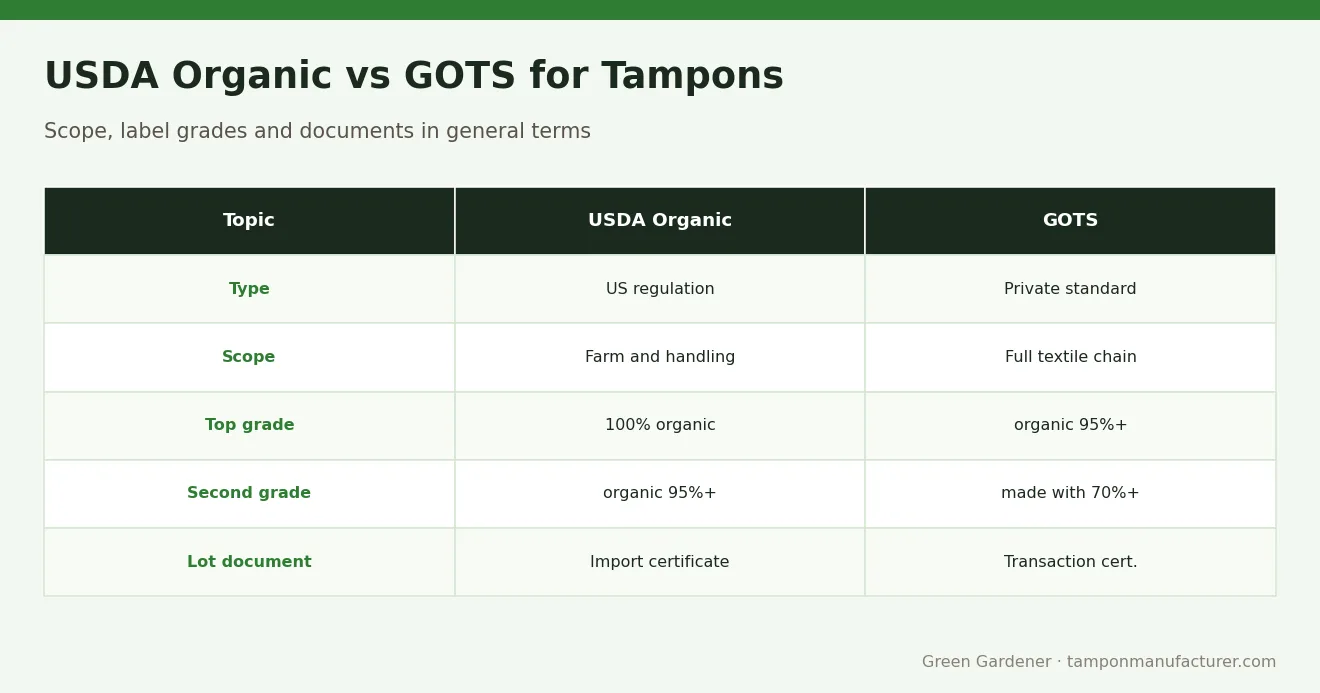
USDA Organic and GOTS are different systems. USDA Organic is a US government programme for agricultural products, run by the National Organic Program under 7 CFR Part 205. GOTS, the Global Organic Textile Standard, is a private international standard for textiles made from organic fibre, covering processing, chemicals and social criteria. Either can support an organic claim on tampon packaging, but only with certified supply chain documents and the correct label wording. This guide compares both and explains what brands should check.
Why Organic Claims Need a Standard Behind Them
“Organic cotton” is one of the most valuable words on a tampon box, and one of the most scrutinised. Retail buyers, marketplaces and regulators increasingly expect any organic statement to be backed by an independent certification and a traceable document chain, not just a supplier declaration.
For tampons, two frameworks come up most often in buyer conversations: the USDA National Organic Program (NOP) and the Global Organic Textile Standard (GOTS). Some suppliers also reference the Organic Content Standard (OCS) from Textile Exchange, which verifies organic fibre content through the chain but does not add GOTS-style processing criteria.
Remember that tampons are also medical devices in many markets. In the US, organic certification does not replace FDA device requirements, and in the EU and UK an organic claim must still meet general consumer protection rules on accurate labeling. Certification answers “is this fibre organic?”, not “is this product safe and compliant?”.
USDA Organic: What It Covers
The National Organic Program regulates how agricultural products are grown, handled and labeled when sold as organic in the US. Cotton is an agricultural crop, so organic cotton fibre can be certified under the NOP, and products made from it can carry USDA organic claims if every handling and processing step is certified by a USDA-accredited certifying agent.
Key points brands usually need to understand:
- Label categories – the NOP recognises “100 percent organic”, “organic” (at least 95% organic content) and “made with organic (specified ingredients)” (at least 70%). Only the first two may use the USDA seal.
- Certified chain – each operation that processes or relabels the product generally needs certification, unless an exemption applies.
- Imports – the Strengthening Organic Enforcement rule, in full effect since March 2024, requires NOP Import Certificates for organic products entering the US and widened who must be certified.
Because tampons are FDA-regulated devices, discuss your exact label wording with your certifier and regulatory adviser before artwork is finalised.
GOTS: What It Covers
GOTS is a private standard owned by Global Standard gGmbH and widely used for organic textiles. It requires organic fibre at the start of the chain and then sets environmental and social criteria for each processing stage, such as approved chemical inputs, wastewater treatment and labour conditions.
GOTS has two label grades:
- “organic” – at least 95% certified organic fibre.
- “made with X% organic materials” – at least 70% certified organic fibre.
Every company in the chain that processes or trades the goods must hold a valid GOTS scope certificate, and each shipment is supported by a transaction certificate (TC). The GOTS logo may only be used on products after approval from the brand’s certifier, and the label must show the certifier reference and licence number. Brands that sell under their own name generally need their own certification or licensing arrangement to use the logo, so plan this early and add the logo requirements to your packaging artwork checklist.
USDA Organic vs GOTS Side by Side
The table below summarises the main differences in general terms. Always confirm current rules with the standard owner and your certification body.
| Topic | USDA Organic (NOP) | GOTS |
|---|---|---|
| Type | US federal regulation | Private international standard |
| Legal basis | 7 CFR Part 205 | GOTS standard document (version 7 at time of writing) |
| Scope | Agricultural products and their handling | Textiles from organic fibre, all processing stages |
| Label grades | 100% organic, organic, made with organic | organic (95%+), made with organic (70%+) |
| Extra criteria | Organic production and handling rules | Chemical, environmental and social criteria |
| Key documents | Organic certificate, NOP Import Certificate | Scope certificate, transaction certificate |
| Logo use | USDA seal for top two categories only | Approval from certifier, licence number shown |
Many brands selling in several regions choose GOTS because it is recognised internationally, while US-focused brands may prefer USDA claims. Some use both where the supply chain supports it.
The Documentation Chain Behind an Organic Tampon
A credible organic claim depends on paperwork from field to finished box. For a tampon, the chain typically runs from organic cotton growing, through ginning, cleaning and bleaching, to fibre processing, tampon manufacturing and packing.
| Stage | What buyers usually request |
|---|---|
| Fibre source | Organic certificate of the fibre supplier |
| Processing | Scope certificates covering bleaching and fibre processing |
| Manufacturing | Certification status of the tampon factory for the claimed standard |
| Shipment | Transaction certificate or import certificate for the lot |
| Composition | Bill of materials showing every component and its organic status |
Components matter. The cotton absorbent core may be organic while the withdrawal cord, cover layer or applicator is not. The claim on pack must reflect this accurately, for example “organic cotton core” rather than “100% organic tampon” where non-organic parts are present. Our organic cotton tampon manufacturing page explains the material options we discuss with brands, and we provide supporting documentation on request, confirmed per project.
Wording and Logo Mistakes to Avoid
Most organic labeling problems come from small wording slips rather than bad intent. Watch for these:
- Using a certification logo before the certifier has approved the artwork.
- Saying “certified organic tampon” when only the cotton fibre is certified.
- Mixing USDA and GOTS terms in a way that implies one standard covers the other.
- Implying health benefits from organic cotton; organic status describes how the fibre is grown and processed, not medical performance.
- Forgetting that “chlorine-free” or “toxin-free” claims need their own substantiation.
Organic claims are also environmental claims, so wider green-claim rules apply. For bleaching and residue topics, see our article on chlorine-free bleaching and dioxin testing.
For Brands: Planning an Organic Tampon Line
If organic cotton is central to your brand story, decide which standard you will claim before you sample. The choice affects which suppliers qualify, what certificates you must collect and whether your own company needs certification. Practical steps:
- Choose the target standard by market: GOTS for broad international recognition, USDA where US consumers expect it.
- Ask your manufacturer which certified fibre sources are available and request current certificates for review.
- Agree the exact claim wording with your certifier, then build it into the packaging artwork checklist.
- Set up a shipment-level document file so every lot can be traced to its certificates.
We are a factory-direct OEM manufacturer with 15+ years of experience and organic cotton options for private label. We do not make certification claims on your behalf; we work with you to identify the documents your chosen standard requires.
Request a Quote
Planning an organic cotton tampon range? Share your target markets, absorbencies, applicator type and the organic standard you want to claim. We will confirm available material options and documentation in your quotation and can arrange samples before bulk. Contact us to request a quote or message us on WhatsApp at +86 173 1689 5054.
Frequently Asked Questions
Is USDA Organic the same as GOTS?
No. USDA Organic is a US government programme for agricultural products under 7 CFR Part 205. GOTS is a private international textile standard that adds chemical, environmental and social criteria to each processing stage. Both can support organic claims, but they have different label grades, documents and logo rules, so brands should choose one deliberately.
Can a tampon carry the USDA organic seal?
The USDA seal is reserved for products in the “100 percent organic” and “organic” categories, with every handling step certified by an accredited certifying agent. Because tampons are also FDA-regulated devices, brands should confirm exact wording with their certifier and regulatory adviser before printing the seal on any package.
What is a GOTS transaction certificate?
A transaction certificate, or TC, is issued by a GOTS-approved certification body for a specific shipment. It confirms that the goods in that lot were handled by certified companies and meet GOTS rules. Buyers commonly request TCs for each order so the organic claim can be traced back through the supply chain.
Does organic cotton make a tampon safer?
Organic certification describes how cotton is grown and processed, not medical performance. All tampons must meet the same safety and labeling requirements in their market, including TSS information. Brands should avoid implying health benefits from organic status and should advise consumers to follow package instructions and consult a doctor with concerns.
Do you hold USDA Organic or GOTS certification?
We do not make certification claims in articles. We offer organic cotton material options for private label tampons and provide supporting documentation on request. Tell us which standard you plan to claim and we will confirm in your quotation what documentation can be supplied for your specific project and materials.
Request a Tampon or Pad Quote
Tell us the product, quantity and your market. We reply with options, pricing and sample steps. Prefer chat? WhatsApp +86 173 1689 5054.