The best tampon wrapper material depends on what your brand needs most. Plastic film wrappers give the strongest moisture barrier and the quietest, cleanest opening. Paper wrappers support a lower-plastic story but need careful sealing and coating choices. Plant-based films sit in between and need careful claim wording. As a factory-direct OEM manufacturer, we help brands compare wrapper options on real samples, so hygiene, opening experience, print quality and sustainability messaging all fit the same product.
Why the Individual Wrapper Matters
The individual wrapper is the first thing a consumer touches and the last barrier between the tampon and the outside world. It keeps the pledget and applicator clean in a handbag, a gym locker or a humid bathroom, and it signals quality before the product is used. A wrapper that tears in the wrong place, rustles loudly or lets the tampon fall on the floor creates complaints that no marketing can fix.
For brands, the wrapper also carries practical information: the absorbency term or colour code, a “do not flush” reminder where relevant, and brand identity. It affects line speed, carton fill and even how a retail box looks when opened. Choosing the material is therefore a product decision, not just a packaging detail, and it is worth reviewing alongside applicator type on our applicator tampons page.
The Main Wrapper Materials
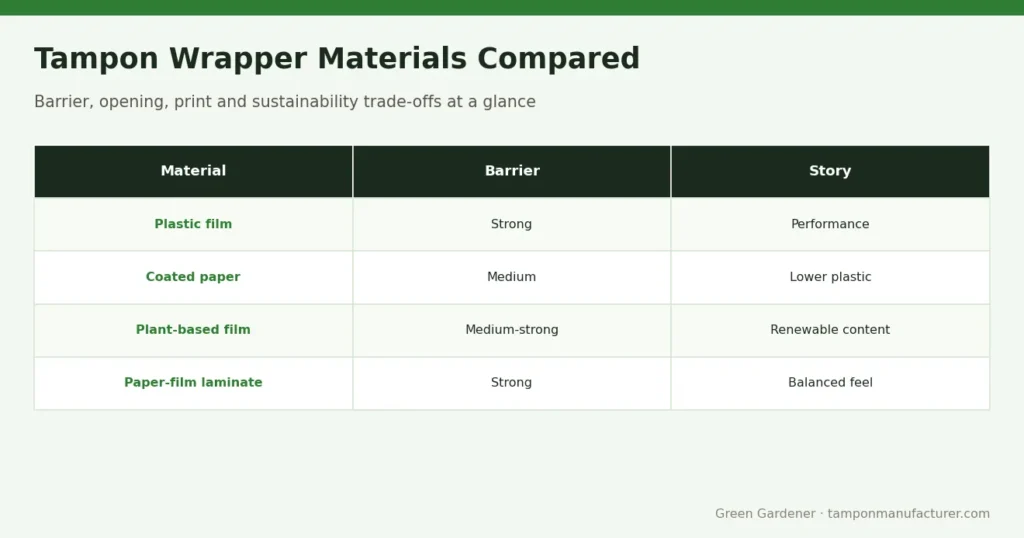
Most individually wrapped tampons use one of three material families. Each can be produced in several thicknesses and finishes, and the final choice is confirmed in your quotation after sampling.
| Material | Strengths | Watch points |
|---|---|---|
| Plastic film (PE or PP based) | Strong moisture barrier, smooth opening, bright print | Plastic content in sustainability messaging |
| Paper wrapper (often coated) | Lower-plastic story, natural look and feel | Seal strength, humidity, coating disclosure |
| Plant-based or compostable film | Renewable-content message | Claims need substantiation; disposal routes vary |
| Paper-film laminate | Balance of feel and barrier | Harder to describe as recyclable |
The applicator also influences the choice. Compact plastic applicators suit small, tight wrappers, while cardboard applicator tampons are often paired with paper wrappers to keep the whole product visually consistent.
Opening Tabs and Tear Features
A good wrapper opens in one motion, without fingernails or scissors, and without exposing the tampon to the floor. The common opening designs are:
- End tear notch: a small cut at one end that starts a straight tear; simple and widely used.
- Tear strip or ribbon: a pull strip that runs along the wrapper and opens it cleanly; often preferred for film.
- Peel seal: two layers sealed with a peelable bond, common on paper and laminate wrappers.
- Twist end: a twisted closure on some film wrappers, quick to open but less tamper-evident.
Opening force should be tested on samples by several people, including users with long nails and users opening in low light. Ask for a sample set with each opening type so your team can compare them side by side before artwork is finalised.
Hygiene, Moisture and Seal Integrity
The wrapper’s job is to keep the tampon clean and dry until use. Seal integrity matters more than the base material: a well-sealed paper wrapper can outperform a poorly sealed film. During development we check seal width, seal continuity and how the wrapper behaves after compression in the retail box.
Humidity is the main stress factor. Paper wrappers can soften or lose seal strength in hot, humid storage, so brands selling into tropical climates or storing stock in non-air-conditioned warehouses should test packed samples under the conditions their distributors actually use. Film wrappers are more forgiving, but they still need clean seals without channels or wrinkles. Our quality team can provide wrapper and seal inspection records as part of the documentation described in our tampon quality control documentation guide.
Printing and Branding on Wrappers
Wrappers are a small canvas, but they carry a lot of brand value. Film takes fine detail and bright colours well, while paper gives a softer, matte look that suits natural or organic positioning. Typical decisions include:
| Decision | Options | Tip |
|---|---|---|
| Colour coding | One colour per absorbency | Match the colour key on the outer box |
| Print coverage | Full print or spot logo | Spot print can simplify recycling messaging |
| Finish | Gloss, matte, pearlescent film | Approve on a physical sample |
| Text | Absorbency, brand, disposal note | Keep text legible at small size |
Print colours on paper and film rarely look identical, so approve each substrate separately. If your range mixes wrapper materials, set a colour standard per material rather than expecting a perfect match.
Production and Packing Considerations
Wrapper material also changes how the product runs in the factory. Film wrappers are formed and sealed at high speed with consistent results, while paper wrappers need tighter control of seal temperature, pressure and dwell time to avoid weak or scorched seals. Thicker or stiffer materials can change how many wrapped tampons fit in a box, which may affect carton size and shipping efficiency.
Before bulk production, we agree on the points that will be checked on every lot:
- Wrapper dimensions and seal width against the approved sample
- Seal continuity, with no open channels or wrinkles
- Print registration and colour against the approved standard
- Opening feature position and function
- Box fill and closure after wrapped tampons are packed
Writing these points into the specification avoids surprises when a brand reorders months later or adds a new absorbency to the range.
Sustainability Trade-Offs Without Greenwashing
Switching from film to paper reduces plastic in the wrapper, but it does not automatically make the product “eco-friendly”. Paper wrappers may carry coatings or adhesives, need more material weight to reach the same barrier, and may change carton size. Compostable films only deliver their promise where suitable composting is available, and tampon wrappers usually end up in general waste.
Describe what changed in specific, verifiable terms, such as “paper wrapper” or “plastic-free wrapper” if that is literally true for every component, and keep the evidence on file. Rules on environmental claims are tightening in several markets, so review claims with your compliance adviser before printing. In the EU, products such as tampons and tampon applicators fall under single-use plastics marking rules where plastic is present; check the current requirements for your packaging.
For Brands: Choosing and Testing Your Wrapper
A practical selection process keeps the decision grounded in evidence rather than opinion:
- Define your positioning: performance, value, natural or premium.
- Request samples of two or three wrapper options on your chosen applicator.
- Run an opening test with a small internal panel and record failures.
- Store packed samples in conditions that match your distribution climate.
- Approve print colour on the final substrate, then lock the specification.
Brands building a full range can review options on our private label tampons page. Samples are available before bulk production, and wrapper specifications are written into your order documents so every lot is produced the same way.
Request a Quote
Tell us your applicator type, absorbency mix, target markets and preferred wrapper material, and we will prepare samples and a quotation with wrapper options. Contact our team through the contact page or on WhatsApp at +86 173 1689 5054 to start your wrapper comparison.
Frequently Asked Questions
Are paper tampon wrappers as hygienic as plastic film?
Both can protect the tampon well when the seal is complete and the material suits the storage climate. Plastic film gives a stronger moisture barrier, while paper relies more on seal quality and coating. Testing packed samples in realistic humidity is the best way to confirm performance for your markets.
Can I call a paper wrapper plastic-free?
Only if every component of the wrapper, including coatings, inks and adhesives, is free of plastic and you hold documentation to prove it. If any coating or laminate contains plastic, use a narrower, accurate description instead. Review the final wording with your compliance adviser before artwork is printed.
Which opening style do consumers prefer?
Preferences vary by market and applicator type. Tear strips and peel seals usually feel easiest, while end notches are simple and familiar. The most reliable answer comes from a small panel test using your actual samples, recording how many attempts each person needs to open the wrapper.
Does wrapper material affect cost?
Yes. Material type, thickness, print coverage, opening features and line efficiency all influence the unit cost. Paper and specialty films can cost more than standard film depending on specification. Exact figures depend on your order and are confirmed in your quotation after the wrapper specification is agreed.
Can different absorbencies use different wrapper colours?
Yes, colour coding by absorbency is common and helps consumers pick the right tampon from a mixed box. Use the same colour key on the outer box and insert, and approve each colour on the actual wrapper material, because print can look different on paper and film.
Request a Tampon or Pad Quote
Tell us the product, quantity and your market. We reply with options, pricing and sample steps. Prefer chat? WhatsApp +86 173 1689 5054.