
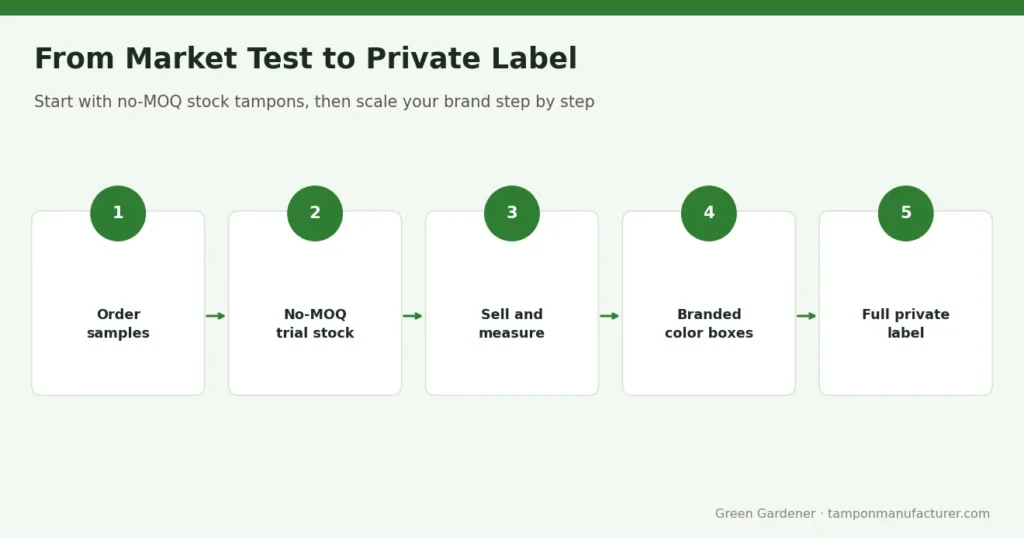
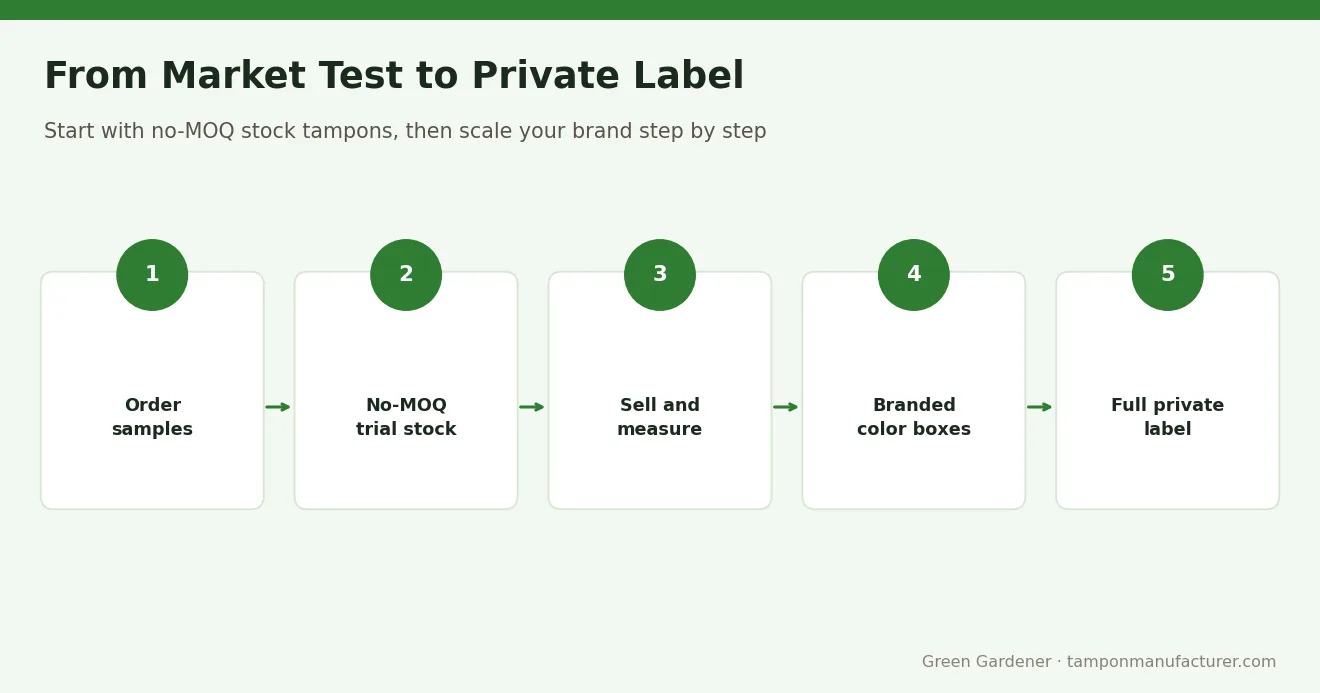
Quick answer
Start with in-stock tampons that have no minimum order quantity, sell them through one or two channels, and track sell-through, reorders and customer feedback. Once demand is proven, move to custom printed color boxes, which need a minimum of 5,000 boxes, and then to a full private label programme with your own specification and packaging.
The safest way to enter a new tampon market is to test demand with stock tampons before committing to a private label order. Our in-stock plastic applicator tampons have no minimum order quantity, so start-ups and distributors can order a trial quantity, sell through real channels and measure results. When the numbers support it, you can add branded color boxes, which start at 5,000 boxes, and then move into a fully custom programme with the same factory.
Why Test Before You Commit
A first private label order involves artwork, packaging, sampling, approvals and an order quantity confirmed in your quotation. All of that is worthwhile when you know the product will sell. When you do not yet know, the risk sits in your warehouse as unsold stock.
Testing with a ready product changes the order of events. Instead of designing packaging first and finding customers second, you put a real tampon in front of real buyers, learn what they want, and only then invest in a brand. This approach is common with distributors entering a new country, online sellers adding a category, and founders building a period-care brand from scratch.
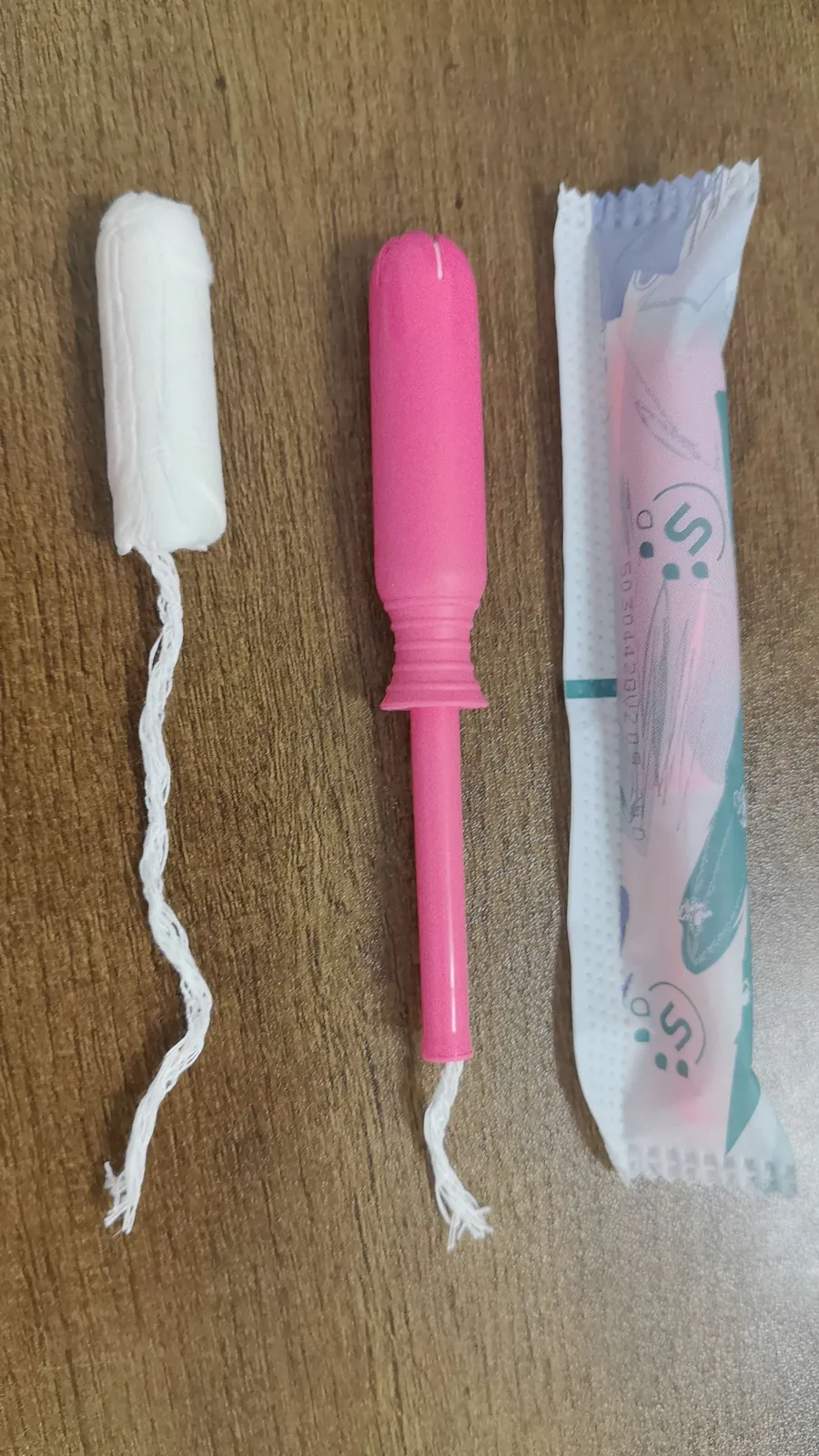
Our stock tampon is a standard unbranded “public version” product: a 70% cotton and 30% viscose core, a long pink PE applicator with finger grip rings, a cotton withdrawal string and an individually sealed PE wrapper. It is the tampon shown on this page, and it is ready to ship.
What a Market Test Should Answer
A good test is designed around clear questions. Before you order, write down what you want to learn:
- Demand: do customers in this channel buy tampons from you at all, and how quickly?
- Format: is a long plastic applicator the right format, or do buyers ask for compact, cardboard or non-applicator tampons?
- Absorbency mix: which absorbencies sell first, and which sit on the shelf?
- Price point: what retail or contract price does the channel accept?
- Reorders: do customers or accounts come back without heavy promotion?
If you cannot measure an answer, simplify the test until you can. One channel measured well is more useful than five channels measured loosely.
Choosing Your Test Channel
Different channels give different signals. Pick the one closest to your long-term business model.
| Channel | What it tells you | Watch points |
|---|---|---|
| Pharmacy or convenience retail | Shelf sell-through and reorder pace | Retail labeling and packaging rules |
| Online marketplace | Search demand and reviews | Listing rules and product claims |
| Institutions (schools, offices) | Contract volume and consistency | Tender terms and dispenser fit |
| Subscription or gifting | Retention and churn | Pack format and delivery costs |
| Distributor sub-accounts | Wholesale interest across regions | Margin structure and credit terms |
Institutional channels are often the quickest to validate, because one account can order steadily. Our guide to free period product laws and bulk supply explains how public-sector demand works in several markets.
A Simple Test Plan
Here is a practical sequence that keeps risk low and data clean:
- Request samples of the stock tampon and check the applicator, wrapper and string quality yourself.
- Tell us the absorbency you need; we confirm what is in stock and quote a trial quantity with no minimum.
- Confirm the labeling your market requires before the product goes on sale.
- Sell through one channel for a fixed test period and record units sold, reorders and feedback.
- Review the results against the questions you wrote down at the start.
- Decide whether to reorder stock, add branded color boxes, or move to private label.
Keep notes on every customer question. Questions about fiber content, applicator comfort or absorbency are early signals of what your private label specification should include.
It also helps to agree internal roles before the test starts. Decide who records sales, who collects feedback from accounts or reviews, and who makes the final reorder decision. When the same person tracks results from start to finish, the data stays consistent and the review meeting at the end is short. Store each shipment’s details, including absorbency and quantity, so you can link feedback to a specific delivery if questions arise later.
Measuring Results
Use a small set of indicators so the decision is objective rather than based on enthusiasm. The table below shows useful measures and what each one suggests.
| Indicator | Positive signal | Warning signal |
|---|---|---|
| Sell-through | Stock moves steadily | Stock ages on the shelf |
| Reorders | Accounts reorder unprompted | Sales need constant discounting |
| Feedback | Requests for more absorbencies | Complaints about format or fit |
| Margin | Price covers landed cost and margin | Margin only works at unsustainable prices |
| Channel interest | New accounts ask to stock it | Interest limited to one buyer |
If most signals are positive, you have the evidence to justify branded packaging. If they are mixed, adjust one variable, such as channel or absorbency mix, and run a second short test with stock tampons before spending on artwork.
Step Two: Branded Color Boxes
The first branding step does not require a new tampon. We can pack the same stock tampons into custom printed color boxes carrying your brand. Our color-box supplier requires a minimum of 5,000 boxes per order, while the tampons inside stay available from stock with no minimum order quantity.
This middle step gives you a retail-ready brand presence with less development work than a full private label programme. Before printing, make sure the box carries the labeling required in your market. In the United States, FDA rules at 21 CFR 801.430 cover absorbency terms and toxic shock syndrome (TSS) information on tampon labeling; check current FDA requirements, and confirm requirements for Canada, Australia or the GCC with Health Canada, the TGA or the SFDA.
Step Three: Full Private Label
Once your brand has steady demand, a full private label programme lets you specify the product: applicator type (plastic, compact, cardboard or non-applicator), core material including organic cotton options, wrapper design and packaging. Order quantities, pricing and timing are confirmed in your quotation.
Because the stock tampons come from the same factory, the move is straightforward. Your sales history from the test tells us which absorbencies and formats to prioritise, and samples are provided before bulk production. Learn more on our plastic applicator tampons page and our private label tampon OEM manufacturing guide.
Request Stock Pricing
Ready to test your market? Send us your country, channel, the absorbency you need and an estimated trial quantity. We will confirm what is in stock and send a written quotation. Reach us through the contact page or on WhatsApp at +86 173 1689 5054.
Frequently Asked Questions
What is the smallest order I can place for a market test?
The in-stock tampons have no minimum order quantity, so you can choose a trial quantity that fits your test channel. Tell us your target market and the absorbency you need, and we will confirm availability and pricing in a written quotation before you commit to anything.
How long should a market test run?
Long enough to see repeat purchases, not just first orders. The right period depends on your channel: institutional accounts may show a pattern quickly, while retail shelves need more time. Decide the test period in advance and judge results against the indicators you set at the start.
Can I sell stock tampons under my own brand during the test?
Yes, by using custom printed color boxes. We pack the stock tampons into retail cartons printed with your brand. Our color-box supplier requires a minimum of 5,000 boxes, so many buyers test in standard packing first and add branded boxes once demand is proven.
Will my private label tampon be the same as the stock tampon?
It can be, or you can change the specification. Many brands keep the proven stock format and add their own packaging, while others switch applicator type, core material or wrapper design. Samples are made before bulk production so you can compare options side by side.
What labeling do I need before selling?
Labeling rules depend on your market. In the United States, 21 CFR 801.430 covers tampon absorbency terms and TSS information. For other countries, check with the relevant regulator, such as Health Canada, the TGA or the SFDA. We provide product documentation on request to support your review.