

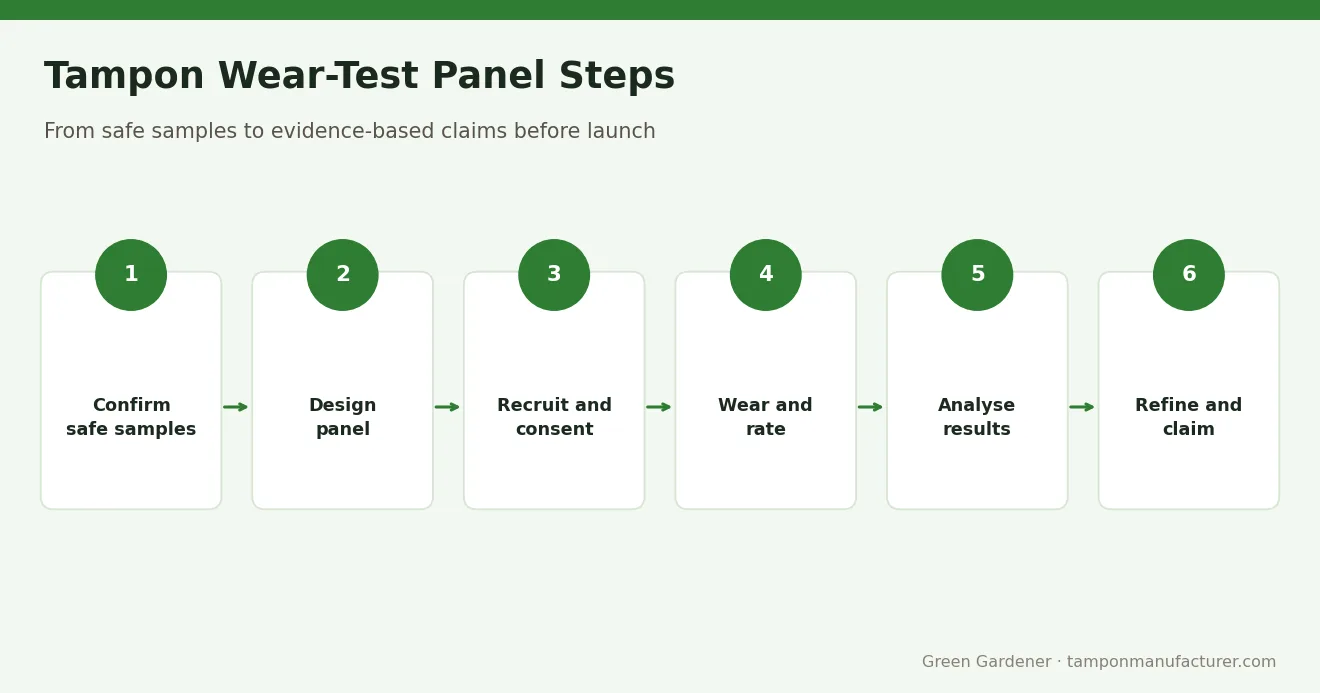
A tampon wear-test panel is a structured trial in which adult volunteers use your samples during their periods and report on comfort, insertion, removal and leakage. It helps brands compare designs, refine the product and decide which consumer-perception claims they can support. Good panels use samples that already meet safety and labeling requirements, obtain informed consent, protect privacy and use consistent scoring forms. This guide explains how to plan, run and analyse a wear test before launch.
Why Run a Wear-Test Panel
Laboratory tests measure absorbency, cord strength and other technical properties, but they cannot tell you how a tampon feels to use. A wear-test panel fills that gap. It shows how real users experience insertion, comfort during wear, removal and leakage, and it often highlights differences between designs that look similar on paper.
Wear tests also support marketing. Statements such as “most panellists rated it comfortable” are consumer-perception claims, and they need data from a properly designed study. Running the panel before final packaging means you can base copy on evidence rather than assumptions.
Panels are equally valuable for spotting problems early. A slightly sharp applicator tip, a cord that feels too short or a pledget that users find hard to remove are far cheaper to fix at sampling stage than after thousands of retail boxes have been printed and shipped. Retail buyers reviewing a new range may also ask what consumer testing has been done, so a documented wear test strengthens your line review presentation.
Common Wear-Test Mistakes to Avoid
Many panels produce weak data because of avoidable design errors. Watch for these:
- Testing branded packaging, which biases participants towards or against a product.
- Changing the questionnaire partway through the study, making results impossible to compare.
- Recruiting only colleagues or friends, who may not represent real customers and may rate kindly.
- Testing one absorbency and assuming results apply to the whole range.
- Making claims broader than the data, such as “leak-free” from a small panel.
Agreeing the protocol, questionnaire and analysis plan before samples are sent keeps the study fair and the conclusions defensible.
Before You Start: Safety and Ethics
A wear test involves people using a product internally, so preparation matters. Before recruiting, confirm the following:
- The samples meet the safety, absorbency and labeling requirements of the market where testing takes place.
- Each participant receives the package insert, including TSS information and usage guidance.
- Participants are adults and give written informed consent, including the right to withdraw at any time.
- Personal data is collected only as needed, stored securely and handled under applicable privacy law, such as GDPR in Europe.
- There is a clear route for participants to report problems, and they are advised to stop use and consult a doctor if they have health concerns.
Depending on the country, the type of product and how results will be used, independent ethics review may be appropriate. Many brands use specialist research agencies familiar with local requirements.
Designing the Panel
Panel design determines whether results are useful. Key decisions include:
| Decision | Options | Guidance |
|---|---|---|
| Panel size | Small pilot or larger panel | Larger panels give more reliable comparisons |
| Participants | Current tampon users, first-time users, specific flow levels | Match your target customer |
| Design type | Single product or comparison | Comparisons work best with blinded, coded samples |
| Duration | One or more cycles | Longer studies capture more variation |
| Absorbencies | One level or full range | Test each absorbency you will sell |
| Benchmark | Current market product | Optional, repack neutrally to avoid brand bias |
Randomise the order in which participants use test products when comparing designs, so results are not skewed by which tampon was tried first.
Recruiting Participants
Recruit people who represent your intended customers. For a mainstream range, that usually means adult regular tampon users with a mix of flow levels and applicator preferences. For a beginner-focused or heavy-flow line, adjust the criteria accordingly.
- Write a short screening questionnaire covering tampon use, preferred absorbencies and applicator type.
- Exclude anyone who should not take part on health grounds, as advised by your research partner.
- Explain the study clearly, including time commitment and data use.
- Collect signed consent before sending samples.
- Provide discreet packaging and clear instructions.
Feedback Forms and Scoring
Use the same questionnaire for every product and participant. Short forms completed after each use, plus an end-of-study summary, work well. Rating scales, often five points, make results easy to compare.
| Attribute | Example question | Scale |
|---|---|---|
| Insertion | How easy was insertion? | 1 very difficult to 5 very easy |
| Comfort | How comfortable was the tampon while worn? | 1 very uncomfortable to 5 very comfortable |
| Leakage | Did you notice any leakage before removal? | None, slight, moderate, heavy |
| Removal | How comfortable was removal? | 1 to 5 |
| Wear time | Approximately how long was it worn? | Recorded time band |
| Overall | How likely are you to buy this product? | 1 to 5 |
Include open questions for comments; they often reveal issues such as applicator edges or cord feel that ratings miss. Remind participants to follow the package guidance on maximum wear time.
Analysing Results
Summarise results by product and absorbency, comparing average scores and the share of positive ratings. Look for consistent patterns rather than single comments, and check whether differences between designs are meaningful given the panel size.
Segment the data where the panel allows, for example by usual absorbency, applicator preference or first-time versus experienced users. A design that scores well overall may still disappoint a key group, such as heavy-flow users, and that insight can shape range planning and packaging guidance.
Turn findings into action: adjust applicator finish, cord length, pledget design or absorbency targets, then confirm changes with a follow-up sample round if needed. Record which claims the data supports, the exact wording, and the study details, and keep this file with your other product documentation. Our sample request guide explains how to obtain additional samples for repeat testing.
For Brands: Planning Samples for Your Panel
As a factory-direct OEM manufacturer, we provide samples before bulk so brands can run wear tests on the actual design they intend to launch. For panels, plan sample quantities per absorbency and per design, and ask for neutral or coded packaging if you are running a blinded comparison. Supporting documentation for the samples is available on request.
We offer plastic, compact, cardboard and non-applicator formats, including plastic applicator tampons, and can adjust details such as applicator finish and pledget design between sample rounds. Labeling guidance for your final packaging is covered in our tampon labeling requirements guide.
Request a Quote
Planning a wear-test panel before launch? Tell us which designs, absorbencies and applicator types you want to compare, and we will confirm sample arrangements in your quotation. Request a quote or contact us on WhatsApp at +86 173 1689 5054.
Frequently Asked Questions
What is a tampon wear-test panel?
A tampon wear-test panel is a structured study in which adult volunteers use sample tampons during their periods and rate insertion, comfort, removal and leakage. Brands use the results to compare designs, improve the product before launch and support consumer-perception claims with documented evidence rather than assumptions.
How many people should be in a wear-test panel?
There is no fixed number. Small pilot panels can reveal obvious issues quickly, while larger panels give more reliable comparisons between designs and absorbencies. If you plan to make published claims, ask your research partner what panel size and study design are appropriate for the type of claim you intend to make.
Do participants need to sign consent forms?
Yes. Participants should be adults who give written informed consent after receiving a clear explanation of the study, the products, data use and their right to withdraw at any time. They should also receive the package insert with TSS information and be advised to stop use and consult a doctor if concerned.
Can wear-test results be used in marketing claims?
They can support consumer-perception claims, such as the share of panellists who rated a product comfortable, if the study was properly designed and documented. Keep the exact claim wording, study details and data on file. Claims must be truthful, not overstated, and consistent with the rules of each market where you sell.
Should wear tests use final production samples?
Ideally, yes. Testing samples made with the intended materials, design and applicator gives the most relevant results. Samples must already meet the safety and labeling requirements of the market. If you change the design after testing, consider a follow-up round to confirm the changes perform as expected.
Request a Tampon or Pad Quote
Tell us the product, quantity and your market. We reply with options, pricing and sample steps. Prefer chat? WhatsApp +86 173 1689 5054.