
Junior and small tampons are slim tampons in the lowest absorbency band, which US labeling calls Light (6 g or less, measured by the syngina test). They suit light flow days and many first-time users, including teens. The right size depends on flow, not age: start with the lowest absorbency that manages your flow, follow the package insert and ask a doctor if you have concerns. Below we explain sizes, first-use tips, TSS awareness and what brands should consider when building a junior line.
What “Junior” and “Small” Tampons Mean
“Junior”, “small”, “mini”, “slim” and “teen” are product or marketing names, not regulatory categories. On a US package the absorbency term that appears is set by FDA rule 21 CFR 801.430, and the lowest band is labeled Light. A product sold as “junior” is normally a Light absorbency tampon with a narrower width and a smooth applicator designed for comfortable insertion.
Two different things are often mixed up:
- Absorbency – how much fluid the tampon holds in a standardized lab test, shown by the absorbency term on the pack.
- Physical size – the width and length of the tampon and applicator, which affects how it feels to insert and remove.
A slim tampon is not automatically low absorbency, and a Light tampon can vary in width between brands. Reading the absorbency term on the box is the reliable way to compare products. For a wider overview of first-time options, see our guide to the best tampons for teens and first-time users.
Absorbency Bands: Why Light Is the Usual Starting Point
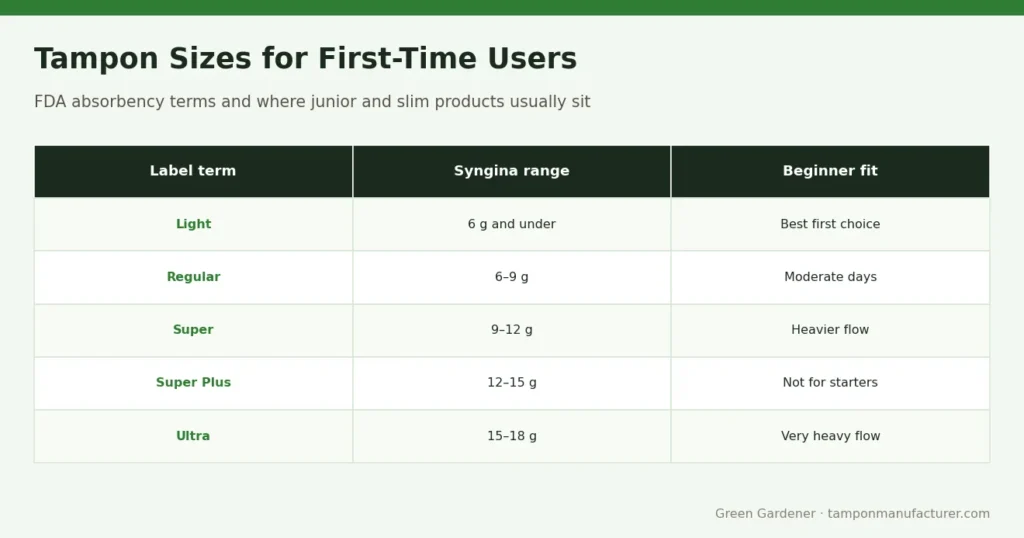
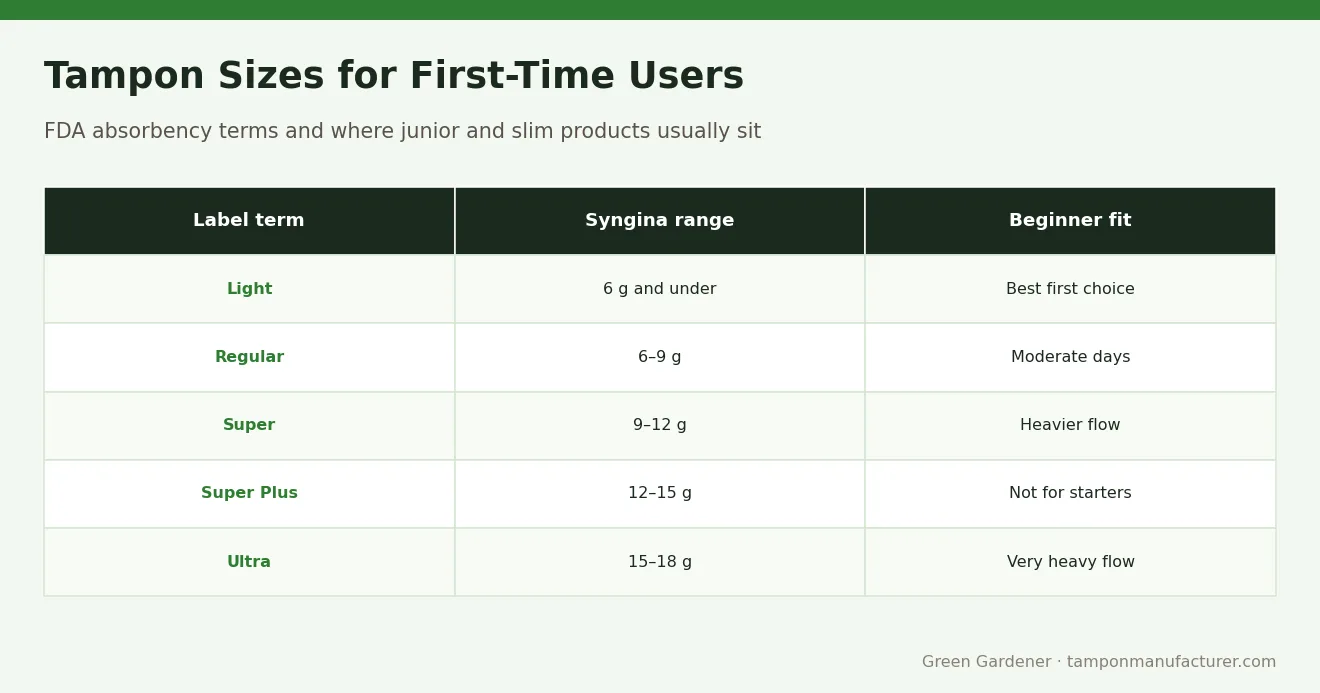
FDA labeling uses standard terms so shoppers can compare brands. Each term corresponds to a range of grams of fluid absorbed in the syngina test:
| Label term | Syngina range | Typical use |
|---|---|---|
| Light | 6 g and under | Light days, first-time users |
| Regular | 6–9 g | Light to moderate flow |
| Super | 9–12 g | Moderate to heavy flow |
| Super Plus | 12–15 g | Heavy flow |
| Ultra | 15–18 g | Very heavy flow |
Package inserts advise using the lowest absorbency needed to control your flow. That is why Light tampons are the natural first choice for beginners and for lighter days. If a Light tampon becomes fully soaked well before the time you would normally change it, moving up to Regular may be appropriate. If it is still mostly dry and uncomfortable to remove, the absorbency may be higher than needed. Our article on tampon absorbency levels covers the full range.
Slim Width, Applicator and Tip: The Physical Side of Size
For many teens the feel of insertion matters as much as absorbency. Product design choices that make a tampon feel smaller include:
| Feature | Beginner-friendly option | Why it helps |
|---|---|---|
| Width | Slim or mini profile | Less stretch on insertion |
| Applicator | Smooth plastic or compact | Glides easily, guides placement |
| Tip | Rounded, petal tip | Gentler entry |
| Grip | Textured finger grip | Better control for new users |
| Cord | Secure, easy-to-find string | Confident removal |
Non-applicator (digital) tampons are also available in small sizes, but many first-time users find an applicator easier at the start because it guides the tampon to the right depth. Cardboard applicators work well too, though they are firmer than plastic.
Length also varies. Mini and compact formats are shorter overall, which makes them easy to carry in a pocket or school bag, but the absorbency term still decides how much fluid they hold. When comparing two products labeled Light, the one with the narrower width and smoother applicator will usually feel smaller in use, even if both absorb a similar amount in the lab test.
What Size Tampon for a 13-Year-Old?
There is no tampon size tied to a specific age. A 13-year-old, an older teen and an adult with a light flow may all choose the same product. What matters is:
- Flow level – start with Light absorbency and move up only if needed.
- Comfort – a slim width with a smooth applicator is usually easiest.
- Readiness – there is no rule about when to start using tampons; it is a personal choice, and pads or period underwear are equally valid options.
A tampon cannot get lost inside the body, and using one does not change virginity. If insertion is painful every time, or if there are questions about anatomy or very heavy bleeding, it is sensible to speak with a doctor or school nurse.
Parents and carers can help by buying a small mixed pack, so a teen can try Light tampons alongside pads and liners and decide what feels right. Practising on a moderate flow day at home, rather than before a sports event or exam, also takes pressure off the first attempt.
First-Time Tips for Using a Small Tampon
These general tips follow the kind of guidance found in standard package inserts. Always read the leaflet in the box you buy.
- Wash your hands and read the instructions before you start.
- Choose a day with a moderate flow; a completely dry tampon is harder to insert.
- Find a relaxed position, such as sitting on the toilet with knees apart or standing with one foot raised.
- Angle the tampon toward the lower back rather than straight up.
- Insert until your fingers touch your body, then push the inner tube fully and remove the applicator.
- If you can feel the tampon, it is usually not far enough in; remove it and try a new one.
- Change it regularly and never leave it in longer than the maximum time stated on the insert.
TSS Awareness for Teen Users
US tampon labeling must explain Toxic Shock Syndrome (TSS), a rare but serious illness associated with tampon use. The required information notes a higher reported risk for teenagers and younger women, which is one reason beginners are advised to use the lowest absorbency that manages their flow. Package inserts list warning signs such as sudden high fever, vomiting, diarrhea, dizziness or fainting, and a sunburn-like rash. If these appear, the advice is to remove the tampon and seek medical attention right away.
Good habits include alternating tampons with pads, for example using a pad overnight, and never using a higher absorbency than needed. This article is general information, not medical advice.
For Brands: Building a Teen or Junior Tampon Line
A dedicated junior range helps brands reach first-time buyers early and build long-term loyalty. Practical points to plan with your manufacturer:
- Range mix – a Light slim tampon as the hero, often paired with Regular slim and a starter pad or liner.
- Applicator choice – smooth plastic or compact applicators for comfort, or cardboard for plastic-reduction positioning.
- Clear insert – simple language, step diagrams and the full TSS information required in each target market.
- Packaging tone – reassuring and discreet, with the absorbency term easy to find.
- Testing – syngina results that support the Light label, plus material documentation.
As a factory-direct manufacturer with 15+ years of experience and 500+ clients, we produce slim and Light tampons with plastic, compact, cardboard and non-applicator options, including organic cotton cores. See our slim, mini and Light tampon OEM page and private label tampon service for details. Samples are available before bulk production.
Request a Quote
Planning a junior or teen tampon range? Share your target market, absorbency mix, applicator type and packaging ideas through our contact page or on WhatsApp +86 173 1689 5054. Minimum order, pricing and timing are confirmed in your quotation, and we provide test documentation on request.
Frequently Asked Questions
Are junior tampons the same as Light tampons?
Usually, yes. “Junior” is a product name rather than a regulatory term. In the US, the absorbency term printed on the pack must follow FDA rules, and the lowest band is Light, meaning 6 g or less in the syngina test. Check the absorbency term on the box rather than relying on the product name.
What size tampon should a beginner use?
Most beginners start with a Light or slim Regular tampon with a smooth applicator. Package inserts advise using the lowest absorbency that controls your flow. If a Light tampon soaks through quickly, try Regular. If it feels dry and uncomfortable to remove, the absorbency is likely higher than you need.
Can a 13-year-old use tampons?
Yes, many teens use tampons from their first periods if they feel comfortable. There is no medical age limit, and pads or period underwear are equally good choices. Starting with the lowest absorbency, following the package insert and talking to a parent, school nurse or doctor with any questions is a sensible approach.
Why does tampon labeling mention teenagers and TSS?
US labeling rules require tampon inserts to explain Toxic Shock Syndrome, including the higher reported risk among teenagers and younger women. This is why beginners are encouraged to use the lowest effective absorbency, change tampons regularly, alternate with pads and seek medical help quickly if warning signs such as sudden fever or rash appear.
Can brands order slim Light tampons as private label?
Yes. We manufacture slim and Light tampons for private label brands with plastic, compact, cardboard or non-applicator formats and optional organic cotton. Packaging, insert language and absorbency mix are agreed during development, samples are provided before bulk orders, and minimum order details are confirmed in your quotation.