
Tampon absorbency is one of the most important product characteristics in feminine hygiene manufacturing. It affects user safety, product labeling, market compliance, and customer trust. That is why absorbency cannot be estimated or described casually. It must be tested using standardized methods and documented correctly.
For consumers, absorbency helps them choose the right product for their flow. For brands, importers, and sourcing teams, absorbency testing is a critical part of quality control when working with a professional tampon manufacturer.
What Does Tampon Absorbency Mean?
Tampon absorbency refers to how much fluid a tampon can absorb under defined test conditions. It is normally measured in grams and used to classify the tampon into standard absorbency categories.
Absorbency matters because it influences:
- product performance
- labeling accuracy
- user guidance
- regulatory compliance
- quality consistency across batches
A tampon that is poorly classified or inconsistently produced can create both safety risk and commercial risk.
Why Standardized Testing Is Necessary
Absorbency testing must be standardized so results can be compared consistently across product types and production batches. Without a standardized method, two products might claim the same absorbency level while performing very differently in use.
That is why manufacturers use controlled lab procedures rather than informal internal estimates.
How Tampon Absorbency Is Commonly Tested
A widely used lab approach for tampon absorbency testing is based on controlled fluid exposure under standardized conditions. In the U.S. market, testing is commonly aligned with recognized FDA absorbency measurement principles, including the syngyna-based method used to classify tampon absorbency.
Although exact lab procedures may vary by testing environment, the general process includes:
1. Sample Selection
A defined number of tampons from the same product specification are selected for testing. Samples must represent the actual production design, including the same material composition, density, and dimensions.
2. Controlled Test Medium
The tampons are exposed to a standardized saline solution or equivalent controlled test fluid under lab conditions. This is important because testing must be repeatable and comparable.
3. Measured Fluid Uptake
The amount of fluid absorbed is measured in grams. This result determines the product’s absorbency classification.
4. Multiple Sample Verification
Manufacturers do not rely on one single sample. Average performance across multiple units is reviewed to confirm consistency.
5. Documentation and Record Retention
The final results are recorded as part of the product’s quality documentation. These records are especially important for OEM tampons, regulatory review, and private label projects.
Common Absorbency Categories
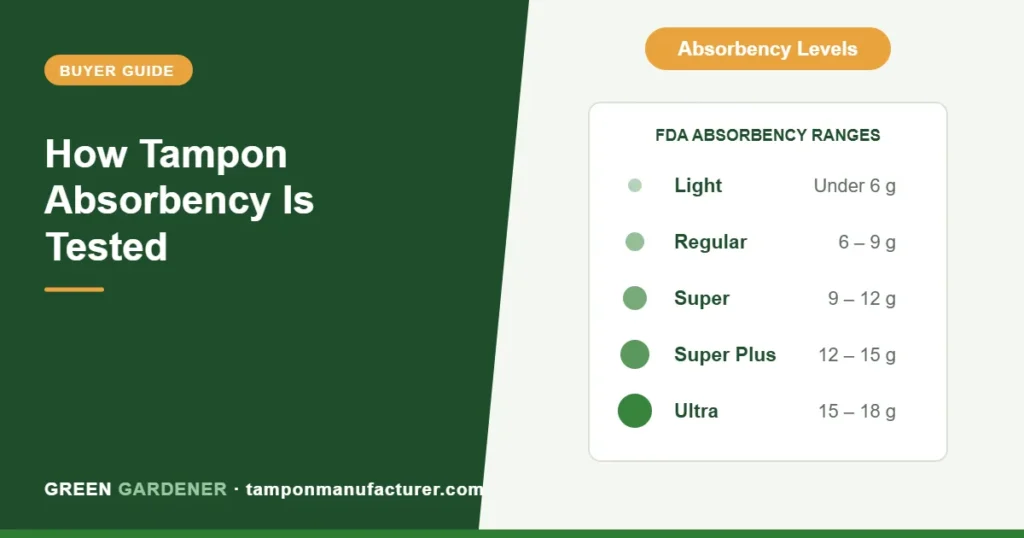
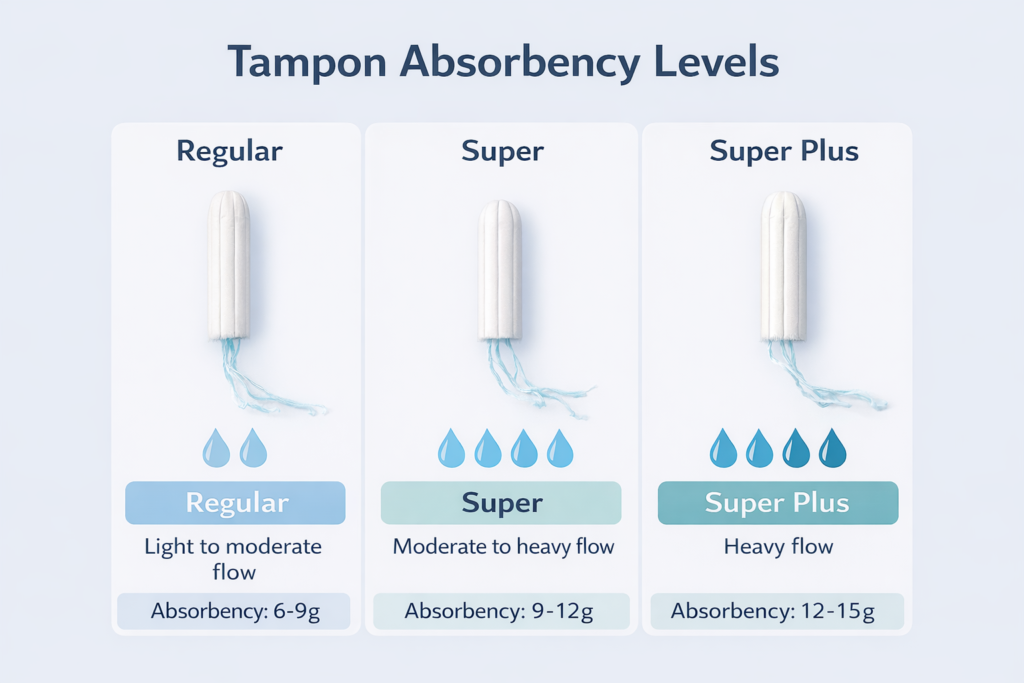
For the U.S. market, tampon absorbency categories are generally classified as follows:
| Absorbency Level | Absorption Range |
|---|---|
| Light | Less than 6 g |
| Regular | 6 to 9 g |
| Super | 9 to 12 g |
| Super Plus | 12 to 15 g |
| Ultra | 15 to 18 g |
These ranges matter because packaging and marketing claims must match tested performance. You can also review our detailed guide on tampon absorbency levels.
Why Accurate Testing Matters
Absorbency testing is not just a technical requirement. It directly affects how a product is sold and trusted in the market.
Accurate testing helps ensure:
- The right absorbency label appears on the pack
- Product claims are supported by test data
- Consumers can choose the appropriate flow level
- quality remains stable from one batch to the next
- The brand reduces compliance and recall risk
For a tampon factory, absorbency testing is part of the broader quality system, not a one-time lab exercise.
Absorbency Testing and OEM / Private Label Projects
If you are launching private label tampons, absorbency testing becomes especially important because the brand owner is still responsible for product claims even if production is outsourced.
Before launching a product, buyers should confirm:
- whether each absorbency level has been tested separately
- whether reports match the exact product design
- whether material changes trigger re-testing
- whether the manufacturer keeps clear batch records
This is why many brands review both tampon quality control in manufacturing and how tampons are manufactured before selecting a supplier.
Common Mistakes Brands Should Avoid
Brands and buyers sometimes make avoidable mistakes, such as:
- assuming one test report covers all absorbency levels
- using marketing language that does not match the tested range
- changing material composition without re-checking absorbency
- focusing only on price without reviewing the manufacturer’s quality records
These problems often appear later, when packaging is finalized, shipments are inspected, or customer complaints begin.
What to Ask Your Tampon Manufacturer
When evaluating a supplier, ask these questions:
- What test method do you use for tampon absorbency?
- Are absorbency reports available for each specification?
- How do you control consistency between batches?
- What happens if raw materials or density settings change?
- How is absorbency testing integrated into your quality control workflow?
A reliable manufacturer should be able to answer clearly and provide supporting documentation.
Final Thoughts
Tampon absorbency testing is a core part of product safety, labeling accuracy, and quality assurance. It helps manufacturers classify products correctly, helps brands make compliant claims, and helps consumers choose the right option.
For sourcing teams, absorbency testing is also a practical way to evaluate whether a tampon manufacturer has a strong quality system. If you need support with absorbency categories, OEM product development, or compliance-oriented production, contact us to discuss your project.
Frequently Asked Questions
How is tampon absorbency usually measured?
Tampon absorbency is usually measured in grams under standardized test conditions. The result is used to classify the product into absorbency categories such as regular, super, or super plus.
Why is absorbency testing important?
Absorbency testing is important because it supports product labeling accuracy, quality consistency, consumer guidance, and compliance with market standards.
Do all absorbency levels need separate testing?
Yes, each absorbency level should be evaluated according to its own specification because changes in material, density, or design can affect performance.
What should private label buyers ask about absorbency testing?
Private label buyers should ask about test methods, report availability, batch consistency, documentation, and whether product changes trigger re-testing.