
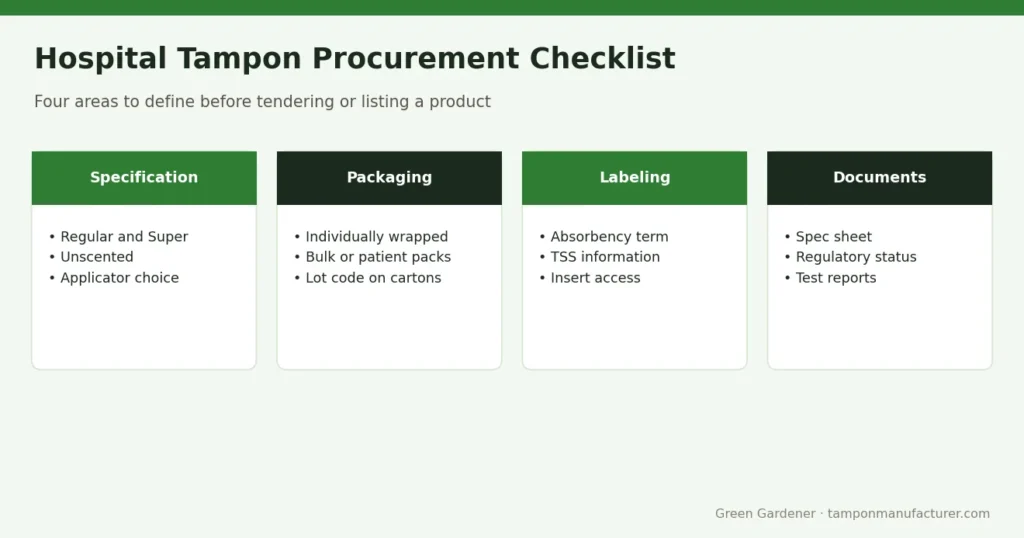
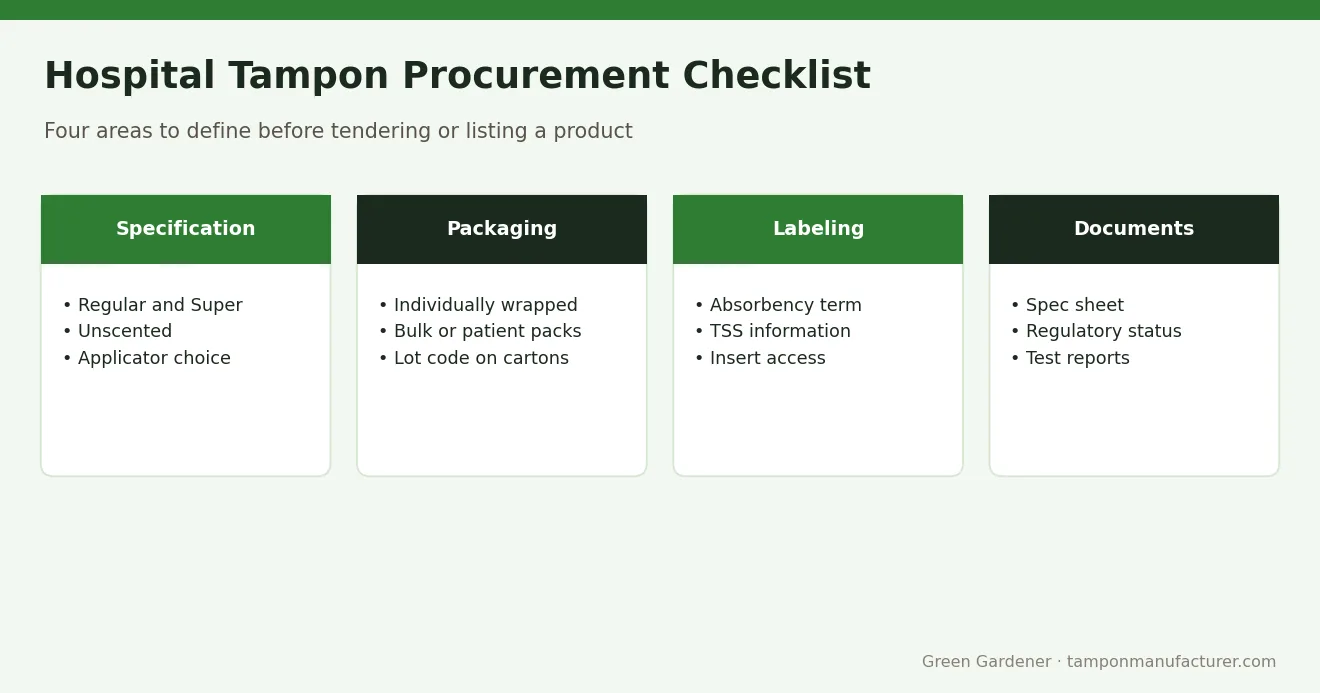
Hospitals and clinics buy tampons for patients, visitors and staff, usually through tenders, group purchasing or healthcare distributors. The priorities differ from retail: individually wrapped units, clear absorbency labeling with toxic shock syndrome information, consistent lot coding, compact storage and a complete documentation file. This guide explains how institutional buyers and the distributors who serve them can specify, source and document bulk tampons from a manufacturer.
Where Tampons Are Used in Healthcare Settings
Demand in healthcare is steady but spread across many points of use. Typical locations include inpatient wards, where patients may need products during a stay; women’s health and outpatient clinics; staff changing rooms and restrooms; visitor facilities; and long-term care settings.
Not every department needs tampons. Postpartum care, for example, typically relies on maternity pads, and tampon use after childbirth or gynaecological procedures should follow clinician advice. This is why many institutional orders combine tampons with sanitary pads and panty liners under one supply agreement, which simplifies tendering and delivery.
Mapping these points of use before you write a tender helps you estimate volumes, choose pack formats and decide which absorbencies each location really needs. A women’s health clinic may want a wider absorbency range, while staff restrooms can usually be served with two core options.
Storage, Stock Rotation and Delivery for Healthcare Sites
Hospital store rooms are often crowded, so compact cartons and clear outer labeling make a real difference. Tampons should be kept in a clean, dry area away from heat and humidity, off the floor and within the stacking limits printed on cartons.
Rotate stock by expiry date so older lots are issued first, and record lot codes when stock is moved to wards or dispensers. Central stores that supply several sites benefit from consistent carton sizes and barcodes, which speed up receiving and inventory counts. Delivery frequency, carton configuration and labeling for your distribution network are confirmed in your quotation.
Product Specification for Institutional Tampons
A clear specification keeps tenders comparable and avoids substitution problems later. Most institutional buyers define:
| Specification | Typical institutional choice | Why it matters |
|---|---|---|
| Absorbency range | Regular and Super; Light on request | Covers most needs with fewer SKUs |
| Applicator type | Plastic, compact or cardboard | Hygiene, user preference, waste policy |
| Absorbent material | Cotton, rayon blend or organic cotton | Policy and patient preference |
| Fragrance | Unscented | Widely preferred in healthcare |
| Wrapping | Individually wrapped | Hygiene and single-unit issue |
| Labeling | Absorbency term and TSS information | Regulatory and patient information |
See our applicator tampons range for the formats we produce. Unscented, individually wrapped units are the most common institutional choice.
Keep the specification focused on performance and safety rather than on one supplier’s product names. That keeps the tender open to comparable offers and makes it easier to approve a second source if supply is disrupted.
Packaging Formats for Wards and Restrooms
Institutional packaging should be easy to store, count and issue. Retail-style boxes are fine for small clinics, but larger buyers usually prefer simpler formats that reduce waste and storage space.
- Bulk boxes of individually wrapped tampons for nurse stations and store rooms.
- Dispenser-compatible packs for restrooms, checked against the dispenser model before ordering.
- Small patient packs containing a few tampons and the package insert, for discharge or ward issue.
- Mixed cartons with tampons, pads and liners for smaller sites.
Whatever the format, every outer pack and carton should carry the product name, absorbency, quantity and lot code so stock can be rotated and traced.
Labeling and Patient Information
In the United States, 21 CFR 801.430 requires tampon packages to show the absorbency term (Light, Regular, Super, Super Plus or Ultra, based on syngina-tested ranges) and to provide information on toxic shock syndrome, including warning signs and guidance on choosing the lowest absorbency needed. When tampons are issued singly, the package insert can be separated from the product, so agree how patients will receive that information, for example by including inserts in patient packs or displaying it near dispensers.
Other markets have their own requirements. For Canada, Australia and GCC states, tampons are regulated; confirm labeling with Health Canada, the TGA or the SFDA. Patients should always follow the package instructions and consult a doctor if they have concerns.
For private label or distributor-branded products, review artwork with a regulatory specialist before printing. Correcting a label after a tender has been awarded is costly and can delay supply to every site in the contract.
Documentation Hospitals Typically Request
Healthcare procurement teams and distributors usually build a supplier file before listing a product. Expect requests similar to these:
| Document | Purpose |
|---|---|
| Product specification sheet | Materials, dimensions, absorbency, packaging |
| Regulatory status statement | Device classification and market clearance route |
| Labeling and insert copies | Check absorbency terms and TSS information |
| Test reports | Absorbency, residues and material tests |
| Quality system evidence | Audit reports or quality certificates of the factory |
| Lot coding explanation | How to read codes for traceability and recalls |
In the United States, tampons are Class II devices; check current FDA requirements, including 510(k) status, before tendering. We provide documentation on request, and our FDA import guide covers the importer’s side.
Prepare the file once and keep it updated. When materials, packaging or labeling change, send revised documents to every institution and distributor that holds the old version, so their records always match the product delivered.
Tenders, Group Purchasing and Distributors
Many hospitals buy through group purchasing organisations, national supply bodies or healthcare distributors rather than directly from factories. In those cases the distributor holds the contract, and the manufacturer supplies under the distributor’s or the institution’s own label.
For distributors, this is a natural private label opportunity: one specification, consistent packaging across sites and a single documentation file. Pricing structure, delivery schedules and minimum quantities are confirmed in your quotation. Distributors should also check that their own registrations and listings in each market cover the products they plan to supply. Our wholesale tampons page explains how bulk supply works.
Supplier Checks Before You Award a Contract
A tender win can be undone by an unreliable supplier. Before awarding, procurement teams commonly:
- Request and test samples from the specific factory that will produce the order.
- Review documentation against the specification, not just a generic catalogue.
- Confirm lot coding, retained sample policy and complaint handling.
- Agree packaging artwork, carton marks and labeling for each market.
- Set out recall contacts and responsibilities in the supply agreement.
These steps protect patients and the institution, and they make audits far simpler. They also give the supplier a clear picture of expectations from the start, which reduces disputes and substitutions once the contract is running.
Request a Quote
We are a factory-direct manufacturer with 15+ years of experience, more than 500 clients and a 52,000 m² facility, supplying tampons, sanitary pads and panty liners for distributors and institutional programmes. We offer plastic, compact, cardboard and non-applicator tampons, organic cotton options and private label packaging, with samples before bulk orders.
Contact us to request a quote or message us on WhatsApp +86 173 1689 5054. Specifications, pricing and delivery terms are confirmed in your quotation.
Frequently Asked Questions
Do hospitals need individually wrapped tampons?
Most hospitals and clinics prefer individually wrapped tampons because units are often issued one at a time from bulk stock or dispensers. Wrapping protects each tampon from contamination during storage and handling, and it allows staff to give patients only what they need while keeping the remaining stock clean.
Which tampon absorbencies should a hospital stock?
Many institutions stock Regular and Super, with Light available for users who need less absorbency. Users should choose the lowest absorbency that meets their flow, as advised in the toxic shock syndrome information on the package insert. Final choices depend on the patient population and clinical policy.
How should patients receive tampon safety information?
Every package must carry the required information in markets such as the United States. When tampons are issued singly, hospitals can use patient packs that include the insert or display the information near dispensers. Patients should follow package instructions and ask a doctor or nurse if they have questions.
What documents should a healthcare distributor ask a tampon factory for?
Typical requests include a product specification, regulatory status statement, labeling and insert copies, absorbency and residue test reports, quality system evidence and a lot coding explanation. Requirements differ by market and institution, so share your tender documents with the manufacturer early.
Can a distributor supply hospitals under its own brand?
Yes. Many healthcare distributors use private label tampons, pads and liners made by a manufacturer to their own specification and packaging. The distributor must make sure the product and labeling meet local regulations and that its role as importer or own-label supplier is properly registered where required.
Request a Tampon or Pad Quote
Tell us the product, quantity and your market. We reply with options, pricing and sample steps. Prefer chat? WhatsApp +86 173 1689 5054.