
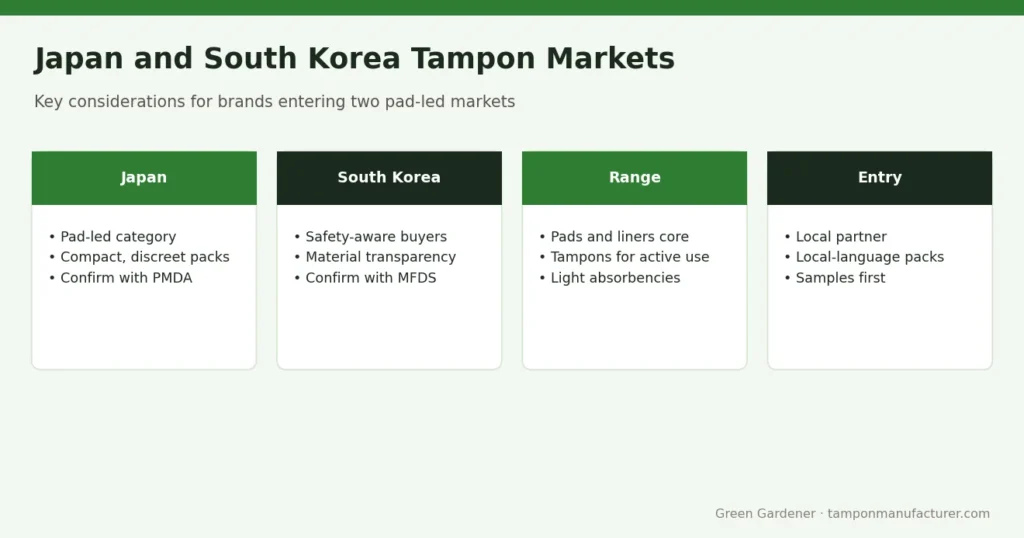
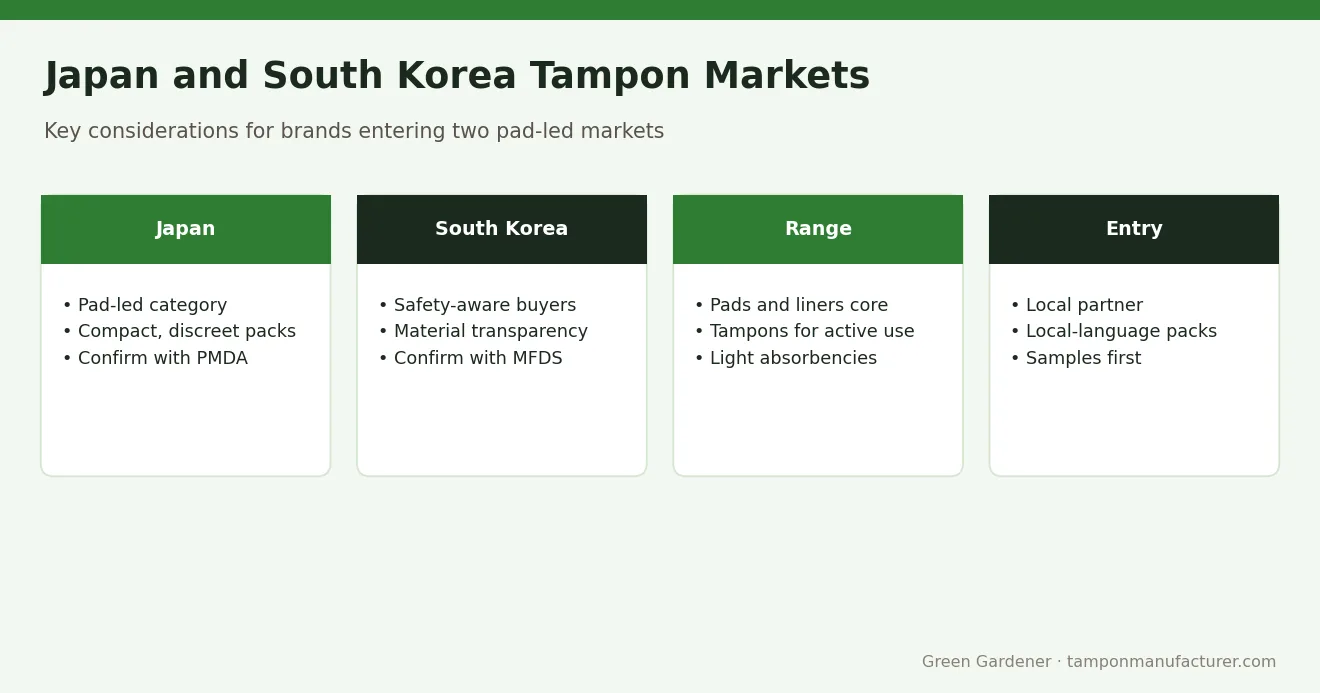
Japan and South Korea are sophisticated personal care markets, but tampons are commonly reported to play a smaller role there than sanitary pads. Brands that succeed usually combine compact, comfortable tampons with strong education, high packaging quality and a pad or liner range. Both countries regulate menstrual products under health product laws, so confirm requirements with PMDA in Japan and MFDS in Korea. As a factory-direct OEM manufacturer, we help brands prepare products and documentation for these demanding markets.
Two Advanced but Pad-Led Markets
Japan and South Korea share several characteristics that matter to tampon brands. Consumers are well informed, expect excellent product quality and pay close attention to packaging, materials and comfort. Retail is highly developed, with dense networks of drugstores, convenience stores and online platforms. At the same time, sanitary pads are by far the most used period product in both countries, and tampon use is commonly reported to be relatively low compared with North America or parts of Europe.
The reasons often cited include cultural familiarity with pads, the wide range of advanced pad products available, and limited education about tampons. These are general observations rather than precise figures, and usage is changing, particularly among younger consumers, athletes and frequent travellers. Brands should use current local market research to size the opportunity rather than relying on general statements, including the ones in this article.
Japan: Market Notes
Japanese drugstores and supermarkets carry a wide range of pads, including ultra-thin, night and scented options, while the tampon shelf is usually smaller. Tampons sold in Japan include both applicator and non-applicator types. Consumers place high value on discreet, compact packaging, clear instructions and a soft, quiet product experience.
Premium and natural positioning can work well, especially organic cotton products and those with careful, minimal design. Convenience stores matter for urgent purchases, so small packs are useful. Japanese buyers and retailers usually expect very consistent quality, detailed specifications and fast, precise answers to technical questions. Building a relationship with a local distributor who understands drugstore buying cycles is often the most practical route to shelf.
South Korea: Market Notes
South Korea has a fast-moving beauty and personal care market with strong online sales and influential social media. Korea has also seen intense public attention to menstrual product safety in recent years, which raised consumer interest in materials, ingredient transparency and testing. That environment has helped organic cotton pads, period underwear and menstrual cups gain visibility.
Tampons are commonly reported to hold a modest share, but interest exists among younger and active consumers. Brands that can show transparent material information and documentation are better placed to earn trust. Korean shoppers often research products online before buying, so detailed product pages, clear diagrams and honest answers to common questions are important. Marketplaces and specialist online retailers can be a practical entry point before approaching larger offline chains.
Regulators to Confirm With
Both countries regulate menstrual products under health product legislation, and requirements for foreign manufacturers and local companies can be detailed. The table is a starting point only.
| Country | Authority | What to confirm |
|---|---|---|
| Japan | MHLW and PMDA | Product category, approval route, local authorisation holder |
| South Korea | MFDS | Product category, licensing, local importer duties |
In Japan, regulated health products generally need a locally based company to take marketing responsibility, and foreign manufacturing sites may also need to be registered or accredited. In Korea, menstrual products are commonly described as quasi-drugs, with obligations falling on the local importer or licence holder. Confirm the current classification, documents and labeling requirements with PMDA, MFDS or a qualified local regulatory consultant before you finalise product specifications.
Product Preferences to Consider
When planning a range for these markets, consider:
- Compact formats: compact applicators and slim designs suit consumers who value discretion; see our compact applicator tampons.
- Lighter absorbencies: light and regular options support first-time users.
- Material transparency: clear information on cotton, rayon and applicator materials, backed by documentation.
- Quiet, high-quality wrappers: soft, easy-open wrappers with refined print.
- Detailed instructions: illustrated inserts in Japanese or Korean, advising users to follow package instructions and consult a doctor with health questions.
Fragrance-free products are generally a safer starting point, and any scented product would need its own regulatory review.
Cross-Selling Pads and Liners
Because pads lead the category, a brand that offers only tampons may struggle to secure shelf space. Pairing tampons with pads and liners creates a complete range and gives retailers a reason to list the brand.
| Product | Role in range | Positioning idea |
|---|---|---|
| Ultra-thin pads | Core volume | Comfort and discretion |
| Night pads | Heavy-flow support | Overnight protection |
| Panty liners | Daily use, repeat purchase | Freshness and comfort |
| Tampons | Active and travel use | Sport, swimming, travel |
We manufacture sanitary pads and panty liners as well as tampons, so brands can source a coordinated range with consistent packaging.
Packaging and Language
Packaging must be in Japanese or Korean, with content that meets local regulatory requirements and consumer expectations. Work with native-speaking regulatory and marketing partners to write the text, and supply final approved artwork files to your manufacturer. Japanese and Korean consumers notice small details, so check print quality, colour accuracy and insert folding on samples. Plan artwork so regulatory text can be updated without redesigning the whole box, and keep a version record for every market.
Packaging style also deserves attention. Shoppers in both countries often prefer calm, refined designs with soft colours and clear hierarchy, and many value boxes that look discreet in a bathroom or handbag. Individually wrapped tampons with easy-open, quiet wrappers fit these expectations well. If you plan to sell in both markets, consider a shared visual identity with separate language versions, which keeps design costs lower while respecting local requirements. Retailers may also request specific case packs or display units, so ask early.
For Brands: Entering Japan or Korea
- Commission current market research and define your target consumer.
- Confirm regulatory requirements with PMDA, MFDS or a local consultant.
- Appoint a local partner to hold authorisations or import responsibilities.
- Plan a focused range, ideally with pads and liners alongside tampons.
- Develop local-language packaging and approve samples.
Our overview of global private label tampon supply markets compares Asian markets with other regions.
Documentation is often requested in more detail than in other markets. Prepare product specifications, material information, test reports and lot traceability records, which we provide on request, and allow time for your local partner to review them. Shipping is usually by sea freight in standard cartons, with moisture protection for humid summer months. Agree carton labels and any local barcode requirements before the first production run.
Request a Quote
Tell us your target country, product range, packaging language and regulatory plan, and we will prepare samples, documentation on request and a quotation. Contact our team through the contact page or on WhatsApp at +86 173 1689 5054.
Frequently Asked Questions
Are tampons widely used in Japan and South Korea?
Tampons are commonly reported to be used less than sanitary pads in both countries, although usage is growing among younger, active and travelling consumers. Figures vary by source and change over time, so brands should commission or buy current local market research before setting volume plans or launch budgets.
Which regulator should I contact in Japan?
Japan’s Ministry of Health, Labour and Welfare sets the framework, and the PMDA handles many review and consultation functions. Menstrual products are regulated under health product law, and a locally based company usually takes marketing responsibility. Confirm the current route with PMDA or a qualified Japanese regulatory consultant.
Which regulator covers tampons in South Korea?
The Ministry of Food and Drug Safety (MFDS) regulates menstrual products in Korea, which are commonly described as quasi-drugs. Obligations usually fall on the local importer or licence holder. Confirm current classification, documentation and labeling requirements with MFDS or a qualified Korean regulatory consultant before launch.
Should I launch tampons alone in these markets?
Many brands find it easier to secure shelf space by offering pads and liners alongside tampons, because pads lead the category. A coordinated range with consistent packaging gives retailers a complete brand block, while tampons serve active, swimming and travel needs within that range. Sales data from pads can also guide which tampon absorbencies to add later.
Can you print packaging in Japanese or Korean?
Yes. We print boxes, wrappers and inserts in Japanese, Korean and other languages using final approved text and artwork supplied by the brand. We produce printed samples for approval before bulk production, so your local partners can check language, layout and regulatory content. Changes are easiest to make at this stage, before bulk printing begins.
Request a Tampon or Pad Quote
Tell us the product, quantity and your market. We reply with options, pricing and sample steps. Prefer chat? WhatsApp +86 173 1689 5054.