

Factory social audits help tampon buyers check how a manufacturer treats workers and manages health, safety and ethics. The two schemes buyers most often mention are amfori BSCI, run by the business association amfori, and SMETA, the audit methodology from Sedex. Neither is a product certification; both assess workplace conditions at a point in time. This guide explains how each works, what they cover and how buyers can request and use audit information when sourcing tampons.
Why Tampon Buyers Ask for Social Audits
Retailers, brands and public buyers increasingly need to show that their products are made responsibly. Many retailers include social compliance requirements in supplier manuals, and some jurisdictions have introduced due diligence or modern slavery reporting obligations for larger companies. A social audit is one of the tools buyers use to gather evidence about factory conditions.
For private label tampon brands, the request often comes from a retailer during onboarding or a line review. The retailer may name a specific scheme, a minimum result or a maximum age for the audit report. Knowing what each scheme is, and what it is not, helps brands respond accurately.
A social audit complements, rather than replaces, quality and product compliance checks. Product safety, labeling and performance are assessed through specifications, test reports and quality inspections, as described in our guide to factory quality evidence for private label tampons.
amfori BSCI at a Glance
amfori is a global business association for open and sustainable trade, and BSCI is its social performance program. Member companies, typically retailers, importers and brands, use the amfori BSCI Code of Conduct as the reference for their supply chains.
- Audits are carried out by independent auditing companies approved under the amfori system.
- The audit assesses factory performance against the principles of the amfori BSCI Code of Conduct.
- Results are summarised in an overall rating, with ratings shown on a letter scale.
- Audit information is shared through the amfori platform, where members can see results for factories in their supply chain.
- Follow-up audits may be required depending on the result.
Buyers who are amfori members can usually access audit results directly through the platform once the factory is linked to their supply chain. Non-members generally request a copy of the report from the factory or ask for audit access to be arranged.
SMETA at a Glance
SMETA stands for Sedex Members Ethical Trade Audit. Sedex is a membership organisation that runs a platform for sharing supply chain data. SMETA is an audit methodology, and the audit is conducted by approved third-party audit companies.
SMETA audits refer to the ETI Base Code and local law. A 2-pillar SMETA covers labour standards and health and safety, while a 4-pillar SMETA adds environment and business ethics. Unlike a rating scheme, SMETA does not issue a pass or fail. It records findings, called non-compliances, and a corrective action plan that the factory works through.
Results are uploaded to the Sedex platform, where linked customers can view the report and track corrective actions. Buyers commonly specify which pillars they require and how recent the audit should be.
Comparing amfori BSCI and SMETA
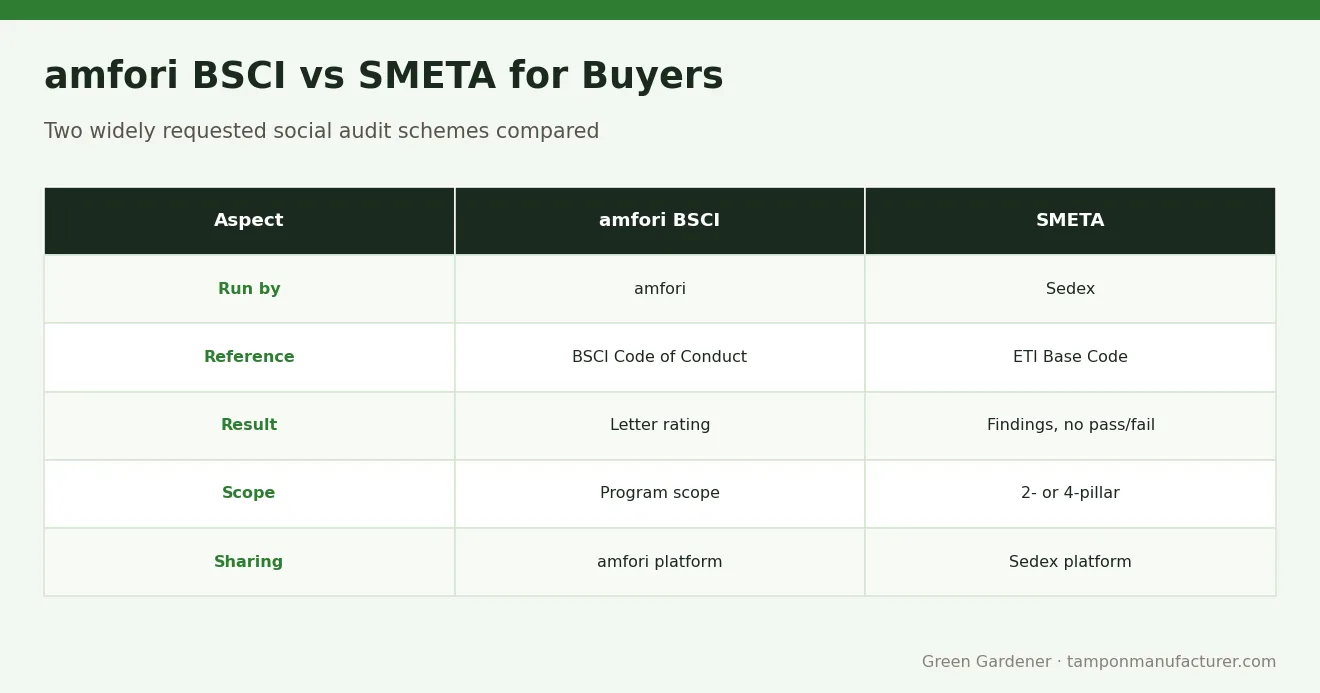
Both schemes cover similar themes, so many retailers accept either, though some prefer one. The table summarises the main practical differences buyers notice.
| Aspect | amfori BSCI | SMETA |
|---|---|---|
| Owner | amfori business association | Sedex membership organisation |
| Reference standard | amfori BSCI Code of Conduct | ETI Base Code and local law |
| Output | Overall rating plus findings | Findings and corrective action plan, no pass or fail |
| Scope options | Defined program scope | 2-pillar or 4-pillar |
| Data sharing | amfori platform | Sedex platform |
Other schemes exist, such as SA8000 certification and retailer-specific audit programs. Always confirm which schemes your customers accept before asking a factory to arrange a new audit.
What Social Audits Typically Cover
Although wording differs, most social audits examine similar areas of factory life. For a tampon manufacturer, auditors typically review records, inspect production and storage areas and interview workers.
| Area | Examples of what is checked |
|---|---|
| Employment | Contracts, age verification, freely chosen employment |
| Working hours | Hours records, overtime, rest days |
| Wages and benefits | Payroll, legal minimums, social insurance |
| Health and safety | Machine guarding, fire safety, chemical handling |
| Worker voice | Grievance channels, freedom of association |
| Environment and ethics | Waste, permits, anti-bribery (where in scope) |
Audits are a snapshot. A good report shows conditions on the audit days and how the factory responds to findings, which is why buyers look at trends across several audits.
How Buyers Request and Use Audit Reports
A clear request saves time for both sides. When asking a manufacturer about social audits, include the following:
- Which schemes your customers accept, and any minimum result.
- Whether you need a full report, a summary or platform access.
- How recent the audit must be.
- Whether you require specific pillars or modules.
- Who will pay for a new audit if one is needed.
When reviewing a report, check that the factory name and address match your supplier, that the audit covers the site where your tampons are actually made, and that findings have corrective actions with dates. Our guide on how to verify a tampon manufacturer explains how audit evidence fits into wider supplier verification.
Limits of Social Audits
Social audits are useful but have known limits. They are scheduled or semi-announced in many cases, they capture a short period, and they depend on auditor skill and access to records. They do not certify product quality or regulatory compliance of the tampons themselves.
Many responsible buyers therefore combine audits with other measures: direct supplier relationships, site visits, worker voice channels and clear expectations in supply agreements. Treat an audit as one input to a broader due diligence approach, not a final answer.
Audit fatigue is another practical issue. Factories that supply many customers may receive repeated requests for different schemes covering the same topics. Sharing platforms such as those run by amfori and Sedex exist partly to reduce this duplication, because one audit can be viewed by several linked customers. Buyers can help by accepting equivalent recognised schemes where their policies allow, rather than requiring a new audit for every relationship.
Finally, remember that subcontracting matters. If any process, such as printing of packaging, is carried out at another site, ask how that site is covered. Your due diligence should reflect the actual production route of your tampons, not only the main factory address.
For Brands: Discussing Social Compliance With Us
We are a factory-direct manufacturer of tampons, pads, liners, menstrual cups and period underwear, with more than 15 years of experience, a 52,000 m² factory and over 500 clients served. If your retailer requires social compliance evidence, tell us the scheme, scope and timing they need, and we will discuss what documentation we can provide on request and what arrangements are possible. Read more about our company and our private label tampons service. Commercial terms are confirmed in your quotation.
Request a Quote
Sourcing tampons for a retailer with social compliance requirements? Share the scheme names, scope and timeline in your inquiry, together with your product needs. Request a quote or contact us on WhatsApp at +86 173 1689 5054.
Frequently Asked Questions
Is amfori BSCI a certification?
No. amfori BSCI is a social performance program in which approved auditing companies assess a factory against the amfori BSCI Code of Conduct and issue a rating. It is not a certificate and does not certify product quality. Results reflect conditions at the time of the audit and are shared through the amfori platform.
What is the difference between 2-pillar and 4-pillar SMETA?
A 2-pillar SMETA audit covers labour standards and health and safety. A 4-pillar SMETA adds environment and business ethics. Buyers choose the scope based on their policies and customer requirements. SMETA reports list findings and a corrective action plan rather than issuing a pass or fail result.
Does a social audit prove that tampons are safe?
No. Social audits assess workplace conditions such as labour practices and health and safety. Product safety and regulatory compliance are evaluated separately through specifications, labeling reviews, test reports and quality inspections. Buyers sourcing tampons need both types of evidence for a complete supplier assessment.
Which audit scheme should a tampon brand ask for?
Ask your retail customers first. Many accept either amfori BSCI or SMETA, while some specify one scheme, a minimum result or a maximum report age. Requesting the scheme your customers already recognise avoids duplicate audits and makes onboarding faster for everyone in the supply chain.
How do we get access to a factory’s audit report?
If you are an amfori or Sedex member, the factory can link you to its results on the relevant platform. Otherwise, you can request a copy of the report or summary from the manufacturer. Explain which scheme, scope and report date your customers require when you make the request.
Request a Tampon or Pad Quote
Tell us the product, quantity and your market. We reply with options, pricing and sample steps. Prefer chat? WhatsApp +86 173 1689 5054.