

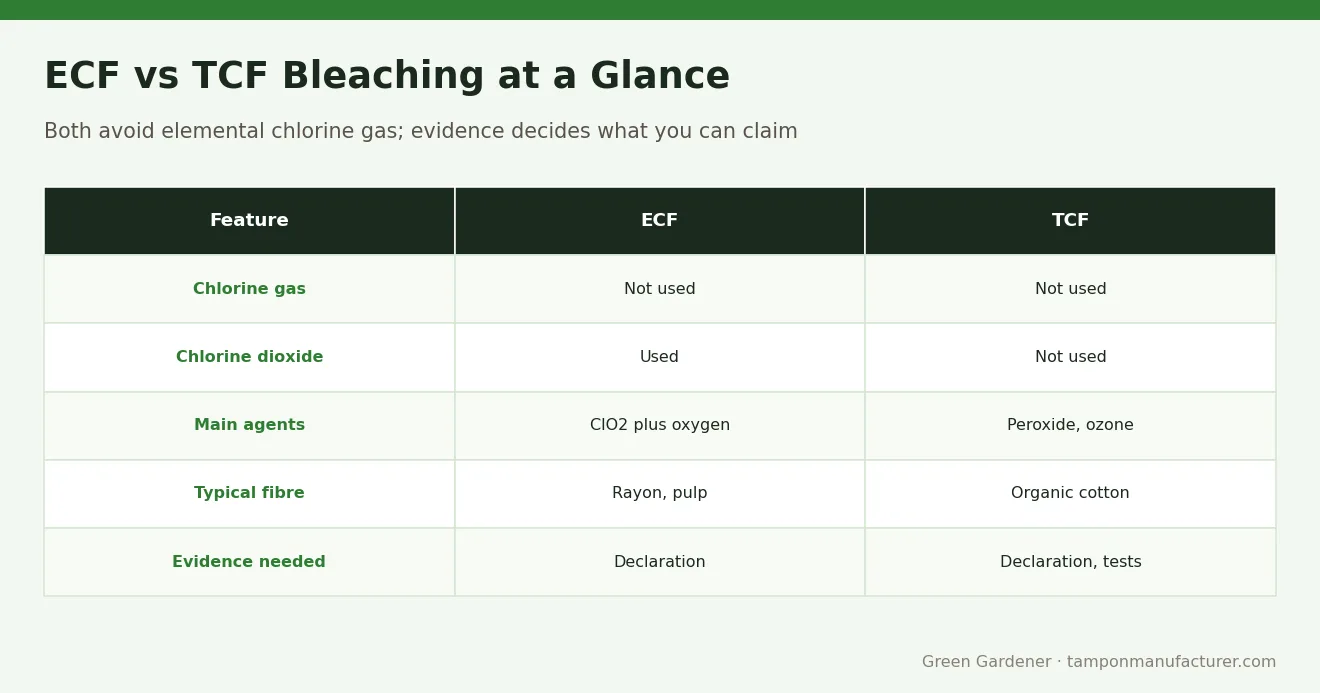
Modern tampon materials are whitened with chlorine-free processes: elemental chlorine-free (ECF) bleaching, which uses chlorine dioxide, or totally chlorine-free (TCF) bleaching, which uses oxygen-based agents such as hydrogen peroxide. FDA’s consumer information explains that these processes replaced the older elemental chlorine bleaching linked to trace dioxins. For brands, the practical question is documentation: which bleaching route your materials use, and which dioxin and residue test reports support your claims.
Why Bleaching Matters in Tampon Materials
Tampons are made from cotton, rayon (viscose) or blends of the two. Raw cotton fibre is naturally off-white and contains waxes and natural impurities; rayon is made from wood pulp that must be purified. Bleaching removes colour and impurities so the absorbent core is clean, consistent and performs predictably in absorbency testing.
Decades ago, some pulp bleaching used elemental chlorine gas, a process that could create trace amounts of dioxins and furans as by-products. That history is why consumers still search for “chlorine-free tampons”, and why buyers ask suppliers to explain their materials. Today the question is less about whether dioxins are a widespread concern and more about whether a brand can show evidence for what it says on pack.
Bleaching is also only one part of the material story. Fibre cleaning, finishing agents, the withdrawal cord, the overwrap and the applicator all contribute to what ends up in the finished product. A sound supplier file therefore looks at the whole tampon, not only at the absorbent core, and links each material to a named supplier and specification.
ECF vs TCF Bleaching Explained
Both routes avoid elemental chlorine gas. The difference lies in the bleaching agents and in how brands can describe the result.
| Feature | ECF (elemental chlorine-free) | TCF (totally chlorine-free) |
|---|---|---|
| Main agents | Chlorine dioxide, plus oxygen stages | Oxygen, ozone, hydrogen peroxide |
| Chlorine compounds used | Yes, but not elemental chlorine gas | No chlorine compounds |
| Typical use | Wide use in rayon and pulp | Common for organic cotton and premium lines |
| Typical on-pack claim | Usually not claimed on pack | “Totally chlorine-free”, if documented |
| Evidence to request | Supplier bleaching declaration | Supplier declaration and test data |
A brand should only print a chlorine-free claim when the fibre supplier’s documentation supports it for every material in the absorbent core, not just one component.
What FDA Has Said About Dioxins and Tampons
FDA regulates tampons as medical devices. Its consumer information on tampon safety explains that the bleaching processes now used for tampon materials are elemental chlorine-free or totally chlorine-free and that any trace dioxin levels that might remain are not expected to pose a health risk. FDA’s guidance on 510(k) submissions for menstrual tampons and pads also addresses dioxin and pesticide residues, so manufacturers and submitters are expected to consider them.
In 2024, an academic study reporting measurable metals in some tampons drew wide attention, and FDA announced that it would review the issue with its own literature review and laboratory work. Regulatory positions can change, so check current FDA requirements and statements before you publish safety claims, and avoid wording that implies any product is free from all substances.
Residue Tests Buyers Commonly Request
There is no single universal test panel for tampons. Buyers usually choose tests according to their market, their claims and their retailers’ requirements. Common requests include:
| Test | What it looks for | Why buyers ask |
|---|---|---|
| Dioxins and furans | Chlorinated by-products | Supports bleaching claims |
| Pesticide residues | Agricultural residues in cotton | Expected for cotton and organic |
| Heavy metals | Lead, cadmium, arsenic and others | Retailer and media interest |
| AOX | Adsorbable organic halogens | Indicator of chlorine chemistry |
| Fluorescent whiteners | Optical brightening agents | Common buyer exclusion |
| pH and extractables | Acidity and soluble residues | General material quality |
Dioxin analysis is generally performed by specialised laboratories using isotope-dilution high-resolution GC/MS methods. Ask which method and detection limits were used, because “not detected” only means below the limit of that specific method.
Reading a Test Report Before You Rely on It
A test report is only as useful as the sample behind it. Before you quote one in your listings or retailer files, check these points:
- The report names the laboratory, the method and the detection or reporting limit for each substance.
- The sample is the finished tampon or the exact absorbent material used in your product, not a similar grade.
- The report date and sample lot are recent enough for your buyer or retailer policy.
- Results are reported per substance, not only as a summary pass statement.
- Any accreditation of the laboratory is shown on the report and can be verified.
We provide documentation on request, and our quality documentation guide explains how test reports fit into a full private label file.
Organic Cotton and Chlorine-Free Claims
Organic cotton tampons are typically whitened with hydrogen peroxide, which supports a TCF route. However, “organic” and “chlorine-free” are separate claims. Organic status relates to how the cotton was grown and handled through the supply chain, and is usually supported by fibre certification documents such as transaction certificates from recognised organic textile schemes. A chlorine-free claim relates to processing.
If you plan an organic line, ask your supplier which documentation supports each claim and how certificates flow from fibre to finished product. Our organic cotton tampons page outlines the options we produce; scheme certificates and scope are confirmed in your quotation.
Writing Compliant Packaging Claims
Regulators and retailers look closely at environmental and safety claims on intimate products. Keep claims specific and supported: “made with totally chlorine-free bleached cotton” is easier to substantiate than “toxin-free” or “chemical-free”, which can be misleading.
In the United States, tampon labeling must also meet 21 CFR 801.430, which covers absorbency terms and toxic shock syndrome information, and some states, such as New York, require ingredient disclosure on menstrual product packaging. In the EU, products fall under general product safety rules. For Canada, Australia and GCC markets, tampons are regulated; confirm claim and labeling expectations with Health Canada, the TGA or the SFDA. Our packaging artwork checklist helps you review claims before print.
For Brands: Building a Bleaching and Residue File
A simple supplier file prevents last-minute delays with retailers and marketplaces. Ask your manufacturer for a material specification for the absorbent core, a bleaching declaration from the fibre supplier, recent residue test reports for the finished product, and a statement of which claims the evidence supports.
Review the file whenever you change fibre supplier, absorbent blend or claim. Retesting after significant material changes is good practice, and some buyers set their own retest frequency in their supplier agreements.
Finally, train your customer service team on the file. Shoppers do ask about bleaching and residues, and a short, accurate answer that points to your testing approach builds more trust than marketing language.
Request a Quote
As a factory-direct manufacturer with 15+ years of experience, more than 500 clients and a 52,000 m² facility, we produce cotton, rayon-blend and organic cotton tampons with plastic, compact, cardboard or non-applicator formats. Samples are available before bulk production, so you can test materials against your own criteria.
Contact us to request a quote or message us on WhatsApp +86 173 1689 5054. Test scope and pricing are confirmed in your quotation.
Frequently Asked Questions
Are tampons bleached with chlorine?
Tampon materials today are generally whitened using elemental chlorine-free (ECF) or totally chlorine-free (TCF) processes rather than elemental chlorine gas. FDA’s consumer information describes current processes as chlorine-free. Brands should still ask their manufacturer which route is used for each material before making a chlorine-free claim on packaging.
What is the difference between ECF and TCF?
ECF bleaching avoids elemental chlorine gas but may use chlorine dioxide. TCF bleaching uses no chlorine compounds at all and relies on oxygen-based agents such as hydrogen peroxide or ozone. TCF is common for organic cotton, while ECF is widely used for pulp and rayon production.
Do tampons contain dioxins?
FDA has stated that tampon materials are now bleached with elemental chlorine-free or totally chlorine-free processes and that any trace dioxin levels that might be present are not expected to pose a health risk. Brands that want evidence for their own products can request dioxin test reports for the finished tampon from their manufacturer.
Which test reports should a private label buyer request?
Common requests are dioxin and furan analysis, pesticide residues, heavy metals, AOX, fluorescent whitening agents and pH or extractables. The right panel depends on your market, your on-pack claims and your retailers. Ask for the laboratory, method and detection limits for each result, and make sure the sample matches your product.
Can I print “chlorine-free” on my tampon packaging?
You can if your documentation supports it for every absorbent material in the tampon and the claim meets advertising and labeling rules in your market. Keep wording precise, such as “totally chlorine-free bleached cotton”, and avoid broad claims like “toxin-free”. Check current requirements with your regulatory adviser before printing.
Request a Tampon or Pad Quote
Tell us the product, quantity and your market. We reply with options, pricing and sample steps. Prefer chat? WhatsApp +86 173 1689 5054.