

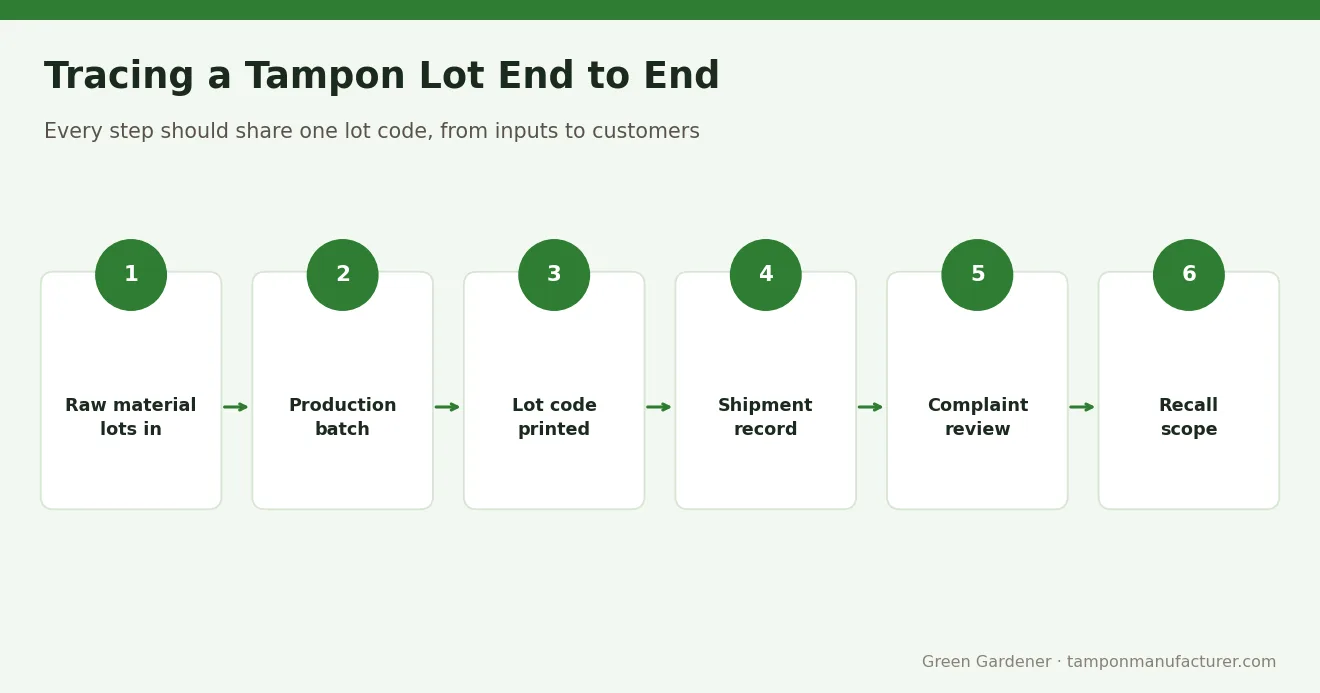
Lot traceability means that any tampon pack on a shelf can be linked, through its printed lot code, to the raw materials, production line, date, inspection results and shipments behind it. For a private label brand, that link is what turns a complaint or a supplier alert into a precise, limited action instead of a market-wide withdrawal. Recall readiness is the second half: a written, rehearsed plan agreed with your manufacturer before anything goes wrong.
Why Lot Traceability Matters for Tampon Brands
Tampons are regulated as medical devices in the United States and are tightly scrutinised as intimate hygiene products elsewhere. When a consumer reports a loose withdrawal cord, a damaged applicator or an unusual odour, the first question a regulator, retailer or insurer will ask is: which lots are affected, and where did they go?
Without traceability, the only safe answer is to pull everything. With it, a brand can isolate one production lot, confirm whether the issue came from a specific bale of cotton or rayon, a batch of applicator resin or a single shift, and act in proportion. Good traceability also protects your relationship with retailers, who increasingly ask private label suppliers to demonstrate it during onboarding.
In practice, traceability is shared work. The factory holds most of the records; the brand holds the distribution data. Both halves must use the same lot code.
What a Tampon Lot Code Should Connect
A lot code is only useful if it unlocks records on both sides of the factory gate. Agree in writing which records each lot code must link to, and who keeps them.
| Record | What it links to | Usually held by |
|---|---|---|
| Incoming material log | Supplier lot of cotton, rayon, cord, applicator, wrapper | Manufacturer |
| Batch production record | Line, date, shift, machine settings, operators | Manufacturer |
| In-process and final QC | Absorbency checks, cord pull checks, visual inspection | Manufacturer |
| Packaging and artwork version | Carton, insert and label revision used | Manufacturer and brand |
| Shipment and invoice data | Container, consignee, quantity per lot | Manufacturer and brand |
| Distribution records | Warehouses, retailers, online orders | Brand or distributor |
The key test is two-way: starting from a raw material lot, can you list every finished lot that used it; and starting from a finished pack, can you trace back to every input?
Batch Records Your Manufacturer Should Keep
Ask your supplier to describe its batch record in the RFQ stage rather than after the first order. A complete record for each tampon lot normally includes:
- Supplier lot numbers and certificates of analysis for absorbent material, withdrawal cord, overwrap and applicator components
- Line clearance checks confirming the previous product and packaging were removed before a new lot started
- Machine settings and any adjustments, with the time and the person responsible
- In-process inspection results, including absorbency sampling and cord attachment checks
- Rejected and reworked quantities, with reasons
- Final release decision and the name of the person who released the lot
Our quality control documentation guide explains which of these documents private label buyers typically request, and we provide documentation on request for your own audits.
Coding on Packs, Cartons and Pallets
A lot code that appears only on the shipping carton disappears the moment a store opens the case. Traceability needs coding at every level the product travels.
| Level | Typical information | Purpose |
|---|---|---|
| Individual wrapper | Often none, or a short code | Optional; useful for dispensers |
| Retail pack | Lot code, expiry or manufacture date | Consumer complaints and shelf checks |
| Inner or display case | Lot code, SKU, quantity | Store and warehouse handling |
| Shipping carton | Lot, SKU, quantity, carton number | Receiving and stock control |
| Pallet label | Lots on pallet, SSCC or pallet ID | Distribution and recall scope |
Decide the code format early so it fits your private label tampon artwork. Inkjet or laser coding is usually applied on line; the print area should be a plain, light panel so codes stay legible after transport.
Complaint Handling: From Consumer Contact to Root Cause
Every complaint should be logged with the lot code, the purchase location and a clear description, ideally with photographs and the returned product. Brands should share relevant complaints with the manufacturer promptly, not in a quarterly summary.
A practical complaint process has four stages: record the complaint and lot; assess whether it could involve a health risk or a regulatory reporting duty; investigate with the factory using retained samples and batch records; and close it with a documented root cause and corrective action. Trends matter as much as single events, so review complaints by lot, line and component on a regular schedule.
Where a complaint mentions symptoms that could relate to toxic shock syndrome or another injury, treat it as potentially reportable and involve your regulatory adviser immediately. Consumers should always be directed to seek medical advice.
Building a Recall Plan Before You Need One
A recall plan is a short, practical document that names people and steps. Agree it with your manufacturer and distributors so nobody improvises under pressure.
- Name a recall coordinator at the brand and a counterpart at the factory, with deputies.
- Define how a decision to hold, withdraw or recall stock is made and who signs it.
- Keep current contact lists for importers, warehouses, retailers and marketplaces.
- Prepare template notices for retailers, consumers and, where required, regulators.
- Set out how affected stock is quarantined, counted, returned or destroyed, with records.
- Describe how effectiveness is checked and how the root cause is closed.
Store the plan with your factory quality evidence file so auditors can see both together.
Regulatory References to Check
Recall and reporting duties differ by market, and your role (importer, own-label distributor or specification developer) shapes which ones fall on you. Use these references as starting points and confirm details with a qualified adviser:
- United States: 21 CFR Part 7 (recall policy), Part 803 (medical device reporting), Part 806 (reports of corrections and removals) and Part 820, the Quality Management System Regulation. See our FDA import requirements guide and check current FDA requirements.
- European Union: the General Product Safety Regulation (EU) 2023/988 expects products to carry an identifier such as a batch number and sets out notification and recall duties.
- Canada, Australia and GCC states: tampons are regulated; confirm traceability and recall expectations with Health Canada, the TGA or the SFDA.
Mock Recalls and Supplier Reviews
A plan that has never been tested is an assumption. Run a mock recall at least once a year: pick a finished lot at random and ask the factory to trace it back to its inputs, while your team traces it forward to customers. Record how long each step took, which records were missing and what you would change.
Combine the exercise with your regular supplier review. Check that lot codes on retained samples match batch records, that complaint files are closed with evidence, and that artwork changes were recorded against the correct lot. Small gaps found in a drill are far cheaper than gaps found during a real event.
Request a Quote
We are a factory-direct tampon manufacturer with 15+ years of experience and more than 500 clients, producing plastic, compact, cardboard and non-applicator tampons in a 52,000 m² facility. We can align lot coding, batch records and recall contacts with your brand before the first production run, and samples are available before bulk orders.
Contact us to request a quote or message us on WhatsApp +86 173 1689 5054. Pricing and terms are confirmed in your quotation.
Frequently Asked Questions
What is a lot code on a tampon box?
A lot code is a short printed reference that identifies the production batch a pack came from. It lets the manufacturer find the raw materials, production date, line and quality checks behind that pack. Brands use it to handle complaints, check stock rotation and limit any recall to the lots that are actually affected.
Who is responsible for a tampon recall, the brand or the factory?
Usually both share the work. The brand or importer normally leads communication with retailers, consumers and regulators in its market, while the factory supports the investigation with batch records and retained samples. Exact legal responsibilities depend on the market and your regulatory role, so confirm them with a qualified adviser.
How long should tampon batch records be kept?
Retention periods depend on the regulations in your market and your quality system, and they are often linked to the product’s expected life plus a margin. Agree a retention period with your manufacturer in your quality agreement, and check current requirements with your regulator or regulatory consultant before you finalise it.
What is a mock recall?
A mock recall is a planned exercise in which a brand and its manufacturer trace a chosen lot backwards to its raw materials and forwards to its customers, as if a real recall had started. It tests whether records are complete and whether contacts and steps in the recall plan actually work.
Should individual tampon wrappers carry a lot code?
It is not always necessary, but it can help. Lot codes on retail packs and cartons are standard practice. Coding individual wrappers is useful when tampons are sold singly, for example through dispensers or institutional programmes, because the outer pack is often discarded before a complaint is made.
Request a Tampon or Pad Quote
Tell us the product, quantity and your market. We reply with options, pricing and sample steps. Prefer chat? WhatsApp +86 173 1689 5054.