
TL;DR: Organic cotton tampons use GOTS-certified cotton free from synthetic pesticides, rayon, and chemical finishes. Conventional tampons typically use rayon-cotton blends with processing chemicals. For brands, organic commands a 25–60% retail price premium, growing consumer demand, and stronger regulatory positioning. This guide gives B2B buyers the facts to make informed sourcing decisions.
The Market Reality: Why Organic Is No Longer Niche
The organic tampon segment has shifted from specialty health stores into mass-market retail. Brands like Cora, Rael, Natracare, and Daye have normalized organic tampon purchases at Target, Boots, Woolworths, and DM Drogerie Markt globally. Behind this shift are three converging forces:
Ingredient transparency demand. Following high-profile investigative reporting on tampon chemical content — including studies detecting pesticide residues and PFAS in conventional products — consumers are demanding to know exactly what they are inserting into their bodies. The FDA’s December 2024 requirement for tampon manufacturers to disclose ingredient lists has accelerated this trend in the US market.
The “clean beauty to clean period” migration. The consumer who reads INCI lists on skincare products now applies the same scrutiny to menstrual products. The logic is simple and powerful: if I wouldn’t put it on my face, why would I put it inside my body?
Retailer ESG requirements. Major retailers are adding sustainability criteria to their private label and house brand sourcing standards. Organic or sustainably certified tampons increasingly qualify for preferred placement and promotional support that conventional products do not.
What “Organic” Actually Means in Tampon Manufacturing
“Organic” is the most misused term in the tampon category. Here is what it actually requires at each tier:
Tier 1: GOTS-Certified Organic Cotton (The Gold Standard)
GOTS (Global Organic Textile Standard) is the most rigorous and meaningful certification for organic tampon production. It requires:
- Cotton grown on certified organic farmland without synthetic pesticides, herbicides, or GMO seed (for at least 3 years)
- Processing and manufacturing free from toxic dyes, bleaches, and finishing chemicals
- Full supply chain traceability from farm to finished product
- Social compliance standards for manufacturing workers
- Independent third-party certification (not self-declaration)
A GOTS-certified tampon is the clearest, most internationally recognized way to substantiate “organic” claims.
Tier 2: Made With Organic Cotton (GOTS Transition / OCS Certified)
Some products use cotton certified under OCS (Organic Content Standard) or in transition to GOTS. This certifies the organic origin of the fiber but does not cover the full processing chain. Legitimate, but a lower standard than full GOTS.
Tier 3: “Natural” or “Pure Cotton” (Non-Certified)
Many products use marketing language like “natural cotton,” “pure cotton,” or “chemical-free” without any third-party certification. These terms have no legal definition in most markets and cannot be verified. For B2B buyers, these products carry significant risk — they cannot be substantiated to retail buyers, regulators, or consumers who ask for documentation.
Bottom line for B2B buyers: Only GOTS certification provides a defensible, internationally recognized organic claim. Request the GOTS certificate (which specifies the certification scope) before using “organic” in any product marketing.
The Material Comparison: What Is Actually Inside Each Tampon
Conventional Tampon Composition
Core material: Typically a blend of rayon (viscose) and cotton (approximately 55% rayon / 45% cotton in mainstream products). Rayon is derived from wood pulp through a chemical process that historically involved chlorine bleaching — though elemental chlorine-free (ECF) bleaching is now the industry standard.
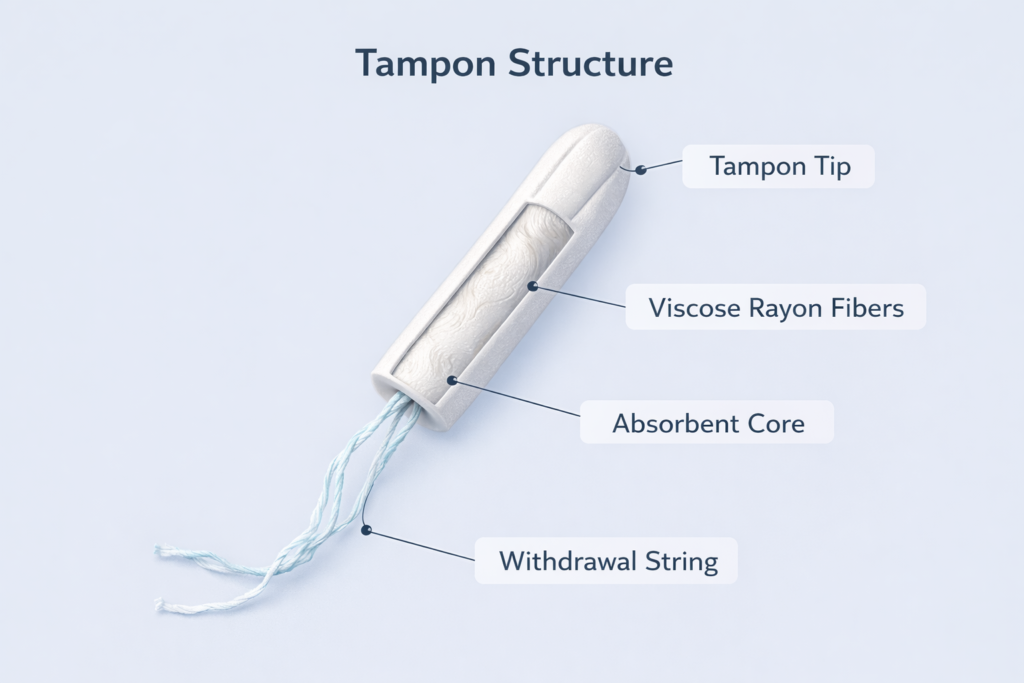
Processing chemicals: Conventional tampons may undergo treatment with:
- Surfactants (to aid fluid absorption)
- Fragrance compounds (in “scented” variants — now largely discontinued)
- Anti-slip coatings on applicators
- Dioxin traces (from chlorine bleaching, though ECF processing has significantly reduced levels)
Testing context: Multiple independent studies, including research published in peer-reviewed journals and Consumer Reports investigations, have detected trace pesticide residues and PFAS compounds in some conventional tampon products. The levels detected are typically well below established safety thresholds — but the presence of any detectable synthetic chemical is increasingly unacceptable to premium brand buyers and their customers.
Organic Cotton Tampon Composition
Core material: 100% GOTS-certified organic cotton, free from synthetic pesticide residues, bleached without chlorine (either unbleached/natural color or hydrogen peroxide bleached).
Processing: Hydrogen peroxide bleaching (for white products) leaves no residue and produces no dioxin. Many premium organic lines use unbleached (natural cotton color) materials to eliminate bleaching.
Absence of synthetics: No rayon, no synthetic fiber blends, no fragrance compounds, no PFAS.
Performance: Organic cotton tampons absorb menstrual fluid effectively. Historically, rayon’s higher absorbency rate was cited as an advantage — but modern GOTS organic cotton processing has significantly closed this gap. Absorbency levels (light, regular, super, super plus) are equivalent in properly manufactured organic products.
Regulatory Landscape: What’s Changing and Why It Matters for Your Brand
United States — FDA Ingredient Disclosure (Effective 2025)
Following the Menstrual Products Right to Know Act, the FDA finalized requirements in late 2024 for tampon manufacturers and importers to disclose all intentionally added ingredients on product labels. This is a watershed moment: for the first time in US history, consumers have a legal right to know exactly what is in the tampons they use.
For brands, this creates immediate pressure: if your conventional tampon contains ingredients that consumers find alarming when disclosed, you have a labeling problem that organic positioning solves.
European Union — REACH and Textile Labeling
EU REACH regulations restrict a broad list of hazardous chemicals in consumer products. The EU textile regulation update (ongoing) is expanding chemical transparency requirements for period products. Brands selling in the EU should ensure all materials — including packaging, inks and adhesives — comply with current REACH restrictions.
United Kingdom — Post-Brexit Product Safety
UK product safety regulations require tampon manufacturers to ensure products are safe for internal use. While broadly aligned with EU standards pre-Brexit, the UK’s own product safety framework is evolving. GOTS certification provides a strong compliance signal in the UK market.
The Pricing Premium: Is Organic Justifiable for Your Brand?
| Product Level | Conventional Tampon | Organic Cotton Tampon | Premium |
|---|---|---|---|
| Factory cost (per unit, 20,000 MOQ) | $0.08–$0.14 | $0.14–$0.22 | 60–75% |
| Retail price (per tampon, branded) | $0.25–$0.40 | $0.40–$0.65 | 60–80% |
| Retail price (per box, 18-count) | $5–$8 | $8–$13 | 50–65% |
| High among the 25–45 age group | — | High among 25–45 age group | Strong |
The organic premium is commercially viable because:
- Consumers who buy organic tampons exhibit strong brand loyalty and low price sensitivity
- Organic products command better retail placement and margin structure
- The certification differentiation supports premium DTC pricing without the need for heavy promotional discounting
Private Label Organic Tampons: What to Specify in Your Manufacturing Brief
When briefing an OEM manufacturer for an organic tampon private label:
Core material: “100% GOTS-certified organic cotton, minimum certification scope: textiles processing” (specify this exact scope — it covers the full production chain)
Bleaching: “Hydrogen peroxide bleached only — no chlorine or chlorine compounds at any stage” or “Unbleached natural color cotton.”
Absorbency levels required: Specify each: Light (6g), Regular (6–9g), Super (9–12g), Super Plus (12–15g) — per FDA absorbency labeling standards
Applicator options:
- No applicator (digital/compact) — most eco-friendly, lower cost
- Cardboard applicator — biodegradable, PFAS-free, growing market preference
- Plant-based plastic applicator — biopolymer, compostable, premium positioning
- Standard plastic applicator — highest comfort rating in consumer testing, but increasingly problematic for eco-positioned brands
Cord: 100% organic cotton cord — specify the same GOTS certification scope as the core material.
Packaging: FSC-certified cardboard, printed with soy or water-based inks — specify both
Certifications required: GOTS (provide the specific certificate number and validity date), FDA registration (for the US market), CE marking (for the EU)
FAQ
Q: Are organic tampons safer than conventional tampons?
A: The scientific evidence on differential safety between organic and conventional tampons for healthy users is limited. What organic tampons definitively provide is freedom from synthetic pesticide residues, rayon fiber, and chlorine bleaching — and full ingredient transparency. For B2B brands, the safety story is most defensible in terms of what is absent (known chemicals) rather than proven clinical superiority.
Q: Does organic cotton affect absorbency?
A: In properly manufactured products, no. GOTS-certified organic cotton tampons meet the same FDA absorbency standards as conventional products. Early-generation organic tampons had lower absorbency; modern manufacturing has addressed this.
Q: What certifications should I require from my organic tampon manufacturer?
A: At minimum: GOTS certification (verify the certificate number on the official GOTS database), ISO 13485 (medical device quality management), and FDA registration for US market imports. CE marking is required for EU market entry.
Q: Can I claim “organic” if my tampon uses organic cotton but has a plastic applicator?
A: Yes, with appropriate specificity. “Made with 100% GOTS-certified organic cotton with a plastic applicator” is accurate. Do not claim the entire product is organic if the applicator or packaging is conventional — this is a greenwashing risk.