
The main types of tampons are classified by insertion format, applicator design, absorbency, absorbent material and expansion structure. A single product may belong to several groups—for example, a compact plastic-applicator tampon with regular absorbency and an organic-cotton core.
Quick classification: Choose first between applicator and non-applicator formats, then define absorbency, core material, product dimensions, wrapper and retail pack. For B2B sourcing, each item must be confirmed as an exact SKU rather than described only as a “type of tampon.”
Types of tampons at a glance
| Classification | Main types | What changes | What buyers should verify |
|---|---|---|---|
| Insertion format | Applicator; non-applicator | How the tampon is positioned | Instructions, component design and target-market fit |
| Applicator design | Full-size plastic; compact plastic; cardboard or paperboard | Component construction and pack configuration | Drawing, material specification, function and availability |
| Absorbency | Market-defined labeled ranges | Tested absorbency and labeling | Test method, tolerance and destination-market requirements |
| Core material | Cotton; rayon or viscose; blends; organic-cotton options | Composition and sourcing documentation | Complete BOM and certificate scope for the exact product |
| Expansion structure | Design-specific radial, widthwise or lengthwise behavior | How the compressed product changes during use | Drawings, samples and performance evidence |
1. Applicator and non-applicator tampons
The first product decision is whether the tampon is supplied with an insertion applicator.
Applicator tampons
An applicator tampon places the absorbent tampon inside a barrel with a plunger. The applicator is used during insertion and then removed. Applicator design, dimensions, material and instructions are part of the finished product specification.
The main commercial formats are full-size plastic and compact plastic. Cardboard or paperboard applicators also exist in the wider market, but the term “cardboard” does not define the board grade, coating, adhesive or environmental performance of a finished component. Green Gardener currently reviews standard and compact plastic applicator projects; cardboard applicators are not currently available from our production route.
Non-applicator tampons
A non-applicator tampon is supplied without a barrel or plunger and is inserted directly. It is also called a digital tampon in some commercial contexts. This format generally has fewer component variables than an applicator product, but the tampon dimensions, core, cover, removal cord, wrapper, absorbency designation and instructions still require approval.
Compare the two formats in our detailed applicator vs non-applicator guide, or review the current non-applicator tampon route.
2. Full-size, compact and cardboard applicators
Applicator types are defined by more than the material name. Full-size plastic applicators are supplied at or near their working length. Compact plastic applicators are shortened for packing and extended or activated before use. Cardboard applicators use paper-based barrel and plunger components whose construction varies by design.
These formats should be compared using component drawings, material declarations, dimensional tolerances, function, wrapper dimensions, user instructions and target-market documentation. Claims such as “comfortable,” “easy,” “biodegradable” or “plastic-free” require evidence for the exact finished product and should not be assumed from the general format.
See the dedicated guide to plastic, compact and cardboard tampon applicators for a component-level comparison.
3. Tampon types by absorbency
Absorbency describes a tested range, not simply the physical size of the tampon. Labels such as Light, Regular, Super, Super Plus or Ultra may be used in some markets, but the applicable ranges and labeling rules must be checked for the destination market.
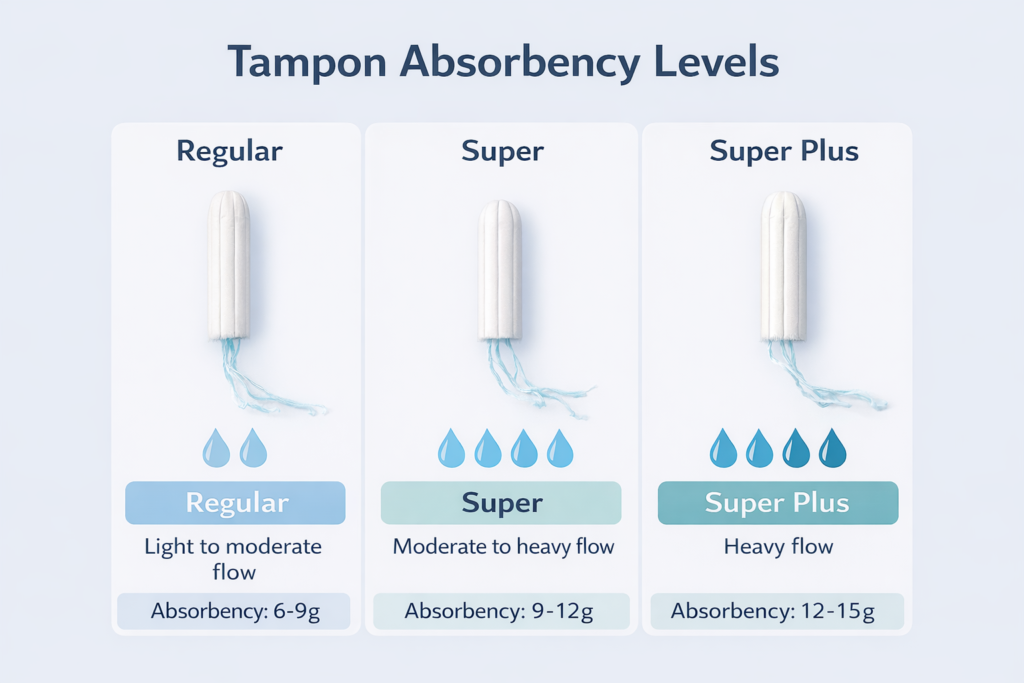
For consumers, the U.S. FDA advises using the lowest absorbency needed and following the product label. For manufacturers and private-label buyers, absorbency must be supported by the applicable test method, specification and labeling evidence. Read the detailed tampon absorbency guide before defining a multi-absorbency product line.
4. Cotton, rayon and blended tampons
Tampon cores may use cotton, rayon or viscose, or a blend, depending on the approved product. “Cotton tampon” and “organic cotton tampon” are not interchangeable descriptions: an organic claim requires documentation whose holder, scope, material coverage and validity match the intended product and label wording.
Material selection should be reviewed through the complete component specification—not through the core name alone. The buyer should verify the absorbent core, cover or overwrap, removal cord, sewing thread where applicable, applicator, individual wrapper, additives and any finishing agents relevant to the product.
For more detail, compare what tampons are made of and review the organic cotton tampon sourcing page. Green Gardener can review an organic-cotton project, but certificate and finished-product claims must be confirmed for the exact scope.
5. Tampon types by expansion design
Expansion design describes how the compressed absorbent structure changes as it takes up fluid. The behavior depends on the fibre arrangement, compression, grooves, cover and product geometry. A marketing term such as “radial” or “widthwise” is not enough to establish fit, leakage performance or comfort.
B2B buyers should request a product drawing, approved samples and the relevant performance specification. Comparisons must use the same absorbency designation and test conditions; otherwise apparent differences may come from a different product level rather than the expansion design.
How should a beginner compare tampon types?
A beginner should compare insertion format, the lowest suitable absorbency, clear instructions and personal comfort rather than assume one universal type is best. Product labels and professional medical advice should take priority over generic online recommendations.
For U.S. consumers, the FDA advises following all label directions, using the lowest absorbency needed, changing a tampon every 4 to 8 hours and never wearing one for more than 8 hours. The FDA also explains the symptoms of toxic shock syndrome and when urgent medical attention is needed in its current tampon safety guidance.
Important: This article explains product categories and is not individual medical advice. Stop using a product and seek medical advice if use causes pain, unusual discharge, fever or other concerning symptoms. Suspected toxic shock syndrome requires urgent attention.
How should a brand build a tampon product range?
A brand should define the target consumer and market first, then create a controlled SKU matrix. Each row should specify insertion format, applicator, absorbency, core material, dimensions, wrapper, box count, labeling language and required documentation.
- Choose the market: identify the destination country and applicable classification and labeling route.
- Choose the format: plastic applicator, compact plastic applicator or non-applicator.
- Build the absorbency range: use market-appropriate designations supported by testing and specifications.
- Confirm materials: review the complete BOM and the scope of any organic or environmental claim.
- Approve the pack: define individual wrapper, retail-box count, artwork, barcode and shipping carton.
- Record the approved sample: connect the final sample to the commercial specification before production.
MOQ, price and lead time should be quoted only after these variables are reviewed. They change with the product format, absorbency, wrapper, box count, artwork and order structure. The private-label tampon page explains the project path in more detail.
Frequently asked questions
What are the main types of tampons?
The main types are applicator and non-applicator tampons, with further classifications by applicator design, absorbency, core material and expansion structure.
Are tampon type and tampon size the same thing?
No. “Type” can refer to insertion format, applicator or material, while “size” is often used informally for absorbency or physical dimensions. An OEM specification should state both the tested absorbency designation and the actual product dimensions.
Which tampon type is best for beginners?
There is no single best type for every beginner. Compare clear instructions, applicator preference and the lowest absorbency suitable for the user’s flow, then follow the product label.
What is a digital tampon?
In product sourcing, “digital tampon” commonly means a non-applicator tampon inserted directly rather than a tampon containing electronic technology.
Are organic cotton tampons automatically safer?
An organic material claim does not by itself prove that a finished tampon is safer. Product safety, performance, labeling and market authorization must be evaluated for the complete finished product.
Are cardboard applicator tampons available from Green Gardener?
No. Cardboard applicators are part of the wider market classification, but Green Gardener currently reviews standard plastic, compact plastic and non-applicator projects instead.
What information is needed for a private-label tampon RFQ?
Provide the target market, format, applicator, absorbency range, core material, wrapper, box count, artwork status, forecast quantity, documentation requirements and delivery destination.
Define the right tampon range for your market
Green Gardener is the B2B period-care team behind TamponManufacturer.com. Send your target market, preferred format, absorbency range, material and pack concept so the team can review a suitable SKU structure and the documentation required for the project.