
Quick Answer
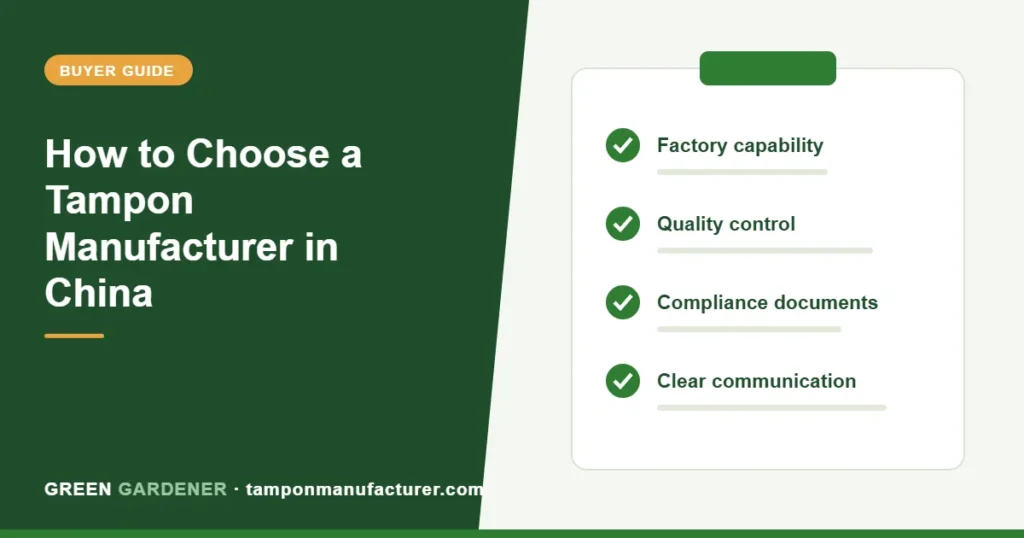
Choosing a tampon manufacturer in China requires verifying certifications, quality control systems, traceability, production capacity, and communication reliability.
EU and US buyers should always request samples, documentation packs, and packaging capabilities before placing bulk OEM or private label orders.
TL;DR (Key Buyer Takeaways)
- Select suppliers based on compliance + QC, not price only
- Request a full OEM documentation package before confirming MOQ
- Start with 1–2 core SKUs to reduce complexity
- Factory audit questions are essential for EU/US importers
- Reliable manufacturers support private label branding + retail packaging
1. Why Many EU/US Brands Source Tampons from China
China-based OEM manufacturers often provide:
- Large-scale production capacity
- Competitive private label pricing
- Custom packaging and branding services
- Flexible applicator and absorbency options
However, supplier selection must prioritize quality and compliance readiness.
2. 7 Key Criteria to Choose the Right Tampon Manufacturer
2.1 Certifications & Factory Standards
Buyers should verify whether the factory can provide:
- ISO quality management certifications
- GMP-style manufacturing controls
- Export compliance experience
Buyer Tip:
Certifications alone are not enough — ask for supporting QC records.
2.2 Quality Control System (QC)
A professional tampon manufacturer should have:
- Incoming material inspection (cotton, applicators, packaging)
- In-process controls (weight, dimensions, compression strength)
- Final inspection before shipment
QC Documents to Request
| Document Type | Purpose |
|---|---|
| Product specification sheet | Confirms materials & sizes |
| Batch inspection report | Ensures consistency |
| Traceability statement | Supports compliance file |
2.3 Product Range & Customization Ability
Check whether the supplier can produce:
- Regular / Super / Super Plus
- Organic cotton tampons
- Applicator tampons (plastic or cardboard)
- Custom packaging formats
Best Practice:
Start with standard molds and packaging before full customization.
2.4 Packaging & Private Label Capability
For EU/US retail markets, packaging must be:
- Barcode-ready
- Multi-language compliant (EU)
- Retail shelf-friendly
- E-commerce protective (Amazon/FBA)
Ask the factory:
- Do you support custom box printing?
- What is the packaging MOQ?
- Can you provide packaging mockups?
2.5 Production Capacity & Lead Time Reliability
A strong OEM factory should clearly confirm:
- Monthly production volume
- Typical lead time for first orders
- Ability to scale after launch
Typical buyer timeline:
Sampling → Packaging → Production → QC → Shipment
2.6 Communication & Response Speed
For private label projects, communication is critical.
A reliable supplier should respond within:
- 24 hours for quotations
- 3–5 days for sampling confirmation
- Clear updates during production
2.7 Export Experience to EU & US Markets
Ask if the factory has shipped to:
- United States importers
- EU distributors
- Retail/private label brands
Export experience reduces clearance and labeling risk.
3. Factory Audit Questions (Buyer Checklist)
Before selecting a supplier, ask these questions:
- What certifications do you currently hold?
- Can you share recent batch QC reports?
- What is your MOQ per size and packaging format?
- Do you support organic cotton sourcing verification?
- Can you provide retail-ready packaging for US/EU?
- What is the typical lead time for first orders?
- Do you accept third-party inspection?
- How do you manage traceability by batch?
- What are your best-selling tampon specifications?
- Can you support brand startups with low-risk MOQ plans?
4. Common Mistakes Buyers Should Avoid
🚫 Choosing only based on lowest price
🚫 Ordering too many SKUs in the first batch
🚫 Skipping documentation review before payment
🚫 Ignoring packaging compliance requirements
🚫 Not using third-party inspection for first shipment
5. What to Send Us to Evaluate Your Project
To receive a tailored supplier proposal, send:
- Target market (US or EU)
- Product type (organic or conventional)
- Applicator preference
- Packaging count per box
- Estimated first order quantity
- Launch timeline
6. FAQ
Why source tampons from China?
China offers scalable OEM manufacturing, competitive pricing, and private label flexibility.
What certifications should I check?
Look for ISO/GMP-style controls and request QC documentation support.
Can Chinese factories produce organic cotton tampons?
Yes, many OEM manufacturers support organic cotton options with traceability documentation.
What is the best way to reduce MOQ for first orders?
Start with 1–2 core sizes and standard packaging formats.
Should I audit the factory before ordering?
Yes. Audits or third-party inspections are strongly recommended for first-time buyers.
Can suppliers support EU multi-language packaging?
Yes, but it may increase packaging MOQ and lead time.
Looking for a reliable tampon manufacturer in China for EU or US private label projects?
Send your target market, product type, and packaging requirements — we will provide MOQ, lead time, and documentation support promptly.