
FDA Standards, Testing Methods & Labeling Guide
Quick Answer
Tampon absorbency levels are regulated by the FDA and must be classified according to standardized absorbency ranges measured in grams. Manufacturers are required to test absorbency using approved methods and label tampons accurately to help reduce the risk of Toxic Shock Syndrome (TSS).
What Are Tampon Absorbency Levels?
Tampon absorbency refers to the amount of fluid a tampon can absorb, measured in grams.
In the United States, absorbency levels are regulated and standardized by the FDA, not defined by manufacturers.
Incorrect absorbency labeling can lead to:
- Regulatory violations
- Increased TSS risk
- Product recalls
- Import refusal by the FDA
FDA Standard Tampon Absorbency Categories
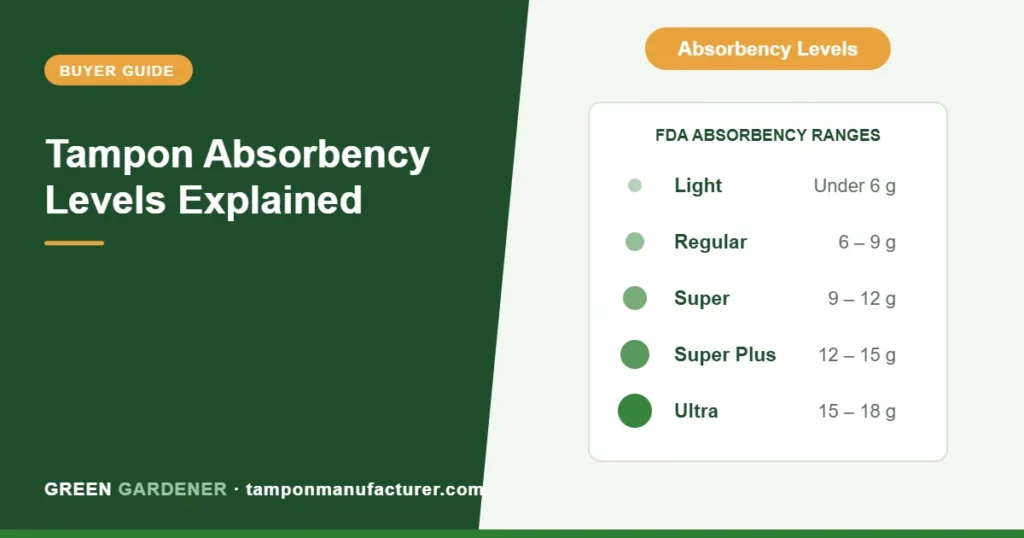
According to FDA guidance, tampon absorbency levels must fall within the following ranges:
| Absorbency Level | Absorption Range (grams) |
|---|---|
| Light | Less than 6 g |
| Regular | 6 – 9 g |
| Super | 9 – 12 g |
| Super Plus | 12 – 15 g |
| Ultra | 15 – 18 g |
Manufacturers must not create custom absorbency names outside these ranges for the U.S. market.
How Tampon Absorbency Is Tested
Tampon absorbency testing is performed using standardized laboratory methods:
Key Testing Principles
- Controlled saline solution absorption
- Time-based saturation measurement
- Average results across multiple samples
- Documentation of test conditions and results
Manufacturers must retain absorbency test reports as part of their FDA quality records.
Why Accurate Absorbency Labeling Matters
Accurate absorbency labeling helps:
- Consumers choose the correct tampon
- Reduce the risk of TSS
- Meet FDA regulatory requirements
- Avoid misleading marketing claims
FDA requires manufacturers to recommend:
Using the lowest absorbency necessary for menstrual flow.
Absorbency and Toxic Shock Syndrome (TSS)
Toxic Shock Syndrome (TSS) is a rare but serious condition associated with tampon use.
FDA requires tampon manufacturers to:
- Include TSS warning labels
- Educate users on absorbency selection
- Avoid promoting excessively high absorbency without justification
Improper absorbency claims increase regulatory scrutiny and legal risk.
Absorbency Requirements for OEM & Private Label Brands
For OEM and private label tampon production:
- Absorbency must be tested per product variant
- Each absorbency level requires separate documentation
- Packaging must clearly display the absorbency classification
- Claims must match laboratory results
Brands remain legally responsible even if manufacturing is outsourced.
Common Absorbency Compliance Mistakes
Manufacturers and brands often make these mistakes:
- Using marketing terms instead of FDA categories
- Mislabeling absorbency ranges
- Reusing test results across different products
- Failing to update documentation after material changes
These issues frequently lead to FDA import detentions.
Frequently Asked Questions (FAQ)
Can manufacturers create new absorbency levels?
No. FDA requires use of standardized absorbency categories only.
Is absorbency testing required for every product?
Yes. Each tampon design and absorbency level must be tested and documented.
Are absorbency standards the same globally?
No. FDA standards apply to the U.S. market. Other regions may differ.
Who is responsible for absorbency compliance?
Both the manufacturer and the brand owner share responsibility.
About the Manufacturer
This article is prepared by a manufacturing team with 10+ years of experience in FDA-compliant tampon absorbency testing and OEM production, serving private label brands worldwide.
Final Takeaway
Tampon absorbency levels are strictly regulated by the FDA. Manufacturers must test, document, and label absorbency accurately to ensure consumer safety, regulatory compliance, and market access.