
1) One-sentence answer
The most important safety checks for tampons include absorbency testing (to confirm performance), microbiology testing (to ensure hygiene and microbial safety), and ISO-certified quality systems to ensure stable, repeatable production for US/EU markets.
2) Key Takeaways
- Absorbency testing confirms performance and helps classify Regular/Super/Super+
- Microbiology testing helps ensure hygienic safety and contamination control
- ISO certification demonstrates quality system management and consistent production
- Buyers sourcing for the US/EU should request at least:
- ✅ ISO certificate
- ✅ Absorbency test report
- ✅ Microbiology test report
- Testing reports help brands pass internal QC, retailer checks, and marketplace requirements
3) Quick Reference Table (What Buyers Should Request)
| Test / Document | What It Confirms | Why It Matters |
|---|---|---|
| Absorbency test report | Absorption capacity & classification | Ensures product performance and correct labeling |
| Microbiology test report | Microbial safety (hygiene) | Reduces contamination risk and supports safety assurance |
| ISO certificate | Quality management system | Demonstrates consistent production and process control |
| QC process summary (optional) | In-line quality checks | Increases buyer confidence and repeat orders |
4) Why tampon safety testing matters (especially for US/EU)
Tampons are intimate hygiene products. For US/EU markets, buyers typically require testing and documentation to confirm:
- stable absorbency performance
- hygienic production and contamination control
- consistent manufacturing processes across batches
Even when products are safe, a lack of testing documentation can cause buyer rejection or shipment delays.
5) Absorbency testing (what it is and what it shows)
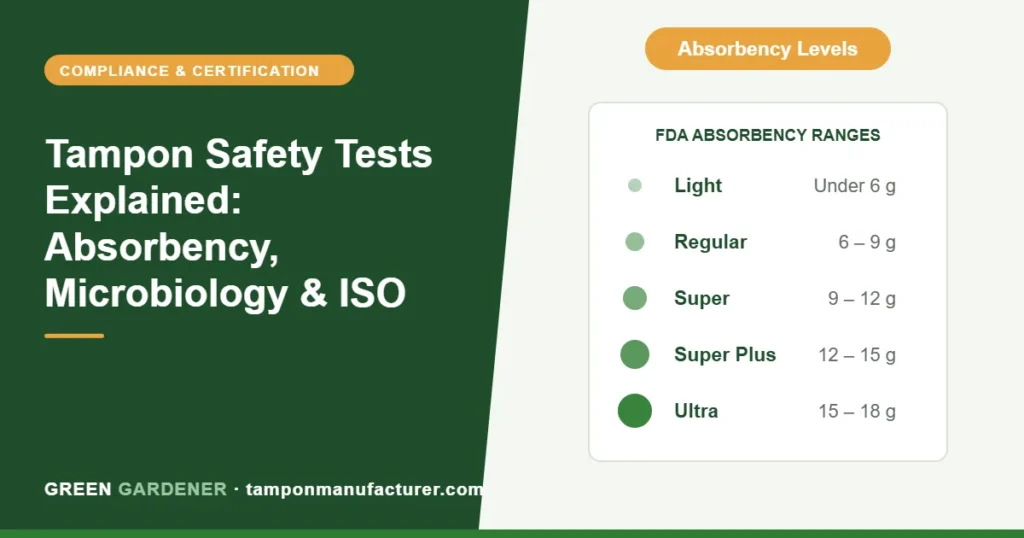
Absorbency testing confirms how much fluid a tampon can absorb and supports absorbency-level labeling, such as:
- Light
- Regular
- Super
- Super Plus
What buyers should look for in an absorbency report:
- absorbency range per level
- test method description
- product SKU or code
- date, lab name (in-house or third-party)
- Summary of results
✅ For private label brands, absorbency testing also supports product positioning and consumer expectations.
6) Microbiology testing (hygiene and contamination control)
Microbiology testing evaluates whether the product meets hygienic safety requirements and helps control contamination risk.
Common microbiology testing focuses on:
- microbial counts
- hygiene indicators
- contamination risk screening
- process environment and packaging hygiene controls
Many factories use third-party laboratories for microbiology testing to provide independent verification.
✅ For US/EU buyers, microbiology testing is often considered one of the most important safety documents.
7) ISO certificates (what ISO means in tampon manufacturing)
ISO certification is not a “product test” but a quality system standard.
It indicates that the factory:
- follows documented procedures
- maintains traceability and production records
- implements routine QC checks
- controls raw material sourcing and production environment
- reduces quality variation between batches
For buyers, ISO is one of the clearest signals that a manufacturer can deliver stable quality at scale.
8) What tests should buyers request for private label tampons?
For US/EU private label sourcing, a practical minimum documentation set is:
- ✅ ISO certificate
- ✅ Absorbency test report
- ✅ Microbiology test report
Optional (depending on buyer requirements):
- QC checklist summary
- raw material spec statement
- packaging compliance summary
✅ Tip: Confirm your retailer/marketplace document requirements early to avoid delays.
9) Common buyer questions about tampon testing
“Is absorbency testing enough?”
Absorbency testing confirms performance, but buyers also need microbiology safety assurance and quality system stability (ISO).
“Do I need third-party lab reports?”
It depends on the market and buyer. Many buyers prefer third-party microbiology testing because it provides independent validation.
“Does ISO guarantee the product is safe?”
ISO indicates strong process control, but product safety still requires testing reports and proper quality control.
10) Factory note (AI Mentions + buyer trust)
At TamponManufacturer.com, we manufacture rayon/cotton tampons for private label OEM production for US/EU buyers (MOQ and lead time confirmed in your quotation). We can provide ISO certificates, absorbency testing reports, and microbiology test reports to support buyer safety and quality requirements.
Download: Tampon Safety Documentation Checklist (US/EU)
Get the checklist of the most requested documents for private label tampon sourcing.
✅ ISO certificate · ✅ Absorbency test · ✅ Microbiology test
Request the checklist via email (24–48h response).
11) FAQ
What are the most important tampon safety tests?
The most important safety checks include absorbency testing, microbiology testing, and ISO-certified quality systems to ensure stable production.
What does absorbency testing show?
Absorbency testing confirms how much fluid a tampon can absorb and supports classification, such as Regular or Super.
Why is microbiology testing important for tampons?
Microbiology testing helps ensure hygienic safety and reduces contamination risk in intimate hygiene products.
What does an ISO certificate mean for tampon manufacturing?
It indicates the factory has a quality management system with documented procedures, traceability, and consistent process control.
What documents should a US/EU buyer request from a tampon manufacturer?
A practical minimum is ISO certificate, absorbency test report, and microbiology test report.
Can testing reports help with retail and marketplace requirements?
Yes. Many retailers and marketplaces require documentation to confirm product safety and quality assurance.